EOS: Canon r5c in 2025?

scorsesefan

Veteran
I was thinking of picking up an r5c as a b-cam to my c70. What attracts me is the lightweight form factor, full frame and higher resolution video. I don't shoot stills much. Thoughts?
 
If you require Canon's 8K around that price range, it's either that or the R5 I/II.

If you don't, the R6 II is a great camera for less money which could easily serve a B-cam, even without C-Log2 because no one will tell the difference after some light post. [And it's lighter and smaller.]
 
I still love my R5C and use it on every shoot where I'm doing two camera angles for interviews. I regularly have cut it with a C500 II, C300 III and a Red Komodo at times. No issues matching it up with those for client delivery.

If you're primarily shooting video then I think it's a better buy than the R5 I or R5 II because of the cinema operating system, the fan (I've never once had an issue with overheating) and timecode.

If you're mostly going to use it as a gimbal cam for short bursts, then the overheating may not be as much of an issue for you. But I have heard of people having issues with some of those other small Canon mirrorless when it comes to long runtimes and overheating.
 
I still love my R5C and use it on every shoot where I'm doing two camera angles for interviews. I regularly have cut it with a C500 II, C300 III and a Red Komodo at times. No issues matching it up with those for client delivery.

If you're primarily shooting video then I think it's a better buy than the R5 I or R5 II because of the cinema operating system, the fan (I've never once had an issue with overheating) and timecode.

If you're mostly going to use it as a gimbal cam for short bursts, then the overheating may not be as much of an issue for you. But I have heard of people having issues with some of those other small Canon mirrorless when it comes to long runtimes and overheating.
Thanks, Dustin. Do you find it has a bit more of a crunchy/digital image than the c500/c300?
 
I use my R6mk1 all the time. It is fine. So an r5c is better than fine.

These R mirrorless cams are suprisingly brilliant.

I dont know why.. ibis, af stickyness quality of evf.. some stuff came together on them that works to make an excellent tool. You can just hold and film. No rig.

My first pencil for the new year Im thinking about my R6 and running dual sound rather than schlepping my built C200.

It will be broll heavy interview light.

S
 
Thanks, Dustin. Do you find it has a bit more of a crunchy/digital image than the c500/c300?
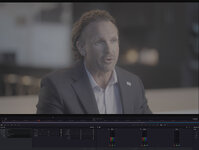
Rather than give my probably biased opinion on it, I'll post a few frames for you to make your own conclusions.

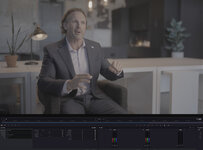
These are A and B camera angles with the C500II and R5C. Lenses were the Sigma Cine 40mm at T1.5 on the wide angle (C500 II) and the Sigma Cine 85mm, also at T1.5, on the tight (R5C). T1.5 you say? Yes, I like to live dangerously.

Here's a frame from the C500 II on one of my last shoots. It was captured in the 5.9k RAW LT setting. This is uncorrected, so there's none of my personal aesthetic interfering with the file the camera captured.

Frame grab from Resolve's color page.

Screenshot-2025-01-02-at-8.32.32 AM.jpg

And here's a screenshot of the R5C's angle. Shot in the 8k Raw LT. You can see that I've set the R5C to Canon Log 2 in Resolve's color settings, even though technically the R5C only has the internal capability to shoot Canon Log 3.

We could get deep into the merits of interpreting the R5C's Raw output as Clog3 vs. Clog2, but suffice it to say, I almost always convert the R5C's Raw to Clog2 in post and it helps it match better with my C500 II and I get no complaints.

Screenshot-2025-01-02-at-8.34.21 AM.jpg

Since looking at highly compressed screenshots on an online forum isn't ideal, you can download the full res tiff's from a Drive folder here if you'd like: https://drive.google.com/drive/folders/1hGkXtmbgF0k5DD4ygVKkpjQA5XgOPI_h?usp=share_link
 
Thanks, Dustin. Both look great!.. Are you using diffusion on the r5c shot? The reason for my previous comment is that I've noticed Canon changed their "look" a bit on their cinema cameras starting with the r5c and including the new c80/400. Everything seems a bit sharper and detailed compared to the DGO sensors... Have you been able to take advantage of the new batteries in the r5c with their increased run time?
 
Thanks, Dustin. Both look great!.. Are you using diffusion on the r5c shot? The reason for my previous comment is that I've noticed Canon changed their "look" a bit on their cinema cameras starting with the r5c and including the new c80/400. Everything seems a bit sharper and detailed compared to the DGO sensors... Have you been able to take advantage of the new batteries in the r5c with their increased run time?
Ah, yeah great question. I did forget to list that.

They actually both had a Black Pro-Mist on. I believe 1/4 and 1/8. So yes to your question, they both had diffusion. And to your point, I usually like to take a bit of the edge off with the Sigma's being very sharp and Canon's sensors resolving quite a bit of detail at 8k and 6k.

I have not gotten the brand new batteries for the R5C yet, but I'd like to. I typically will just run USB C power to the R5C during interviews and don't really depend on the internal batteries at all, although I will chuck the R5C on a gimbal and just run off the internals in those situations.
 
Thanks. The main reason I would pick up the r5c is to have a lighter camera than the c70 for run and gun shoots. The c70 with focal reducer and some EF lenses gets a bit heavy. With the new r5c battery life (aprox 1.5 hrs in 4K) I think it would be more than usable...
 
I have used the C70 as a C camera to two C70s and have been very happy with it. I use the C70s for interviews and b-roll. The R5C usually lives on a gimbal so that I can I just grab and go on with it on projects. Most often I'll film in raw on the R5C in order to get as much dynamic range out of it as possible. The raw opens into CLog2 in FCP. It's not true Clog2 but it's better DR than XFAVC on the camera.

I just got the new battery to test with the R5C but haven't done so yet. In general I haven't had battery issues with it but I have worked within its limitations for the most part. If it's on the gimbal then it's not filming or on constantly. If I need longer run time I can add the battery grip or run power in via USB-C. From what I've seen the new batteries will add 50% more run time so they'll be good for piece of mind on set.

I find having Cinema EOS OS on the R5C to be a huge plus. There's no getting lost in menus and settings when bouncing between it and other cameras in the cinema line.

I worked on this Canon R5C series. Highly recommend for info about the R5C. It's a great series.

Canon R5 C Training Series

James, the lead DP, filmed all of the primary footage to create the promo. I was the second DP overseeing the R5C cameras and filming all of the b-roll. The b-roll was shot on C70s. So, throughout the series you're seeing footage from each mixed together.

The R5C footage shot in raw does tend to be sharper, more detailed, than the C70 XF-AVC footage but it's not been issue once things get to YouTube or Vimeo. At that point any difference is negligible. It might be more of a factor if I was filming the R5C as a B cam to the C70 on interviews.
 
Last edited:
Here's some more work C70 + R5C work:

https://www.roemerfilm.com/Our-Work/Recent-Work/thumbs

The Mount Sinai and Fordham Law videos are a mix of C70 and R5C. The R5C used as a described in my earlier post, living on a gimbal and mixed in with other C70 b-roll footage which was shot handheld or on sticks. I grab the R5C when I need a more flowing shot, smoother pan, or if I need to follow someone. The AFCU video of the bank is compilation of a clip library created for a client. The exteriors are drone but the interiors are all R5C in slow/fast mode (XF-AVC Wide DR) on a gimbal.
 
Thanks! I was based in central NJ and had a lot of clients in NYC. I just moved to Maine about six weeks ago. Now based in the Portland area.
 
My first pencil for the new year Im thinking about my R6 and running dual sound rather than schlepping my built C200.

It will be broll heavy interview light.
I don't want to derail the thread since I have questions of my own, but I'm going the complete opposite way Sam! I just bought a second c200 rather than painstakingly bouncing between main cam and minimal rig/gimbal cam. I had it down to undoing 3 screws, then unplugging 3 things (video cable, HDMI for tx, XLR cable), but it's so much better having separate cameras IMO, unless you need versatility working out of a backpack etc.

I'm now thinking in terms of an ultimate interview work station, where I can add even more bits and pieces, that can also go on and off the shoulder. Then smaller cameras for smaller footprint handheld that can get the camera in more places, as well as bare bones gimbal mode. I'd probably even go with a third body for the headquarters master build, smaller handheld, dedicated gimbal rig, but I'm not there yet.

I find having Cinema EOS OS on the R5C to be a huge plus. There's no getting lost in menus and settings when bouncing between it and other cameras in the cinema line.

I worked on this Canon R5C series.
Nice work Jon, thanks for sharing.

To you, or anyone else - IQ aside, which canon camera currently has the best AF? Assuming it'd be between the R5II, R5C, C80/400?

I think maybe Norbro mentioned the stills cameras (unfairly!) sometimes have better AF - if so, does the R5C fall into this category?

I recently shot something using the camera operator's brand new BM cine 12k LF, along with DJI focus pro, as well as his very well organised management of the system. Potential tediousness and extra hardware aside, using cinemodded leica R lenses, the lidar focus performed borderline flawlessly. The canon c200 hugely drops the ball whenever there's any hard back light or much brighter background. I know it's a generation behind the c3003/C70/C5002 and I've only considered it as a bonus for product shots on a slider or low stakes interviews, but as I'm doing more and more gimbal work it's time to explore more options. I'd much rather keep things internal AF, but we can assume a DJI pro 2 will be just around the corner, at which point, would be funny to think c200/cheap manual "cine" lenses and whatever else they come out with could be providing better AF than the latest gen c-series cameras.

Here's the shoot I referenced, it was LIGHTING FAST half day whirlwind (wish we had more time for a few more stylised scenes) https://www.slq.qld.gov.au/transformingthecorner.

All of the gimbal stuff was with lidar/the BM. Also funny that the now ancient c200 and BM can match pretty closely. Not much of a side by side DR comparison but good to know coming up with some type of match isn't too tough.
 
Last edited:
Thanks Rob.

In terms of best AF for video, I'd think it would be between the R5II, C80, and C400. The R5C in video mode has similar AF to the C70. I have the C80 now and it does have better AF than the C70. I haven't used it enough to go into more detail but it was issue free on a recent interview project with both A and B cameras.

That said what lens you use can play a big factor in the AF. In general the L series RF zooms have faster quieter AF than many of the original RF prime lenses. This is in reference to video only. And the new VCM primes plus the new Z series zooms seem to be the best yet for video AF. I haven't used the new 70-200 Z but the 24-105 f2.8 USM Z is great as are all three of the VCM primes.

As mentioned earlier in the thread I have used the R5C on a DJI RS3 pro quite a bit. It works really well and the AF is great as long as you use a good lens. The RF 14-35 f4 zoom is great, the RF 35 f1.8 is not, and the RF 15-35 f2.8 is great but a lot bigger/heavier than the RF 14-35 f4.

The first three videos in this series (student profiles) all have b-roll with the R5C with the RF 14-35 f4 on the RS3 Pro especially for walking/tracking shots.

https://www.roemerfilm.com/Our-Work/Series/thumbs
 
Last edited:
Thanks Jon, that's great to know. I definitely wasn't thinking as much about combinations even though of course lens choice matters.

If solo gimbal operating wasn't a thing, I'd be happy with my EF zooms forever. Going to a brand new camera with RF lenses would be such a big upgrade, especially when I don't care at all about advances in IQ. I know focus is a huge, huge part of the filmmaking craft, but I feel like it takes up an unfair amount of the production budget in the corporate space:

DJI offering - cheapest option but extra hardware and weight
first AC - extra crew member and $$$
latest AF system - expensive and not a "sure thing" just yet even though it's getting really good

I shot this with the c200, mostly in manual focus, with a few tracking (object tracking) shots ("Exhibition Teaser") https://www.slq.qld.gov.au/discover/exhibitions/neon?cid=

It's not ideal touching the LCD screen because you have to take your hand off the grip. It'd be possible to get the monitor within thumb's reach of the handgrip but that'd require a lengthy cable run, plus the canon VIDEO cable isn't exactly minimal. I'm going to see if the browser remote/wifi/phone will work at all, even with a delay. I've used it for touch AF in the past, but this is all just a workaround and ideally we could mostly be purely operating and composing the shot rather than managing AF.

Also, not expecting you to watch, just leaving some samples here in case anyone stumbles on this thread and can use the points of reference.
 
Last edited:
Thanks Jon, that's great to know. I definitely wasn't thinking as much about combinations even though of course lens choice matters.

If solo gimbal operating wasn't a thing, I'd be happy with my EF zooms forever. Going to a brand new camera with RF lenses would be such a big upgrade, especially when I don't care at all about advances in IQ. I know focus is a huge, huge part of the filmmaking craft, but I feel like it takes up an unfair amount of the production budget in the corporate space:

DJI offering - cheapest option but extra hardware and weight
first AC - extra crew member and $$$
latest AF system - expensive and not a "sure thing" just yet even though it's getting really good
There's a few ways to look at that. I also do small crew work with often with only one assistant. What you can do now on a limited budget with a small crew and get a cinematic feeling is amazing. Your neon exhibition promo you linked to is proof of that.

The first few years of having an RF mount camera, the original EOS R, I used EF glass. Once you dip your toe in the RF lens world and especially if you then end up with all RF mount cameras it becomes hard to go back. Even though the Canon adapters work wonderfully it becomes one less thing to deal with. IQ aside, the better IS and AF of the RF lenses is noticeable.

While the latest video AF is always means more money it has been viable for a while. Do you need the latest AF system or top of the line camera? Not necessarily.

I shot this with the c200, mostly in manual focus, with a few tracking (object tracking) shots ("Exhibition Teaser") https://www.slq.qld.gov.au/discover/exhibitions/neon?cid=

It's not ideal touching the LCD screen because you have to take your hand off the grip. It'd be possible to get the monitor within thumb's reach of the handgrip but that'd require a lengthy cable run, plus the canon VIDEO cable isn't exactly minimal. I'm going to see if the browser remote/wifi/phone will work at all, even with a delay. I've used it for touch AF in the past, but this is all just a workaround and ideally we could mostly be purely operating and composing the shot rather than managing AF.
That promo is great! Nice work. I've done projects like that using the C300M2 handheld. A lens with IS and slo-mo can smooth out a lot of issues.
 
Back
Top