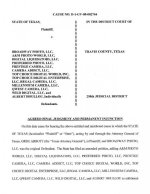
Canon is Suing “Get It Digital” and Others to Stop Gray Market DSLR Sales

Didn't B&H sell some grey market lenses? I remember seeing the same model lens for two different prices, one marked "USA" the other "International," or something like that.

But reading the article, it doesn't sound like these companies are just taking stock marketed for other countries that don't have US warranties, it sounds like they changing serial numbers, boxes, etc. which seems a lot worse & actually damaging to consumers and then Canon's reputation too.
Yes, all common practices by these grey market places in NYC & Crooklyn...many games have been played over the years and these so-called companies were under 5-7 different names but were the same place. One of the latest tactics is they sell on Amazon and when someone got screwed over from their games, the customer would post on Amazon their complaints....and then get contacted by the seller begging them to take down the post in exchange for making their order right...and still not get them right after they do!.......you get what you pay for and there is no free lunch.....

Jim Martin
EVSonline.com
 
And Canon likes their 60% margins.

But this law suit won't get them anywhere. The crooked online retailers are a different problem entirely. It's between them and the final customer.
 
I think that in this case there were some other issues that Canon wasn't happy about. Like pulling the Canon battery and charger to sell elsewhere while replacing it with a cheap off brand battery and charger. Some people are fine with that, but they weren't exactly forthcoming with that info at time of purchase. They were also breaking up kits to sell separately.
That low price has to come from somewhere after all, and it wasn't just on the profit margin (which isn't 60%).
 
... That low price has to come from somewhere after all, and it wasn't just on the profit margin (which isn't 60%).
It's close to that for the manufacturers - higher on lenses, lower on bodies - but not for the retailers who work between 25% on the low end and 45%-50% on the high.
 
But, as I said, this is the state suing on behalf of the consumers for the de facto fraud.

That's not what Canon's law suit is about, unless they assert that these practices - changing accessories, etc. - is harming Canon as a brand name.
 
BTW, here's how these "gray market" deals may work.

A dealer X and Dealer Y (Y can but doesn't have to be in the same country as X but it helps being in the same tariff zone) come to an agreement that a manufacturer will frown upon. Y will buy far more given units that it can sell at the MAP and he knows it. So, he then will cross-ship most of his units to X, who is not an authorized retailer and can thus sell many more pieces than an authorized retailer due to being able to offer a significant discount on an item without having to abide to any manufacturer stipulated agreements. (supply and demand at work) As a result, Y becomes an unauthorized wholesaler of the product, which then violates his contract with the manufacturer, who is then legally entitled to end the business relationship and could even sue for damages.

For both X and Y dealer, this can be very lucrative if they hit the right price point on the supply&demand curve. Y moves a lot of pieces with hardly an effort and X undercuts licensed dealers and, in this internet era, can easily absorb the lower margins as a trade-off for greater profits (most anyone with any business experience would concur with the last item).

Hypothetically speaking, a consumer could benefit from these type of shenanigans. The catch is that most people involved in these shenanigans are not very trustworthy and one can end up with a lot of headaches by purchasing from these type of operations.

As a side note - there must be a great incentive for these cross-shipping/gray market type operations in the photo-video industry specifically because all the major manufacturers are Japanese, a country where cartels are quite legal and thus its members have the ability to avoid price wars. Should a Chinese, a Korean or even American company jump into fray, market would become far more competitive. The case of Red and Black Magic Design are exact examples of how overpriced the mid-to-high end the Japanese made lines are. In fact, had it not been for the Japanese cartelization, there'd be no reason for BMD and Red even to exist, as the large scale producers can both amortize the R&D and other fixed costs and also save on the variable costs due to their mass assemblies.

And this is why Samsung's likely departure from the industry is such a loss. As a cartel outsider, it could offer a much bigger bang for the buck. But the retailers stood little to benefit from such a disruption and let Samsung wither on the vine.
 
I tend to aggree with that ^
I believe I should be able to sell anything that I own, at any price I want. If I buy from Canon for $1000 and want to sell for $1050 instead of the $1250 that they say I should charge, it's MY choice. And refusing to sell to me for $1000 because of this goes against free market.
The only thing here is that if these particular outlets are changing serial numbers and swapping accessories and such, then it's a much more shady thing and I get why Canon would like to stop them (if you go to Canon with your invalid warranty and they say they won't fix it, it's Canon that looks bad).
 
I tend to aggree with that ^
I believe I should be able to sell anything that I own, at any price I want. If I buy from Canon for $1000 and want to sell for $1050 instead of the $1250 that they say I should charge, it's MY choice. And refusing to sell to me for $1000 because of this goes against free market...
It's a free market when a retailer R enters into an agreement with a manufacturer M. Once the contract is signed, however, its terms are enforceable within the jurisdiction of the powers controlling that market (naturally, there can be contentious issues on what does and does not constitute a contract violation, which is why there are lawyers around). As far as I know, most manufacturer-retailer stipulations only cover the minimal advertised prices. If a customer then tells the retailer that he won't pay above a certain point for the product in question, the retailers could then still negotiate with the customer and can conclude the transaction by settling on any price above his cost (in the US, there are many states that have this anti-dumping regulations on their books). In other words, if you walk into a store and tell the salesperson that you want 5D MK III at $2,000 and not a penny more, then the store is in no shape or form obligated to stick to its MAP of $2,500. What the gray market dealers do is to buy 5D MKIII for around $2,000, giving the original dealer a profit of ~ $250-$350, and then will advertise it for $2,200 (or even less, if they replace some of the accessories). A customer will then compare the gray market store with an an authorized retailer, notice a $300 price difference and make his final purchase decision based on it without ever trying to negotiate a lower price from an authorized dealer. (negotiating prices is not an easy task ... most Americans only do it with housing and automobiles ... other cultures vary)

The way the legitimate retailers work around the MAP agreements is by offering "instant in-store rebates" or bundling together accessories not covered by their manufacturers (i.e., made by other manufacturers). "Buy 5D MKIII for $3,500 and get instant $200 store credit. Included in the bundle is a free Zeiss Otus 55 mm F 1.4 lens and a 10-year warranty". And there's nothing a manufacturer can do.
 
It seems like there is a lot of misunderstanding about grey market and what it is, what it does, why it's a problem, and why it even exists.

Canon Inc who develops and manufactures cameras is a different company from Canon USA who just markets and sells the cameras here in the US. In order to pay for advertising, administration, repairs, taxes, etc, Canon USA has to sell at a certain price. This may be higher than the price that Canon Inc can sell it for in Japan. A grey market seller buys cameras in a cheaper market like Japan and then sells them in the US. They don't pay for any of the advertising costs, warranty repair, taxes, or admin costs of Canon USA and thus push that burden higher on the cameras that are sold legitimately in the US.

MAP is Minimum Advertised Price. It's exactly what it sounds like. It doesn't mean that you have to sell it at that price, but you can't advertise a lower price. It's a contract between Canon USA and the retailers and it is completely legal and quite common. The reason this exists is to prevent a company like (just for example) Amazon selling a camera for below cost to hurt other dealers that can't afford to lose money and thus remove the competition by running them into bankruptcy. Before MAP was common B&H could negotiate a volume discount that would make their retail price with a profit lower than what a little mom and pop camera shop could buy it for at wholesale. MAP forces everyone to compete on service while leaving them enough room in the price to keep the lights on.

There are a few problems with the grey market sellers... When the camera needs warranty repair Canon USA doesn't want to pay for it because they didn't sell it and didn't make any of the money that would go towards keeping the repair center running. They're under no obligation to fix it, but Canon Inc in Japan or wherever the camera came from might be, unless they claim it wasn't purchased from an authorized dealer, so the customer is SOL if it breaks.
The chargers are made for a different electrical system so they won't work in the USA 120v outlet. The grey market seller puts in a cheap charger.
The manual that is in the box is not in English, so you either don't get one or you get a copied one.
There have been some cases of accessories being pulled out too, like Canon batteries swapped for knockoffs.
The serial numbers are often changed to try to hide where the grey marketer is getting them. (I've been told that just possessing a product over a certain value with an altered serial number is a criminal offense in some countries! I guess it's meant to prevent selling stolen goods or something.)
All of this makes for a bad customer experience, and often one you didn't know you were getting into.

Canon USA obviously doesn't like it because they're losing sales and then having to pay the warranty costs, or have to piss off a customer who has a busted camera. Although Canon Inc in Japan gets a sale either way, they depend too much on their international partners to allow it, and for the reasons above they don't want to have customers with bad chargers, batteries, no manuals, and fake serials.

But you still want to save a few bucks? Yeah, I get that. I can be a cheapskate too, but a good solution is just to buy a used one. That way at least you'll still have warranty coverage.

The USA isn't so bad for price because of the size of the market and the value of the dollar, but smaller markets with weaker currencies get hammered on price. It's not because those distributors are jacking up the price to buy gold plated backscratchers (I hope), but mostly because with smaller markets it's harder to cover the overhead costs while selling a lot fewer cameras. The money for the advertising, customer service, repair coverage, taxes, staff, admin costs, rent, etc has to come from somewhere.
 
I tend to aggree with that ^
I believe I should be able to sell anything that I own, at any price I want. If I buy from Canon for $1000 and want to sell for $1050 instead of the $1250 that they say I should charge, it's MY choice. And refusing to sell to me for $1000 because of this goes against free market.
The only thing here is that if these particular outlets are changing serial numbers and swapping accessories and such, then it's a much more shady thing and I get why Canon would like to stop them (if you go to Canon with your invalid warranty and they say they won't fix it, it's Canon that looks bad).

"Free Market" works both ways. They don't have to sell to anyone that doesn't want to agree to the terms.

I've bought grey market and was totally happy. It was the identical product, and I saved a lot, and haven't had any issues. your mileage may vary.
 
... The USA isn't so bad for price because of the size of the market and the value of the dollar, but smaller markets with weaker currencies get hammered on price...
The currency exchange rate in and of itself has nothing to do with the relative prices. The cross-shipping is more profitable from the countries with low tariffs or within a common trade zone. Japan, btw, is a high tariff/high tax zone and a negative effect for a Japanese manufacturer with regard to the "gray market" is that it undermines its legitimate channels. "Advertising, R&D, repairs, taxes, etc." are basically paid as long as the units in question aren't stolen from the company own warehouse.

PS. One should not ignore the stolen goods possibility. In many high crime and/or corrupt places - hello, Vladimir - a lot of stolen merchandise is available.
 
Let me clarify: even if the terms of the agreement are legal and both parties agree to them, I still can think it goes against the free market. There are lots of monopolistic practices that are banned, and my point is that this one ("I will only sell this to you for $XXX if you sell it for $YYY" or "if you sell it only in country ZZZ") should be banned too, precisely to protect the free market.

One nice example, in case anybody is interested: "if I lower the price of this thing you're buying in the next 3 months I will give you back the difference" is banned in most places because it's a commitment device that sellers can use precisely to avoid lowering prices in the future (i.e. you will see less price drops if this is in place, in equilibrium this measure is hurting consumers, not helping them).

Also: the arrangement in Europe regarding warranty is as follows: there's a two-year mandatory warranty that has to be honored by the outlet that sells the goods (so, if they buy them from Canon Japan because it's cheaper, they have to send it there if it breatks, or fix it themselves). Higher prices here for many goods are explained partly by VAT taxes, but also by this mandatory two-year warranty (well, actualy 6 months no-questions-asked and then another 18 months in which you may be required to prove it wasn't your falt that it is broken).
 
Let me clarify: even if the terms of the agreement are legal and both parties agree to them, I still can think it goes against the free market. There are lots of monopolistic practices that are banned, and my point is that this one ("I will only sell this to you for $XXX if you sell it for $YYY" or "if you sell it only in country ZZZ") should be banned too, precisely to protect the free market.

One nice example, in case anybody is interested: "if I lower the price of this thing you're buying in the next 3 months I will give you back the difference" is banned in most places because it's a commitment device that sellers can use precisely to avoid lowering prices in the future (i.e. you will see less price drops if this is in place, in equilibrium this measure is hurting consumers, not helping them).

This is merely price discrimination and I don't think it's harmful to the consumer.

https://en.wikipedia.org/wiki/Price_discrimination

Here's an example of Price Discrimination (which can also be done internationally, see link above). It explains why you are not actually being harmed:

More generally, targeted price discounts allow businesses to engage in "price discrimination," which is the practice of offering different prices to different segments of the clientele. Movie theaters often offer cheaper prices to students and senior citizens, not because it's cheaper to have them sit in the theater, but because they are typically more careful with their spending than middle-aged adults with jobs. The use of coupons and rebates (which require the customer to mail in a form or go to a website) also help a business segregate the "cheapskates" among their customers from the people who are too busy to worry about saving a few dollars.

In all of these cases, the granting of special pricing for certain groups need not harm the groups paying full freight.
For example, if a movie theater in a small town were barred from giving child, student, and senior discounts — and instead had to charge one ticket price for all customers — it might not be able to stay in business. It would hardly help the middle-aged adults to have a "fair" pricing policy with no theater in town. This example shows the pitfalls in thinking about "the cost" of providing a seat in a movie theater and deriving the "fair" price that a theater ought to charge all customers.

https://mises.org/library/economics-coupons-and-other-price-cuts
 
Last edited:
Like nikon, they refuse to service any grey equipment. Canon usa should do the same. Problem solve.
 
Back
Top