Canon EOS C100

The C300 has that rating, we have no idea what the C100 will do. The Sony FS100 shares a sensor with the F3 but does not resolve as well, nor does it have the same color. Nowhere has Canon said that other than AVCHD the C100 has the same image processing as the C300.

Thank you. I would not rate the FS100 and the F3 in the same league image wise, so I would not think the C100 to be in the same league as the C300.
 

And the 5d is said to have full 1080p HD. Aka, manufacter specs don't hold much weight in evaluating IQ. At any rate, with a list price like that, the resolving power should be up there, but that is also only one of several concerns in this price bracket, for me.


Also, I felt the C demo video was somewhat interesting in that it put the camera in the wild, showing how videoish it can look, and except for the awful FX used, i think it did quite well. But I saw nothing that I couldn't accomplish with a 7d and a gopro (visual impact wise). So, this seems to be for the more affluent corporate guys and gals who will pay a premium for less moire' better color and more resolution (which are all good things) and buzz equipment. But I am willing to be put wrong with more samples and testimonials. So, I will stop commenting here, as it is too early in the game for all this speculation and debate for a camera I am not interested in. Have a good day.
 
Last edited:

Thanks for the link. In that lnk they describe DR this way:

During normal shooting: 300%
With Canon Log gamma: 800%
(ISO 850 or above/gain 2.5 dB or more)

Can someone tell me what that means? I can guess but does anyone know? Barry?

This is exactly how they described the C300 so I assume the C100 has the same DR, 12 stops at all ISOs, which is GREAT. I am just fascinated by the way they describe it and what subtleties there are in this method.
 
Last edited:
This is the quote on the C100 page at the Canon Digital Learning Center:
When shooting with an ISO of 850 (2.5db gain) or above, users can capture image with 12 stops of latitude (6.7 stops below middle gray and 5.3 stops above).

http://learn.usa.canon.com/resources/articles/2012/eos_c100_whatsnew.shtml#showAll


​
That seems to match the specification given in the Canon White Paper on Canon Gamma Log for all three cameras. That is good news, in that it indicates there should be very little diffence in the signal from the C100 and the C300:


See especially page 8, for a list of the DR allocation at various ISO's. ("Push" or "pull" in Canon parlance there.)


It is worth noting that we are talking about 12 stops at the base ISO of 850, which is pretty impressive!

This is the main page for the Cinema series at the Canon Learning Center, with other White Papers available:

http://learn.usa.canon.com/resources/articles/2012/cinemaeos_white_papers.shtml?categoryId=221
 

Thanks Pave1, exactly what I needed to read:

15.0 Camera Dynamic Range – the Broadcast Video Scenario
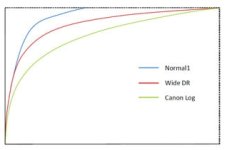
The challenge to the design of the RGB video processing system within a camera is to exploitthat sensor dynamic range in a manner that faithfully retains the scene detail within theoverexposed region, while ensuring a superb tonal reproduction over the range from cappedblack to reference white level. This entails considerable care in the manner in which the RGBvideo signals are nonlinearly processed. The various HDTV Production standards (SMPTE andITU) mathematically specify the nonlinear optoelectronic transfer function (gamma correction)characteristics for the video region between the camera’s capped black level and referencewhite level. The standard leaves it to the camera manufacturer to structure nonlinearprocessing for the scene details between 100% and the 800% capability of the image sensor.This is generally limited in its ability to sensibly reconcile the specified gamma curve and the“knee” adjustments typically implemented for dealing with the overexposed signals.
Such processing will achieve a reasonable compromise for overexposure levels on the order of300% -- see Figure 16. The C300 camera actually has nine choices of nonlinear transfercharacteristics programmed within the DSP microcircuit – that are variants on that outlined inFigure 16 for different forms of program origination. This offers choices for various forms ofbroadcast video applications, as well as other curves tailored specifically for cinematic imageorigination.

A separate white paper will discuss an important additional transfer curve termed Canon-Logthat is also included in the C300 camera. This is a specially structured logarithmic curve thatexploits the full 800% Luma dynamic range of the image sensor (when set to +2.5dB mastergain) allowing this to be faithfully captured on the camera’s recording medium.


The FS700 has a lot going for it, but filming 24p in 50 Hz countries isn't one of them. For those of us who travel abroad often it's not a great option.
Why? Flickering? Always the same myth? 24fps has been the film norm for decades and nobody has complained on using the shutter speed in order to have it under control ;-)
 
I don't know the camera looks like a pretty great option to me. For those who like the Canon mojo and image, but can't afford the C300 and want to use their EF glass on something other then a DSLR...it's a match made in heaven. You get the C300's DR, an AF100/FS100-like codec, internal ND's, C-Log, HDMI 422 out, etc. Seems pretty good to me.

B&H's price of $6500 or so seems reasonable for what the camera is. I expected it to be more, but $6500 for what you get isn't half bad. No 60p I understand, but for those who don't really need it...C100 is the ideal little bro of the C300.

Not sure what all the fuss is about from some. Ah well :)
 
philiplipetz, you talked about Canon deliberately crippling the C100's dr in the DVInfo thread. And that you were going show before and after grading samples to prove this. Reading your posts in this thread confuses me.
 
philiplipetz, you talked about Canon deliberately crippling the C100's dr in the DVInfo thread. And that you were going show before and after grading samples to prove this. Reading your posts in this thread confuses me.

What I said was not that Canon crippled the camera's DR but that the demo video did lower the camera's apparent DR. The camera has much better DR than the video shows.

I am having trouble getting my screen grabs to post at a decent size. Will post when I get home, even if I cannot solve the downsizing problem with the forum uploading service. Never had that problem before
 
Last edited:
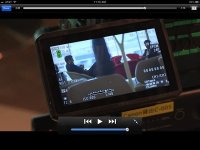
C100-2.jpgC100 DR -2 copy.jpg
As you can see from these screen grabs the Canon C100 clearly recorded face detail in poorly illuminated interior figures before a bright window while also recording the bright exterior without total blowout, but in the final version these faces are obscured shadows. The camera had the DR to pull off this difficult shot, the director made a different artistic decision in post.
 
Last edited:
The beauty of the C300/C100 and C500 are somewhat buried in deeper specs, drwan out in the 2, 16 page White Papers we have been takling about above.

This is, indeed, an incredibly well engineered sensor. :)

If you read the Canon White Papers, the sensor is capable of (I believe) 73 dB dynamic range total (going from memory.) That 12 stops of usable DR across the entire ISO spectrum, up to 20,000 ISO, represents 54 dB. That was what Canon was able to effectively translate into an 8 bit Log representation of the sensor data.

What that means at lower ISO, is that there is 3+ stops of available "overexposure" that can be recovered from the highlights, and that can be allocated to different portions of the image at different ISO. A

t lower ISO, like 320, more of that DR is allocated to the shadows, making that perfect for shooting on green/blue screen and doing very high quality keys.

At higher ISO, more of the DR is allocated to the portion of the image above 18% grey. (And 89% white. That is the meaning of the 300% and 800% discussion above.)

Between the two White Papoers - on the Sensor, and on Canon Log Gamma - there is a very detailed discussion of the design of the sensor, and conversion of raw sensor data to digital represenation on the C100, C300, and C500. That includes 8 bit, 10 bit, and 12 bit, Log and RAW, internal (proxy) codecs, and external recorder data, compressed and uncompressed codecs.

Canon really has done a "bang up" job on the sensor. And they have created a great series of Cinema cameras using different implementations of the same sensor, at different price points, based mostly on hardware costs for the bandwidth/pipeline required for back end data processing and data output.

This was all pretty clearly mapped out by Canon last November when the C300 was announced. I had heard it in a podcast, but didn't fully understand it until now. Why they had a 4K sensor on the front end, but were not immediately able to implement a full 4K workflow on the back end at that time, their road map for that work flow, etc.

All in all this is great news that this sensor is available now at the $6,5000 price point (whatever you think of buying that or another camera for your needs.) It means that you can buy a C100 used for about $5,000 maybe 5-6 months after their release. Or catch a great deal for a new one a few months after the early adopters are satisfied, and inventory starts to stay on the shelf.

Or buy a C100 for $3,500 in 1.2 years when the C200 is expected, or at $2,000 in two years....... Or buy a competitors equivant, etc.

Canon really did a great job on design! The market price point will find itself. I

If the Yen was not so strong, this would sell for $6,500*2/3 = $4,333 in 2008 USA dollars! (With Yen 80/120=2/3, from 2008 whenm the Yen was at 120, to 2012 with the Yen at 80.


+++++++++++++++++++++++++++++++++++++++++++++++++++++++++++

As an example/metaphor on the market evolution: This all harks back, for me, to the $8,000 Canon 1DsII, 16 MP full frame camera that I bought in 2004, and the 8 mp 20D crop that I bought at the same time for $2,000, using ascaled down version of that chip.

That let me sell my 2 Mamiya 7II, 6x7 camera kits, when I was spending $5,000 a year on film only for my personal projects. The 1DsII depreciated about $1,500 per year the first 2 years, and paid for itself in 3-4 months per years. Similar here. (There was also the Kodak 14n released about 6 months earlier. But taht was not a great all-around camera like the 1DsII. It waas a great niche camera, though, for those who could make it work at ISO 25.)

That same 1DsII still sells for around $1,100, a bit less than the 5DII used or refurb.

I think that is about where we are in terms of Log/RAW video, data representation, bandwidth,, etc. Almost here for those that can't justify $5K to $15K, and need an "all around" camera.
 
What that means at lower ISO, is that there is 3+ stops of available "overexposure" that can be recovered from the highlights, and that can be allocated to different portions of the image at different ISO. A

t lower ISO, like 320, more of that DR is allocated to the shadows, making that perfect for shooting on green/blue screen and doing very high quality keys.

At higher ISO, more of the DR is allocated to the portion of the image above 18% grey. (And 89% white. That is the meaning of the 300% and 800% discussion above.)

So unlike other cameras, in which you lose dr as you move away from the ideal iso, these cameras maintain their dr? And allocate to highs and lows differently depending on the iso chosen?

Are there negatives to this approach? For eg, if I'm shooting for the cleanest image possible, say at 320, do my highlights suffer because most of my latitude is in the shadows?
 
There 8.1 stops below 18% gray at ISO 320 and 6.7 at ISO 20,000. Since DR is always 12 Stops at all ISOs that means that there is more highlight room at higher ISOs, and more shadow room at lower ISOs, so proper exposure for dark detail is lower ISO and proper exposure for highlights is higher ISO, the opposite of what you intuitively expect.
 
Last edited:
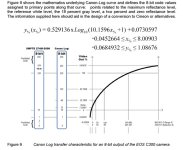
The C300 records only 19 levels from 100 to 108pct (235-254 in the 8-bit code values), which represent 255pct (546-801pct) of the dynamic range.

The C500 outputs 304 levels from 100 to 108pct (3760-4064 in the 12-bit code values), which represent 255pct (546-801pct) of the dynamic range.

19 levels (8bit C300) vs 304 levels (12bit C500) for 255pct of the dynamic range (from 546pct to 801pct) is a big difference. The C100 with the internal 8bit 420 AVCHD record is for me about 400-500pct of the dynamic range. The rest is marketing.
 

Attachments

  • C300_transfer_characteristic_8bit.jpg
    C300_transfer_characteristic_8bit.jpg
    100.4 KB · Views: 0
Last edited:
Pave1, fascinating. Thank you.

Can you comment further on C100 AVCHD theory and the extreme ranges that we have been talking about as well as AVCHD's potential effect on the characteristics of the C series sensor? Thank you.

Also, can you comment how On other cameras like RED, Alexea, BMCC handle the extremes beyond the obvious bit count issues, as opposed to a low end 8 bit consumer cam like say the Pannie GH series, and the C series?
 
Last edited:
I just carefully read the PDF about camera .-) . It is obvious that the difference between 8bit and 10bit/12bit quantization is essential for the DR of the cine camera (with a lot of color grading at post). These cine cameras work with a large dynamic range, the quantization is a very important circumstance for them. If the BMC camera provides 12bit RAW, so it has a clear purpose.

AVCHD recording works with 420 color sampling, there may be a small rounding of brightness levels, color levels are subsampled. It's far away from 12 bit RAW. You can be satisfied with 19levels if you donť want to achieve the best possible outcome, a better price can help you with this decision .-) .

I like the C300 (I do not own it yet) and want to buy one C100, but I don't like this way of marketing.

http://downloads.canon.com/CDLC/Canon-Log_Transfer_Characteristic_6-20-2012.pdf
(Figure 11: the 10bit = 76levels for 100-108 video out, 12bit = 304 levels)
 
Last edited:
Yes, but isn't the 800pct of DR in 8bit as the 800pct DR in 10 or 12bit record. I hope that I help to understand this tiny difference .-) .
 
Back
Top