Canon Cinema lenses?

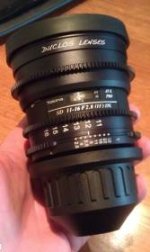
Mr Duclos means it, did you see the price of a rehoused Tokina 2.8 11-16mm in his site: $3495 and it is back ordered. Considering the actual price($700, magnificient lens btw) it is almost 5x more expensive...

I remember you own the tokina 11-16 (in a thread discussing 11-16 versus 16-50) , so did u get the duclos version too, or just let him rehoused the one you had?

Sold my Canon mount one and bought the Duclos one.

Love it.
Screen shot 2011-11-11 at 9.38.29 AM.jpg
 
But it is compared to DLSR and the XF series... which all come in under $4k.

Clearly you think the C300 is worth the same as a DSLR or an XF100. I lot of people would say that's crazy talk, but hey that's your perogative and you're entitled to it.

But that's like saying a Porshe should cost the same as a Honda so you refuse to pay for the Porshe. Again, nothing wrong with that if that's what you want to think. But what you think isn't necessarily justified by the facts.

But it's clearly a mark-up. I don't understand why people are defending them so much. If you can afford one (and are a mediocre DP or director that never has a vision for anything over 24p)... then by all means, go ahead and get one. But you can still be vocal about the obvious marking up they're doing.

There's no question there is a big mark up! This is professional equipment used by a business. Pro equipment always have big marks up, but businesses tolerate it because they're going to use it to make even more money. To them it's all about return on investment.

The problem is you seem to be looking at things from the perspective of a consumer. Consumer products are not necessities and are not investments. Your own RIO is enjoyment and self satisfaction, not actual money. So a consumer is only willing to pay so much for a product. Thus, those products tend to become commodities over time and the price goes way down.

But we're talking about professional equipment here--things that are used by a business to make money. Without these things, they can't make money! So if you are a manufacturer and make something that someone else uses to make even MORE money, wouldn't you want to make a healthy profit too? Absolutely, you have every right to make a nice profit! They're making money with your product. However, the profit margin is not unlimited. There are competitive market forces that will cap how much you can charge.

Oh BTW, save this post. I'm predicting that the next-gen "amateur" slander (like shallow DOF) is going to be over-cranking. In a few months when the glorious C300 hits the streets there's going to be nothing but talk about how "slo-motion" is for hack Micheal Bay wannabees... and statements like "over-cranking is just a cheap trick that armatures use to hide their lack of skill". Sound familiar? (Hint: it's the same thing that happened to DOF.)

This is already happening now. A large percentage of sample Epic footage is all slowmo, sometimes for no apparent reason other than it looks cool. It doesn't matter what camera you have, overuse of any effect, whether it's shallow DOF or slowmo is just tiresome. Just watch any film, they don't do these things excessively.
 
Last edited:
I don't think the price of these lenses ($7000) was motivated by money. It was motivated by stupidity.

LOL!

The CP2 are much slower than the Canon Cine Primes

That's a good point. At first I thought, Zeisses are half the prices of the new Canon cine lenses. But max F-stop, justifiably or not, seems to play a big difference in the price. Another example is Cooke's three lines of lenses:

5/i series (f/1.4) 50mm prime lens: $22,100
S4/i series (f/2) 50mm prime lens: $17,200
Panchro series (f/2.8) 50mm prime lens: $7,850

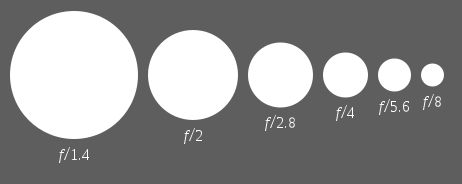
And it kind of (I guess) makes sense when you consider the difference in size of the iris across F-stops:

462px-Aperture_diagram.svg.png


Except for the widest lenses, though, most of the Zeiss CP.2's are f-2, just 1 stop or so smaller than the Canon's, yet half the price. So, right now, it looks like the Zeiss's are the best deal.
 
Last edited:
Yeah, it's not linear. F-stops are exponential. So f/1.4 is twice as fast as f/2 and four times as fast as f/2.8. Since the f-number is focal length divide by the diameter of the entrance pupil of the lens, a larger f-number means that the front element has to be even bigger. In fact, everything gets bigger. Now you have even more glass surfaces to deal with and even more optical problems to correct. Conclusion: it gets exponentially harder and more expensive to get that last bit of high performance of faster glass. Case in point:

Canon 50mm f/1.8 = $90
Canon 50mm f/1.4 = $350
Canon 50mm f/1.2 = $1500

Nikon 85mm f/1.8 = $425
Nikon 85mm f/1.4 = $1700
 
Well Cinema lenses are marked up a bit, but they aren't as unjustified as many think. Cameras are electronics which are enjoying an exponential growth and price decrease. Lenses are not like electronics. Although there are many great advancements in modern times, the physics of glass and light aren't as rapidly developing. In the last 50 years, the greatest developments in optics seems to be lens coatings, which are quite something. Otherwise, it's just perfecting the lens designs and other small parts of the process.

They are sort of like anything in the biz... cheap, fast, and good. You can have two.

Master Primes: Good, Fast, not cheap.
Photography lenses: Cheap, Fast, not as Good.

I'd expect the Canon lenses to be quite similar to performance of CP.2's, likely more uniform. I really expect them to put a half ass effort into them like Sony did with the F3 lenses. They promised more focal lengths, right? Have yet to see them, and with the F3 currently getting older, I'm beginning to doubt if a giant corporation will still continue with that investment.

Canon announced three primes, let's see if they actually deliver more. Professional films won't use just three lenses. Right now, their zooms look way more attractive , and those are PL mount.
 
Last edited:
Yeah, it's not linear. F-stops are exponential. So f/1.4 is twice as fast as f/2 and four times as fast as f/2.8. Since the f-number is focal length divide by the diameter of the entrance pupil of the lens, a larger f-number means that the front element has to be even bigger. In fact, everything gets bigger. Now you have even more glass surfaces to deal with and even more optical problems to correct. Conclusion: it gets exponentially harder and more expensive to get that last bit of high performance of faster glass. Case in point:

Canon 50mm f/1.8 = $90
Canon 50mm f/1.4 = $350
Canon 50mm f/1.2 = $1500

Nikon 85mm f/1.8 = $425
Nikon 85mm f/1.4 = $1700


Les Zellan from Cooke Optics, told me once that for every stop, it is 8x more difficult to make the lens, attaining the same level of quality.

From a 5/i T/1.4, S4 T/2, and Panchro/i T/2.8

Of course it's easier if you make the faster stop with a concession to quality, like super-speeds and other lenses which offer fast speed, but low cost. Usually that wide aperture is filled with negative attributes, like softness, CA, etc. Everyone always gushes over superspeeds... most DP's realize that they are really T/2.2 lenses... anything under that starts to fall apart, and some Superspeeds at 1.3 are really unusable for big screen purposes... So soft.
 
Last edited:
But that's like saying a Porshe should cost the same as a Honda so you refuse to pay for the Porshe. Again, nothing wrong with that if that's what you want to think. But what you think isn't necessarily justified by the facts.

This analogy really doesn't work. Cars use VASTLY different power-trains and motors from model to model. Your analogy would only work if Honda's came with a Porsche engine, suspension, and balance. Which in that case, yes, I would refuse to buy the Porsche (although, in the car world, Porsche's are over-priced an under-featured themselves... but that's another topic).

We're talking about the "guts" of a $3000 camera thrown into a "cinema style" body and then sold for 5x the price. This is MUCH different than cars. I hate when people use these anthologies, since I also know my cars... and most people are WAY off with the comparisons. Car and electronics analogies just don't work. Although, you can draw sort of a comparison between lens manufacturing and automobiles... that makes a little more sense. Although I still think Canon could make more selling cine-style lenses to pro-sumers and enthusiasts. If the cinema lenses were just a bit over the price of their L-series... they would sell TONS. Hell, the should have just put EF grade optics in-side cine housing and sold them for $1k each or something. Then they could have also had these (L-series equivalent) cinema lenses for $7000.
 
Last edited:
Les Zellan from Cooke Optics, told me once that for every stop, it is 8x more difficult to make the lens, attaining the same level of quality.

Right! Also, one thing to mention is cinematographers like fast lenses not because they necessary want to shoot at T1.2, but because that lens will be of higher quality at each successive T-stop compared to a slower lens, with the sweet spot being a bit faster than the slower lens. So T4 on a T1.2 lens will likely be better quality than T4 on a T2.9 lens because you've only stopped down one stop on the slower lens and it's sweet spot might be T8.
 
You just proved my point about the Porshe. You can appreciate that there are real differences in these vehicles because apparently you understand cars. That's why it's crazy talk for someone to say a Porshe should cost the same as a Honda. But you're doing the same thing with the C300 because you can't appreciate what the differences are between it and a DSLR or an XF100.

We're talking about the "guts" of a $3000 camera thrown into a "cinema style" body and then sold for 5x the price. This is MUCH different than cars. I hate when people use these anthologies, since I also know my cars... and most people are WAY off with the comparisons. Car and electronics analogies just don't work. Although, you can draw sort of a comparison between lens manufacturing and automobiles... that makes a little more sense. Although I still think Canon could make more selling cine-style lenses to pro-sumers and enthusiasts.

You keep focusing in the Digic DV III chip, codec and the user interface software from the XF series. You conveniently forget about the real "guts" which is the sensor. This was purposely designed for this product only and is there are no economies of scale making hundred of thousands of them for DSLRs. Maybe they spent $100 million developing this sensor for all you know.

You also forget that the mechanical design is all new, with a brand new motorized ND filter system. To make all these parts, you have to design and make tooling for all the molds (huge, expensive metallic molds), like the internal chassis and all the plastic overwrap parts. All of this electronics packaing is custom designed.
 
Has it been stated yet whether or not these prime lenses are an entirely new optical design? The focal lengths and apertures fall right in line with the 24 1.4 and 50 & 85 1.2 L lenses. It'd be similar to what zeiss does with their cp.2 lenses, and arguably what Canon did with their old K35s. Just curious because I haven't read anything about the actual lens elements or anything yet.
 
The K-35 lenses were not re-housed FD lenses as some think. I had a set of them when new, and they were designed from the ground up as cinema lenses. Canon even received an award for their design.
 
The two PL zooms are new optical formulas, according to Larry Thorpe. No word on the primes. They do seem suspiciously like the L lens equivalents, but we probably shouldn't jump to conclusions without further evidence.

Yep, Canon won an Academy Award for the K-35 series of lenses in 1977.
 
So T4 on a T1.2 lens will likely be better quality than T4 on a T2.9 lens because you've only stopped down one stop on the slower lens and it's sweet spot might be T8.

Yes lenses usually improve when stopped down, but the difference from wide open and stopped down differs based on lens design. These days, it's not always true.... errr noticeably true, rather.

Top cinema lenses made today are designed to perform very well at their full open apertures. Much more so than possible in the past, when that golden rule of the sweet spot held more gravity. There are some lenses made today which try to give the extra speed and do so at the expense of quality because of the design... that is when you get lenses that begin to fail at open apertures. I see this especially in lens sets like the CP.2's. Wonderful lenses but they (the faster ones) can get ugly when all the way wide. Stop it down a little and you get back to pleasantville. Also, if you are familiar with Elite's, I have not tested them, but I have heard they fall apart when wide open too. A good example of a lens that forces speed over performance.... the design of the lens can't support the speed, and your image suffers.

The sweet-spot practice is much more useful on older lenses or lenses not of top caliber design.

I'm sure a Ziess Cinema lens or Cooke cinema lens is much better at wide open than lesser caliber lenses closed down. It just depends, and with modern lenses, is much less obvious... if observable at all.
 
Last edited:
Interesting, well it doesn't surprise me that top shelf lenses are good wide open. It's all out performance with those lenses, above all else. The designers probably threw every trick they knew at the problem.

But are they really being used wide open a lot (I'm asking--I don't really know). Shooting at T1.4 or even T2 seems like DOF would be excessively shallow except for a few close ups. I figured most would be shooting at T4 or something.

Yup!

On those lenses where wide open is pretty solid, it's purely the choice of the DP... Zeiss Master Primes and Cooke 5/i's are damn good at T/1.4..... their use is based on the story. Is really shallow DoF appropriate? Is a more moderate middle ? Maybe deep DoF?

Many DP's think T/1.4 is too shallow for most applications, so it is very common to find T/4's used on big sets that can light that. Now that sensors are getting really sensitive, I'd say it's more of a choice than ever before, where-as 10 years ago, many indie kiddos had to shoot on T/1.4 or T/2 because they were shooting on ISO 250 or 320 cameras/film stock... now 800-1280 is pretty common on digital cameras.

You do see some people still shoot wide open.. and that is either because they have difficultly getting exposure, or the story calls for shallow depth of field as a story telling tool.
 
You do see some people still shoot wide open.. and that is either because they have difficultly getting exposure, or the story calls for shallow depth of field as a story telling tool.

Or they think it looks cool to shoot everything at f/1.4 no matter what the scene calls for.
 
Or you shoot at 1.4 on lenses because you want it a little softer. Highlights tend to flare/bloom and contrast is reduced. It's another in-lens look.
DPs used to use lenses with inherent optical aberrations for glamor beauty shots.
 
Or they think it looks cool to shoot everything at f/1.4 no matter what the scene calls for.

If they are using super shallow depth of field and doing so in negligent disservice the story... they have really failed the only rule of cinematography: Serve the story.

That's the only rule. :/
 
I think that it also should be noted that every AC worth his or her salt will tell you flat out they require cine lenses. This is not from a point of elitism on their part, it's because if you blow a take on set it could cost you your job. Also ask around and see how many AC's actually own the lenses they use on a daily basis... They don't. Buying high end glass is usually reserved for rental houses or very well established cinematographers who can justify the purchase. Are most cine lenses over priced? Maybe from a consumer point of view, but from a "Every take must be in focus or your fired, because we're spending thousands of dollars an hour" point of view? Worth it every time. I'd say that the thing most people over look as indie film makers is a good lighting kit anyway, if you've got ten grand to buy lenses with and you shoot often enough to think you can justify the buy, look at your kit... Do you have HMI's and a good genny? Kinos? Invest in lights, they will make what ever lens your shooting with produce better results. Just my 2 cents.
 
Back
Top