Canon announces the XC15 4K video camera

joe1946

Veteran
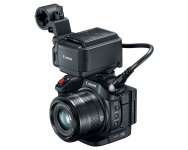
Canon has announced the new XC15 camera, a 4K UHD camcorder in a compact body.
Though it’s clearly a follow-up to the company’s XC10 model, introduced in 2015, Canon is positioning the XC15 very differently. When the XC10 was announced Canon presented it as a camera that could bridge the gap for those who needed to shoot both video and stills, emphasizing its 12MP still capture capability. In contrast, the press release for the XC15 doesn’t even mention still photos, instead positioning the camera as a high quality, compact 4K camcorder oriented at news and video production, possibly as a B-camera to a Cinema EOS model. Canon hasn’t yet provided detailed specifications, but like the XC10 it uses a 1” CMOS sensor and a 10x optical zoom lens, which appears to be the same 24.1mm-241mm F2.8-5.6 (equivalent) lens found on the XC10.
It appears that Canon is making an effort to respond to one very specific area of feedback from many of its video users: the need for XLR microphone support. The camera ships with Canon’s MA-400 microphone adapter that provides XLR-input compatibility.
The XC15 will be available in September for $3000.00
https://www.dpreview.com/news/3045838917/canon-announces-xc15-4k-video-camera


29357729206_7922b71290_c.jpg


Dunno why ppl call this 24mm it's 27 - also fly by wire focus - make it a toy.. At a pro price.. Shame because I like the form and the codec
 
I think I would have rather seen the top handle/XLR adapter the C100 has on this. Though I know it's trying to be compact.
 
This camera is aimed at non-trained, non-DSLR toting "journalists", not pros. If Canon gave this an interchangeable lens mount and other requested features, who would buy the 1080 only C100 MKII? As per usual, Canon makes and markets cameras by niche, they are always expensive, at least at intro and they hardly ever will be ground breakers. It doesn't look as if this will change for the foreseeable future.
 
Does it cost more to make manual focus mechanical? Seems counter-intuitive that involving a motor would be less expensive.
 
Last edited:
It uses a servo system because the lens design relies on moving multiple counter-compensating elements in order to adjust focus and focal length. While it means the lens is more complicated in design, it also makes it less expensive to manufacture as well as smaller and lighter than a strictly mechanical design.
 
Interesting, Mitch.
any idea how large the cost differential?. This cam is not exactly inexpensive.
 
Last edited:
I don't really know, but cost is a minor factor compared to the physical size & weight savings as well as the speed of autofocus. A lens offering similar optical performance utilizing full manual mechanical couplings through cams and toothed gearing would likely be several times larger and heavier. That 10x zoom range would require a mechanical design at least three times the size and the weight would therefore be similarly increased to support it.
 
I just wish it was a constant f2.8, even if they have to cut off some of the range, and had dual pixel autofocus. Other than the lens, I think it's pretty nice.
 
Back
Top