Canon 5d mark iii improved- olpf removed for higher resolution

The first clip is taken into the sun which is why the pier is silhouetted against the sea & sky. There is no detail at all in the shadows but there is no evidence of aliasing on all the fine lines of the girders & wires. The shutter speed is 1/100 ISO 100 Neutral Picture Style with Sharpen 0 Contrast -3 Saturation -2 White Balance 5600K. It would be interesting to know what aperture & what lens was used but obviously it was a non-Canon lens as the EXIF data is missing.

The clip looks just like I would expect from an unmolested 5D3. Whereas from a 5D2 I would expect to see aliasing.

There is simply no proof that removing the OLPF has improved the image. It doesn't seem to have degraded the image but without some real side by side footage it's impossible to say one way or the other. You cannot extrapolate from just one data point.
We are not speaking about the same material.

https://vimeo.com/39541733

There you'll see not a side-by-side comparison, even because they have distinct exposures, but they give a fair idea.
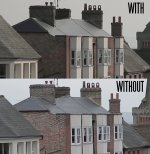
5d-mark-iii-aa-filter.jpg

http://dl.dropbox.com/u/29586086/olpf/5dmk3_ref.jpg
http://dl.dropbox.com/u/29586086/olpf/5dmk3_olpf2_removed.jpg
 
When or if you remove the sensor you have to get it adjusted/calibrated when reattached as I understand to avoid strange focus issues and image distortion.
From James' twitter: «I just adjusted the flange distance on the sensor block. AF seems spot on, but nice thing you can micro adjust on the body.»
 
The first clip is taken into the sun which is why the pier is silhouetted against the sea & sky. There is no detail at all in the shadows but there is no evidence of aliasing on all the fine lines of the girders & wires. The shutter speed is 1/100 ISO 100 Neutral Picture Style with Sharpen 0 Contrast -3 Saturation -2 White Balance 5600K. It would be interesting to know what aperture & what lens was used but obviously it was a non-Canon lens as the EXIF data is missing.

The clip looks just like I would expect from an unmolested 5D3. Whereas from a 5D2 I would expect to see aliasing.

There is simply no proof that removing the OLPF has improved the image. It doesn't seem to have degraded the image but without some real side by side footage it's impossible to say one way or the other. You cannot extrapolate from just one data point.

I hear ya. The images do look striking but I wouldn't open up my camera until A LOT more tests have been done. I really want to buy the MIII (have the MII) and if this is true and the images do get much better than I'll probably grab it instead of the FS100...
 
5D3 doesn't support UHS-1 standard so you will only see the benefit of 95MB/s when transfering footage via USB 3.0 card reader.

Also I don't think they could get the sensor cleaning system work since the vibration unit is attached to the OLPF.

Hey marvin- yeah, I read that the 5D3 didn't support UHS-1 but that these cards could hit 45MBs on the 5D3. That's not the case, the SDHC system on the 5D3 maxes out at 20MB/s, sustained (burst 22MB/s). CF is required to hit 45+MB/s on the 5D3. I'll be testing this theory later today with a 600X Lexar (about the same sustained rate as the 1000X, but $85 lower cost per 32GB card). Again, I want to understand if the macroblocking issues are related to write performance (in the event the firmware does burst writes at more the 2x the 91Mb/s rate (11.38MB/s * 2 = 22.76MB, past the 20MB/s limit)).

It should be possible to remove the vibration system and attach to a new piece of glass. If it's glued, etc., then perhaps a new component can be made and the process copied.
 
We are not speaking about the same material.
Evidently not. I was referring to the raw camera files that were posted on Dropbox. Those are the only ones that it's valid to discuss in this instance as the others have been mucked about with by transcoding editing & grading. Looking at those files they look good but no better than I would expect from a 5D3 in bright sunshine. They are nothing special apart from demonstrating the lack moire & aliasing compare to the 5D2.
 
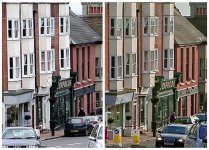
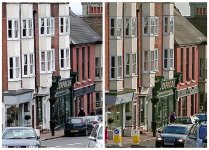
The source OLPF image is dark, noisy, and overcompressed (large areas have no detail due to compression). However, there are areas in both frames with good detail- bricks, green storefront logo, license plate numbers. Both frames have been histogram equalized to show max detail. The OLPF frame has been further processed to try to match the NO-OLPF frame in detail. Higher quality, matched shots are needed to do a more useful comparison. From these tests, however, it appears there may be some high frequency information which is permanently lost and cannot be recovered with the OLPF in place. This difference may be hard to notice for moving images, compared to post processing (need to test with video).
OLPF_CMP.jpg

Here the NO-OLPF frame has been sharpened to match the sharpened OLPF frame. I found that it's not possible to do much sharpening on the NON-OLPF frame before artifacts appear:
OLPF_CMP2.jpg
 
Last edited:
"it appears there may be some high frequency information which is permanently lost and cannot be recovered with the OLPF in place."

Interesting...
 
"it appears there may be some high frequency information which is permanently lost and cannot be recovered with the OLPF in place."

Interesting...

That's what we'd expect, however it's not clear yet if this is due to compression.
This increase in high-frequency information will likely come at a cost of higher aliasing and moire. The question is how much aliasing+moire (enough to ruin a shot, etc.).
 
"it appears there may be some high frequency information which is permanently lost and cannot be recovered with the OLPF in place."

Interesting...
Well, yeah... that's the whole purpose of an OLPF. It is an Optical Low-Pass Filter -- it only lets the low frequencies pass through, and it prohibits (some of) the high frequency information from passing through. The high-frequency stuff, if not sampled properly, is what causes aliasing and moire patterns. The OLPF is there to match the sensor's sampling capability to the incoming data from the lens. With no OLPF in place you are at the risk of getting errant data and invalid samples which are, in a nutshell, aliasing.

Can an image look sharper with no OLPF? Of course. But that sharpness that is added is usually false detail -- aliasing. The crispy/crunchy bogus shimmering detail that ruins images. Extinguishing that false detail will result in more realistic, more natural, more robust images. Images which won't, at first glance, appear as "sharp" -- but that's because the non-OLPF version is falsely sharp.

Now, whether Canon was TOO aggressive with its OLPF is another question, I mean, any specific implementation is always subject to evaluation, but in general, the very purpose of an OLPF is to cut out the highest-frequency detail.
 
Evidently not. I was referring to the raw camera files that were posted on Dropbox. Those are the only ones that it's valid to discuss in this instance as the others have been mucked about with by transcoding editing & grading. Looking at those files they look good but no better than I would expect from a 5D3 in bright sunshine. They are nothing special apart from demonstrating the lack moire & aliasing compare to the 5D2.
Yes, we were referring different stuff. But even if the ideal is obviously to have native footage, we are not in trial to avoid it for procedures handicap : D

Even because there is factual material. The fact is: the difference between the distinct samples is noticeable. Processed or not.

Yet, no point to see the post processing present there as unacceptable, no match purpose, no mask either behind.
 
Now, whether Canon was TOO aggressive with its OLPF is another question
;-)​

"it appears there may be some high frequency information which is permanently lost and cannot be recovered with the OLPF in place."

Interesting...
Indeed ;))​

This increase in high-frequency information will likely come at a cost of higher aliasing and moire. The question is how much aliasing+moire (enough to ruin a shot, etc.).
The whole point to submit to stress testing.​

From James Miller's twitter webpage:
Q: « Is it possible some stress tests like wide(st) angle and pans? »
A: « coming next : ) »
 
Last edited:
I may just not be seeing what others are seeing... I'm no pixel peeper anyway....but Blooms before/after post sharpening tests are STUNNING to my eyes. The before is bland...the after looks incredible. No aliasing or moire that I could see and super lively detail.
OTH...The footage I've seen from the modified camera has that crunchy false detail look and doesn't look all that hot to me..but hey, that's just my opinion.
 
I'm impressed with how much I could lift the shadows in the raw clip that was posted. Some slight sharpening, Color graded, post production grain added on top. Check it out:


9C8jL.jpg


mkjTX.jpg


Not bad. Skin tones aren't perfected, but the shadow lifting is impressive. I'm throwing it up on vimeo so you guys can see it in motion.

http://vimeo.com/39740460
 
I got a lengthy email from someone about all this. I wasn't aware the DIGIC 5 debayered. Cameras like RED it's done in SW, however I guess it's quite possible that DIGIC 5 does it for video. All the DIGIC chips whether in the C300 or 5DMIII share technical similarities I'm sure. It makes sense- the 5D Mark III with one less OLPF of the two it has, and no major increase in aliasing or Moire? So far at least.. Jame Miller filmed into sparkly oceans that would have screamed moire on the 5D Mark II. The old steel pier with all its thin steel rods and jagged angles would be aliasing like mad, however they don't. On the 5D Mark II it would have rang with aliasing. Could it all come down to the new DIGIC 5 chips really do a bang out job in processing that raw data to a video image.


Here is an excerpt:
"Are you aware that the Digic5 debayer's, and this is the reason that there is no increase of moire with the removal of the OLPF from the 5DMIII. Aliasing is not there either because the Digic5 now properly down scales in real time. So you need to ask yourself why the strong additional OLPF then. The answer should be clear."

Any opinions about this?

Pappas
http://PAPPASARTS.WORDPRESS.COM
http://TWITTER.COM/PAPPASARTS
 
Last edited:
Well, yeah... that's the whole purpose of an OLPF. It is an Optical Low-Pass Filter -- it only lets the low frequencies pass through, and it prohibits (some of) the high frequency information from passing through. The high-frequency stuff, if not sampled properly, is what causes aliasing and moire patterns. The OLPF is there to match the sensor's sampling capability to the incoming data from the lens. With no OLPF in place you are at the risk of getting errant data and invalid samples which are, in a nutshell, aliasing.

Can an image look sharper with no OLPF? Of course. But that sharpness that is added is usually false detail -- aliasing. The crispy/crunchy bogus shimmering detail that ruins images. Extinguishing that false detail will result in more realistic, more natural, more robust images. Images which won't, at first glance, appear as "sharp" -- but that's because the non-OLPF version is falsely sharp.

Now, whether Canon was TOO aggressive with its OLPF is another question, I mean, any specific implementation is always subject to evaluation, but in general, the very purpose of an OLPF is to cut out the highest-frequency detail.

There's still an OLPF on the camera, only the 2nd one was removed. I and others have measured 850-890 TV lines of resolution (horizontal), after post sharpening and contrast enhancement (with resolution charts). It's possible as you and others have speculated that the 2nd OLPF's cutoff frequency was too low. For video, we could say the cutoff is 850 line per line width. If removing the 2nd OLPF raised the effective cutoff for video to say 960 or greater (top cameras do 1000+), then we could have won increased resolution but perhaps not an appreciable amount of aliasing (there is aliasing with the 2nd OLPF in place, it's hard to make it happen, though).

pulpfiction007- I agree regarding the crunchy, granular look in some shots. That can be fixed somewhat in post using the opposite of sharpening: a small amount of Gaussian blur. I'm finishing up a test with ALL-I vs. IPB on a fast card (Lexar 600X CF), and watching on a big screen fairly close (46" @ 36" away), the ALL-I does at first appear a bit sharper. However on closer inspection I'm seeing sparkly vertical and horizontal edges: that's a macroblock problem (possibly with decode: something not right with the deblocking step). So far I have only watched the clips using WMP on Win7x64. Will bring into PPro and look more closely shortly.

Emmanuel- it would be extremely useful to see an IPB clip with NO-OLPF. The more I study ALL-I, the more I recommended IPB: more information is stored, less noise, and less artifacts. IPB sharpens wonderfully in post. When artifacts are present, as with ALL-I, they become amplified with sharpening.
 
I got a lengthy email from someone about all this. I wasn't aware the DIGIC 5 debayered. Cameras like RED it's done in SW, however I guess it's quite possible that DIGIC 5 does it for video. All the DIGIC chips whether in the C300 or 5DMIII share technical similarities I'm sure. Any opinions on this?

Here is an excerpt:
"Are you aware that the Digic5 debayer's, and this is the reason that there is no increase of moire with the removal of the OLPF from the 5DMIII. Aliasing is not there either because the Digic5 now properly down scales in real time. So you need to ask yourself why the strong additional OLPF then. The answer should be clear."


Pappas
http://PAPPASARTS.WORDPRESS.COM
http://TWITTER.COM/PAPPASARTS
On the spot ;-) Let's stop to be naive. They want to protect their high-end to our own expenses. I'm sorry, but the money to earn with my work is mine, not property of who SELLS me the gear. I pay for it.

http://www.dvxuser.com/V6/showthrea...ppling&p=1986113437&viewfull=1#post1986113437
http://www.dvxuser.com/V6/showthrea...ppling&p=1986114792&viewfull=1#post1986114792
 
Emmanuel- it would be extremely useful to see an IPB clip with NO-OLPF. The more I study ALL-I, the more I recommended IPB: more information is stored, less noise, and less artifacts. IPB sharpens wonderfully in post. When artifacts are present, as with ALL-I, they become amplified with sharpening.
I will tweet to James. Thanks for your tips, much appreciated John! :-)
 
Back
Top