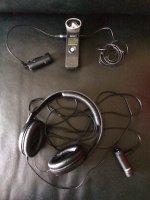
Can you use a field recorder rather than a wireless setup with a lav?

scottfs

Well-known member
Can you just strap a decent field recorder on your talent rather than one of these soon-to-be-obsolete wireless system since the feds are going to auction off all of the spectrum?

Just wondering if that would work. I have little need for a wireless system now, but seems like every director wants to mic everything that moves, or doesn't.
 
I just chimed in on your other post, but I had to comment on this one and just say, definitely. Very popular way of recording.

You won't be able to monitor the levels (if the talent is running around), but some devices record a second track with a lower gain simultaneously.

I am about to buy this one:

https://www.bhphotovideo.com/c/product/1281085-REG/tascam_dr_10l_mini_portable_recorder.html

(It has some quirks and I will probably replace the mic, but can't really complain for the $$)

I just picked up one of these, it is surprisingly good and the stock lav isn't terrible. The menu gives you quite a few options for a $99.00 recorder. I would say the sound is equal to or possibly superior to the DR40/DR60 MKII. I will be using it as a backup to my new Røde Wireless Video Mics, which are wireless but sound amazingly good for the money. I shot interviews and some presentations at a huge, noisy convention at Moscone Center day before yesterday and I listened to the audio today, those cheap Røde wireless sound really good.
 
... I will be using it as a backup to my new Røde Wireless Video Mics, which are wireless but sound amazingly good for the money. I shot interviews and some presentations at a huge, noisy convention at Moscone Center day before yesterday and I listened to the audio today, those cheap Røde wireless sound really good.

Would you say the Rode wireless is in the same league as the Sennheiser G2 and G3 wireless in terms of sound quality, not including the stock lav sound? In other words, talking about the noise floor characteristics and the frequency response.
 
Would you say the Rode wireless is in the same league as the Sennheiser G2 and G3 wireless in terms of sound quality, not including the stock lav sound? In other words, talking about the noise floor characteristics and the frequency response.

In my experience, the Røde's sound a tiny bit thinner, slightly less bass and low mid, but better noise floor and no scanning for clear frequencies. When I say slightly, I don't mean a lot, probably not noticeable to most non sound focused people. In my case, shooting interviews and stand ups about ten feet away from loud speakers and people yelling (conventions sound like a rock concert these days, VERY loud), the thinner sound was an advantage, it cut through the booming much better than the G3. Turn on the Rødes and they work. Keep in mind I am using the stock Røde lav, I may try an Oscar Soundtech lav or a few others I have laying around (Tram, Sanken, etc.) but it defeats the purpose of a $399.00 wireless system to use a $500.00 lav on it probably ;-)

Basically, the G3 is better built than the Røde, are smaller, but thats it. On the two shoots I have used the Rødes so far side by side with the G3, the Røde sounded cleaner and clearer and as I said, I am not a sound mixer, I am far too busy to mess around with scanning, looking up frequency allocation in a given city. I need to turn the mic on and it just works which the Sennheisers don't. There is often interference that requires scanning. Forget that, the Røde is a better choice for me and 90% of video shooters, if not sound mixers. If you are a sound mixer and it is your job to check FCC frequency allocation tables and websites and do frequency scans, have at it, but for the rest of us who are worried about camera, grip and lighting, talent, wardrobe, props, hair and makeup in one man band or small crew scenarios, the Røde just works better. Also, I am researching and writing an article today coincidentally about the vanishing UHF bandwidth in the U.S. so keep in mind that any UHF mic you own today will possibly become illegal to use within a few short years when then FCC auctions off the bandwidth it operates in. They have already auctioned off 700 Mhz, 600 MHz and are in discussions now to auction off more, down in the 400 to 500 MHz frequencies. It's all going bye bye.
 
Last edited:
Can you just strap a decent field recorder on your talent rather than one of these soon-to-be-obsolete wireless system since the feds are going to auction off all of the spectrum?

Just wondering if that would work. I have little need for a wireless system now, but seems like every director wants to mic everything that moves, or doesn't.


Well I know it's popular now but just stating an opinion as a "fact" is really not helpful to others. Wireless is NOT "soon to be obsolete" and the feds are NOT "auctioning off all of the spectrum".

Minus your "alternative facts", the point is valid. Buying wireless right now seems a gamble unless you can recoup the cost in a couple of years because the fed has been over zealous to sell off the spectrum.

To your question, yes and no. You can and if done with some thought and care will work 90+% of the time. So the question is really how close to 100% do you need to be to keep your clients? For a lot of people mitigating with some backup will get them close enough to be happy. If you are getting the big $ then it's probably a risk you don't want to take. I know people who do both for exactly that reason (getting closer to 100%). The Tascam recorder (as it exists outside the US) is exactly for that purpose, as in the built in recorders in some Zaxcom transmitters.

The answers you get on this list will be different than say on JWsound, mostly because a lot more of them need to be really, really close to 100%.

It is also potentially a bunch of extra work. If you were doing a narrative film for instance you don't really want to just run it all day long, and you are really going to want to check the selected take before the setups change so that is more work and a lag time, or a big gamble that nothing went wrong. That won't fly at all on a $$$ set.

BTW it's not just overloads that are a problem. If you have a mic rubbing issue you won't know till you playback the recording. IF you can have the mics visible and in the open then not so much of a problem but if they are buried to hide them then??? So again depends more on what you are shooting.
 
Scott K, you bring up some good points. I think without delving into politics, the current adminstration's influence over the next year or two regarding FCC policy versus the free market and capitalism, it's difficult to say where we may be with UHF and other bandwidth just a few years from now. We can't really discuss politics on this board and we probably shouldn't but I have quite a few thousand dollars of wireless mic systems (one Lectro and two Audio Technica) sitting in my garage that already cannot be used in the U.S. any longer, thanks to the FCC. I occasionally use them to shoot overseas in certain countries so I keep them around. My take on the whole spectrum subject is even if the FCC froze any further action on selling off spectrum, they have already eliminated enough of it from potential use by wireless mic users to the point of using UHF in any congested area or city is already a crap shoot now, more than it was a few years ago. The new technologies like the Røde 2.4 GHz and the Sennheiser AVX at 1.9 GHz sound appealing and my experience with both so far have been very good, much better than my own existing UHF systems. Since I just had to buy two new systems to replace my aging Audio Technica 1800 and Sennheiser G2, which I was never really happy with the sound of anyway, I gambled on the cheap ones and bought the Rødes and so far, they are impressive. I have only tested the Sennheiser AVX and it too sounded great but at more than twice the money, the Rødes seemed like a better deal, I really dislike the proprietary lithium battery idea on the AVX vs. the AAs on the Rødes.

I agree, the non-wireless recording systems are of very limited use because without monitoring what the recorder is recording, clothing rubbing, cable noise and other non-desired sound is often recorded and it's not always possible to go back and listen as you shoot. I bought a Tascam DR-10L as a last ditch backup for certain shoots where using the Røde may be difficult due to interference (Although so far, not a single hit or glitch with the Rødes and that was at a crowded convention in a very spectrum challenged metro area so I am optimistic). I have tried the JuicedLink Little DARling and it sounds good but I was not able to try the model with the wireless features to stop and start recording. At this point, it seems we are in a weird place with wireless mics and solutions for production like these remote recorders. Nobody knows whats going to happen with regard to the FCC, bandwidth availability and what other tricks the manufacturers may have up their sleeves to get us past this period.

Well I know it's popular now but just stating an opinion as a "fact" is really not helpful to others. Wireless is NOT "soon to be obsolete" and the feds are NOT "auctioning off all of the spectrum".

Minus your "alternative facts", the point is valid. Buying wireless right now seems a gamble unless you can recoup the cost in a couple of years because the fed has been over zealous to sell off the spectrum.

To your question, yes and no. You can and if done with some thought and care will work 90+% of the time. So the question is really how close to 100% do you need to be to keep your clients? For a lot of people mitigating with some backup will get them close enough to be happy. If you are getting the big $ then it's probably a risk you don't want to take. I know people who do both for exactly that reason (getting closer to 100%). The Tascam recorder (as it exists outside the US) is exactly for that purpose, as in the built in recorders in some Zaxcom transmitters.

The answers you get on this list will be different than say on JWsound, mostly because a lot more of them need to be really, really close to 100%.

It is also potentially a bunch of extra work. If you were doing a narrative film for instance you don't really want to just run it all day long, and you are really going to want to check the selected take before the setups change so that is more work and a lag time, or a big gamble that nothing went wrong. That won't fly at all on a $$$ set.

BTW it's not just overloads that are a problem. If you have a mic rubbing issue you won't know till you playback the recording. IF you can have the mics visible and in the open then not so much of a problem but if they are buried to hide them then??? So again depends more on what you are shooting.
 
I agree, the non-wireless recording systems are of very limited use because without monitoring what the recorder is recording, clothing rubbing, cable noise and other non-desired sound is often recorded and it's not always possible to go back and listen as you shoot.

It's possible to listen while you shoot, but you just can't do anything about it, haha. (I actually myself said you can't monitor in the post above, but I meant adjust...you can't adjust the levels up or down when the person is wearing the recorder. At least not with any that I know of...but I would love a small device like a Zoom H1 with a remote or app that controls everything.)

Here's my brilliant solution below, lol. Sony AW4 Bluetooth system with the Zoom H1. (I tape it up nicely when I use it.)

I can hear the Zoom H1's recording and monitor for any rubbing/cable noise/etc., but I guess it's moot because in most cases I wouldn't stop the speech/presentation anyway. Maybe could stop an interview though. And I can't ride the levels.

I always try to hire a professional because a good sound guy is a gem to have, but these external recorders can be great in many situations.

Zoom H1.JPG
 
Last edited:
Can you just strap a decent field recorder on your talent rather than one of these soon-to-be-obsolete wireless system...

Really, you can't. If you can't monitor the audio, you don't know what you've got. Would you think it's acceptable to frame and focus your camera without looking at its monitor? Same thing really. If you're not watching / listening, you won't know when something bad happens until you get the footage to post. When it's too late to fix it in the field.
 
Last edited:
The spectrum situation isn't as bad as we earlier thought. Here's an excerpt from Lectrosonics' brief overview of the situation:

This news is heartening. Much less spectrum is being lost than we had originally feared. The original goal of the auction, had it been successful, would have taken away 126MHz of the UHF spectrum. We are grateful that the final loss of only 84MHz will be much less harmful to the operation of wireless microphones and other wireless gear.

The final Channel Reassignment Public Notice (CRPN) that the FCC will publish in the coming months will trigger a 39 month "clock" after which time all wireless microphone operation above 614 MHz must cease. That still gives users up to 3.25 years from today to continue using our gear in the affected blocks and bands.

And here's the page (with chart!) where that quote's from:
http://www.lectrosonics.com/US/Wireless-Resources/fcc-spectrum-updates.html

So sure, we here in the US need to be thoughtful about the frequency range of the wireless systems we use and buy from here on out. But manufacturers are building systems that cover wider (and alternative) ranges of frequencies. Things aren't all bad.

But as others here have pointed out, little belt-pack recorders can be useful tools for certain situations (though I'll continue to primarily rely on wireless systems over recorders...I can monitor the audio, record everything in one file (less hassle for post, etc). Just so the options are in one place:

Tascom DR-10 series recorders. US$200
http://tascam.com/product/dr-10l/

JuicedLink Little DARlink recorders. US$200-US$265 or so. Looks like these are shipping now
http://www.juicedlink.com/collections/audio-recorders

Lectrosonics PDR. US$750 or so
http://www.lectrosonics.com/US/PDR/product.html

Zaxcom transmitters with built-in recorders. US$1700 and up
https://zaxcom.com/product_categories/transmitters-transceivers/

There are probably others...
 
The spectrum loss is not a Political (as in party politics) issue since both parties have been more than happy to sell it off. So I guess it is political (small p) but I don't think there is any real argument in favor in the sound/ filmmaking community.

I also have quite a bit of money in "illegal" wireless, though I have to say that I have lost more money in software and plugins that have been orphaned. That number is in 5 digits.

Never thought of a monitor hop. Bluetooth kind of sucks but since you aren't recording it you could catch the big problems probably. Tascam makes some pocket recorders with WiFi, though I don't know how much control you get.
 
You can attach a recorder to talent or the "subject", but that isn't always ideal, and even then it depends on the device and it's capabilities, and of course, your budget.

The zaxcom stuff is nice because you can record on the transmitter. You can monitor because it is wirelessly transmitting, AND you can remotely change things like gain and frequency on the fly if you have to. Since you can hear it in real time from a greater distance than what bluetooth offers you have a chance to fix any rustle issues. It has timecode as well, if that's a concern of yours.

Lectro has their new small recorder, and it does timecode and looks very very nice, but it's not a transmitter, so if you are looking purely at a body worn recorder, this is on the high end of what you're looking for.

My gut feeling is this:

It doesn't matter what gear you are using, if that body worn recording is your ONLY recording then you are asking for trouble if you have no way of reliably monitoring in real time (I don't consider blue-tooth reliable outside of a few feet of distance) . The law of averages will work out against you eventually, and you won't know it until it is too late. In certain controlled situations, this solution may be perfectly fine, but I'm really uncomfortable not being in complete control of what's going on with my gear and adjustments.

Of course, this all boils down to budget and client expectations. If there is no budget to cover a wireless system rental on a project, and all the client wants is a body worn recorder, then that's what they get, as long as they are well aware of the potential issues ahead of time and you put in your deal memo that you aren't responsible for issues that arise because of budgetary problems.
 
I just picked up one of these, it is surprisingly good and the stock lav isn't terrible. The menu gives you quite a few options for a $99.00 recorder. I would say the sound is equal to or possibly superior to the DR40/DR60 MKII. I will be using it as a backup to my new Røde Wireless Video Mics, which are wireless but sound amazingly good for the money. I shot interviews and some presentations at a huge, noisy convention at Moscone Center day before yesterday and I listened to the audio today, those cheap Røde wireless sound really good.

You got me super excited there as I thought the price had dropped from $199 down to $99! :-o
 
The spectrum situation isn't as bad as we earlier thought. Here's an excerpt from Lectrosonics' brief overview of the situation:


And here's the page (with chart!) where that quote's from:
http://www.lectrosonics.com/US/Wireless-Resources/fcc-spectrum-updates.html

So sure, we here in the US need to be thoughtful about the frequency range of the wireless systems we use and buy from here on out. But manufacturers are building systems that cover wider (and alternative) ranges of frequencies. Things aren't all bad.

But as others here have pointed out, little belt-pack recorders can be useful tools for certain situations (though I'll continue to primarily rely on wireless systems over recorders...I can monitor the audio, record everything in one file (less hassle for post, etc). Just so the options are in one place:

Tascom DR-10 series recorders. US$200
http://tascam.com/product/dr-10l/

JuicedLink Little DARlink recorders. US$200-US$265 or so. Looks like these are shipping now
http://www.juicedlink.com/collections/audio-recorders

Lectrosonics PDR. US$750 or so
http://www.lectrosonics.com/US/PDR/product.html

Zaxcom transmitters with built-in recorders. US$1700 and up
https://zaxcom.com/product_categories/transmitters-transceivers/

There are probably others...

Zoom H1 was the standard low budget option for many years, Aspen Mics even made a belt clip for the H1:
http://aspenmics.com/products/belt-clip-for-zoom-h1-handy-recorder

Though I'd say Tascam DR-10L has squarely taken that thrown now, as it is purpose built for this.

Although the Tascam DR-22WL is another interesting alternative, as you can wireless play from it over WiFi.
 
Yeah, SK. I just like to be snarky. Snarky is my middle name. Ignore the snarkiness. or is it snarkyness...???
 
Back
Top