FS7: Can you safely shoot into the sun?

broughtonfilm

Well-known member
Ok, the title says it all. I know this topic probably keeps coming back but I hear contradictory opinions. Specifically, when using FS7, can you shoot into the sun? I guess it depend whether it is sunrise / sunset or a mid day sun and what kind of lens / aperture / filters are used... Can it damage the sensor? In general, what has been your practice?

I've shot into the sun on many occasions with many cameras, FS7 included, but it was always a sunset or sunrise, and if not, a very quick shot. I'm working on a project which will use the sun element a lot and and I'm sure at some point I'll be tempted to do something stupid... What would that be?
 
Last edited:
Can you describe the context of that a bit more?

If you mean with a ton of ND and stopped down then probably.

If you mean leaving the camera locked off directly at the glaring sun for an extended period, well I look forward to seeing your results and the thread about melting a camera :)
 
There have been plenty of cameras with nice sun arcs burned into the sensor when doing time lapses and any long time-lapse exposures should also avoid specular hits and window reflections too.

Shooting into the sun is not something I'm too fond of and generally avoid.
 
I shoot into the sun all the time. Well, not in the UK as it never comes out. Just don't do it with telephoto lenses in the middle of the day...

Sun1 copy.jpg
 
Can you describe the context of that a bit more?

If you mean with a ton of ND and stopped down then probably.

If you mean leaving the camera locked off directly at the glaring sun for an extended period, well I look forward to seeing your results and the thread about melting a camera :)

I don't know exact context yet in terms of technical specs of it, the project is literally about the Sun so while I can avoid shooting into it as much as I can, I can't imagine not having couple of shots with it in the frame. But in general, yes, I was planning on using ND filters.
 
The paranoia about burning in the sensor comes from the days of tube cameras (1970's and early 80's) when pointing a camera into the sun meant almost instantly burning an image into the vidicon tube. Today's cameras can handle the sun much better but caution is still in order. I shot hundreds of sun shots and sun time lapses with an HVX200, which I still have 10 years later with absolutely no burn in. But I ALWAYS used ND and generally stopped down when shooting, and sometimes used a polarizer or screw on ND for good measure. I then got an AF100 and shot many sun shots with it also with no ill effects. Now, with the FS7, I sometimes shoot a time-lapse into the sun and so far no problem. The sensor burn in the GoPro video above could be due to the fact that there is no ND filter built in.
 
The paranoia about burning in the sensor comes from the days of tube cameras (1970's and early 80's) when pointing a camera into the sun meant almost instantly burning an image into the vidicon tube. Today's cameras can handle the sun much better but caution is still in order. I shot hundreds of sun shots and sun time lapses with an HVX200, which I still have 10 years later with absolutely no burn in. But I ALWAYS used ND and generally stopped down when shooting, and sometimes used a polarizer or screw on ND for good measure. I then got an AF100 and shot many sun shots with it also with no ill effects. Now, with the FS7, I sometimes shoot a time-lapse into the sun and so far no problem. The sensor burn in the GoPro video above could be due to the fact that there is no ND filter built in.
In short I agree with this, but want to say:

Use your head! It's better than any kind of filter you can screw onto the lens. If you need the shot, take the shot, just don't leave the sun in one place for any longer than the shot needs to be taken. Point it away or cap it before the next take. Reducing the amount of light coming in with a filter is good if you can make that shot work. If possible avoid shooting at the infinity focus distance. For time lapse of the sun, I'd get a throw away camera just to be safe. Use a still camera and take a series of stills and make an image sequence in editing. Getting above 4K resolutions is child's play on still cameras so you'll have lots of pixels to work with.
 
If you are doing tight shots, it might be worth getting a solar filter.

How much experience do you have using them? I know the easiest to buy would be the ones used in astronomy, I remember using one once to view a solar eclipse, they shifted colors dramatically, it was visible with a naked eye.
 
How much experience do you have using them? I know the easiest to buy would be the ones used in astronomy, I remember using one once to view a solar eclipse, they shifted colors dramatically, it was visible with a naked eye.

I used them in the 90's with a varicam to shoot close-ups of an eclipse. That's about it.

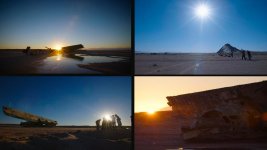
If all you want is a glowing orb and you are shooting mediums and wides, like the ones I posted, you'll have no problem, close-ups at sunrise/sunset too, no problem. I do these types of shots day in day out. A couple of weeks ago we were in Oman, it was 49C and I was shooting into the sun with no sensor issues (obviously, I was stopped down and using ND). If you want anything more elaborate than a glowing orb you're probably into astronomy techniques:

http://www.dailymail.co.uk/sciencet...suns-surface---taken-little-garden-Dover.html
 
Ressurecting this thread.

I shoot in the sun with FS7 all the time, but not over extended periods.

Say if i want to shoot a timelapse of 24 hour sun like they did in Planet Earth 1, in the arctic circle. How would this affect my cameras? Would an older Canon 5D mk II be better suited than Sony A7s II because of the mechanical mirror doors that proect the sensor between each shot?

In Planet Earth, the foreground is nicely exposed so i dont imagine they used a specific solar filter - but i could be wrong.

Its viewable here:
https://www.youtube.com/watch?v=J9eCK7rWMNE
 
Last edited:
Back
Top