Built in ND filter solution?

When it comes to rear-mounted ND filters, is there any exact science to it? Does the filter need to be at the correct distance from the rear of the lens & the sensor in order to maintain the optical qualilty of the image projected by the lens? Does the glass need to be designed in a particular way in order to prevent the distorion of the light rays passing through? Does it need to become an extension of the lens, whereby each piece of glass has a very particular shape for a particular reason, or can you literally just slap a piece of ND glass (high quality, of course) anywhere between the lens and the sensor and it will do it's job?

The reason I ask is because, if the latter is true, and the ND filter can be placed anywhere in the space between the lens and the sensor without affecting focus, convergance, magnification, etc, (and assuming the glass is of high optical quality) then would it be possible/practical to have lens mount adaptors with switchable ND filters - much like the rear mounted gel filters found on larger lenses like the Canon 500mm f/4?

Obviously it would only be practical on certain adaptors (ie those designed for mirrorless mounts such as the GH2 and the FS100), but could this not be the solution many people are begging for? One of the biggest criticism's of both the FS100 and AF100 is the lack of built in ND filters. Given that many people are already using adaptors on these cameras to use lenses such as Canon FD, Nikon, Ziess ZF/ZE, etc, could this be a viable solution for those people?
 
The 'official answer' is that it doesn't work

light goes through an angle when it changes media (glass to air)

The unofficial answer is 'have a play'

My guess is that long teles would buy it, while wides would not

Certainly it messes up witness marks

I would for example like to source an nd for inside my 400 2.8

BTW the AF100 has a filter wheel!

S
 
Fair enough, good to put that question to rest then...

And, if the AF100 has an ND wheel then perhaps the demand would not be as high as I though anyway!
 
Either your camera has built-in ND filters or it does not.
If not there are many ND filters on the market to take care of your issues.

By the way, the AF100 does have built-in ND filters. That being said, I still use ND grads in a matte box with the in camera ND filters of my AF100.
 
those are serious arguments, but is this really that bad? looking naively at the solution inside the C300 (just slide a filter in front of the sensor, close to it), I wouldn't think there would be huge problems (at least as long as the filters are close to the sensor)
 
Either your camera has built-in ND filters or it does not.
If not there are many ND filters on the market to take care of your issues.

Ok, so what particular factors dictate the design of internal ND filters? Must they be in essence an extension of the lens itself, performing all the same duties as a regular rear lens element would, though with the ability to be switched out for a different density filter, or are there other paticularities to their design?
 
the only thing I can see in the C300's internal-ND system that's different from putting a filter inside a nikonF-to-NEX adapter is that in the case of the C300 the filter sits very close to the sensor, and therefore any additional refraction should have a smaller effect - I'd be very happy to hear the technical arguments against deltoidjohn's idea - in any case I'd think it's just a matter of trying this out: anybody with a 5N and some time to spare?
 
Filters mounted between the lens and imager WILL change the focus characteristics of the system. Lenses designed to have a filter on the rear must always have a filter installed to focus correctly - if you don't need ND, then you must put a clear filter on the rear or you will lose infinity focus or at least throw off your marks significantly. Cameras with built-in ND have that glass factored into their design as well.

Not as simple as just slapping a filter in the cavity.
 
Last edited:
A filter behind the lens will throw focus off by 1/3 the thickness of the filter used.
As mentioned above, a clear glass is used in a filter wheel where no ND is used.
 
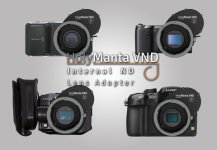
I just created a working adapter with built in variable ND filter! Please check out my fundraising campaign at fundedbyme.com (scandinavian kickstarter.com) to support the project. Also, find more information at www.holymanta.com.

Best regards
/Thomas Läräng, HolyManta VND

FundedByMe_Profile_1_large.jpg
 
I just created a working adapter with built in variable ND filter! Please check out my fundraising campaign at fundedbyme.com (scandinavian kickstarter.com) to support the project. Also, find more information at www.holymanta.com.

Best regards
/Thomas Läräng, HolyManta VND

View attachment 69830

I saw this on reddit. It is awesome.

But there were some critics on reddit stating you should add more funding options. $10 or $200 is too limited. I mean, someone giving $50 or $100 probably wants more than a thank you. Maybe for donations of $50+ you can offer the adapter to them for the $200 price, like with the $200 donation, minus what they have donated, so a $50 donation would let you then purchase the adapter for $150.

Also, for your next version, you need to combine this with the Metabones Speed Booster!
 
I saw this on reddit. It is awesome.

But there were some critics on reddit stating you should add more funding options. $10 or $200 is too limited. I mean, someone giving $50 or $100 probably wants more than a thank you. Maybe for donations of $50+ you can offer the adapter to them for the $200 price, like with the $200 donation, minus what they have donated, so a $50 donation would let you then purchase the adapter for $150.

Also, for your next version, you need to combine this with the Metabones Speed Booster!

You know what, that is not a bad idea at all. I will definately take that into consideration before the weekend. Thanks for the reply!

/Thomas Läräng
 
Back
Top