Broadcasting from home during Coronavirus

But where's the fun in that...? ; )

The question is where's the *ME* in that?

If what NorBro predicts comes to pass, the key question for me is: while I be able to shoot until I voluntarily retire? Or do I need to sooner or later start moving sideways or upwards in the video world.

There will always be a human somewhere, even if there's just one. It might be an editor and a producer, or just a producer, or just the owner of the creative AI that writes, directs, shoots and edits, in a virtual world or a real one.

But god it would suck to stop shooting.

Sometimes, though, there are obstacles in the path of technological progression. After making it off earth and to the moon in a short time, people thought we'd continue to advance in space travel at a rapid clip. But it takes a lot of energy to get off the planet and get anywhere. The apollo missions cost like 5% of GDP or something.

Computers were doubling in speed every 2 years or so but recently they've reached the point where it's harder and harder if not impossible to miniaturize the circuits more. There's quantum computers - but those are still a ways from being useful and may not be useful for everything.

So I want to be optimistic that NorBro's future where shooters like me are unnecessary is still decades away...
 
I think production and post will change a lot in the next 10 years, but you'll still need humans around (like you mentioned).

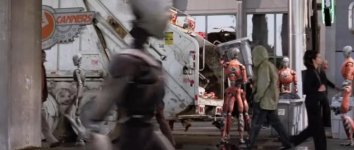
I think we're decades away from robots walking around with people like in I, Robot below. In that scene, you can see two throwing out the garbage and others nearby.

But in a future world, that's exactly how I envision it. Even if it's just a few to start off. Things will change in life. Maybe more realistically, you'll have to place your garbage bins in a certain vicinity (you can use your phone to find the coordinates with an app) outside your houses/buildings and machines can be taught to come to the spots and pick it up while the human drives the truck (teamwork).

Or groceries will be placed in certain sections (as they are now) which will allow the pre-programmed AI to know where everything is and machines can pick up food for you right down to the name brand (if everything isn't being shipped or delivered by a drone to you by then).

Police robots could prevent crime. Or save lives before first responders can assist (like providing you an electric shock to the chest during cardiac arrest).

Or surgeon robots can make very precise surgical incisions. (I don't know about that one, lol.)

___

With production, the image capturing device(s) can be in the eyes/head of the machine and you'll tell it what to do:

"Robot, film Run&Gun cursing while he tries to get his 17-120 lens on the camera."

The robot outputs a hologram showing the image or even sends it to a monitor nearby with everything connected in the cloud.


"Robot, push in...tilt up...brighten a little...okay, that's good. Please export to YouTube account #6540abcdefg."

Exporting...

___

It's a work in progress. And it forever will be perfected. (As human processes are.)

If any of you attend technology trade shows, you'll currently get to see (in person) robots doing cool things, but that kind of stuff above is indeed decades away...all of us here at this time will have expired or be very old by the time the world is running at full speed with any of the above.

I, Robot.jpg
 
Last edited:
Funny post! A couple things

What is "good" and "bad"? People used to put vaseline on their lenses. Styles change. Things look dated today that looked fashionable decades ago. Sometimes you want a sharp lens, sometimes a soft lens, different filters. So maybe you only use natural light or only one light for a documentary interview so that you limit the production value but make it look less artificial or constructed? And yeah, there's some amazing photojournalism that is just beautiful and all they had to work with was camera placement and framing.

The Lion King (I haven't seen it) was crazy because it was all CGI *BUT* they had real dollies and camera equipment that they operated while looking into that virtual world.

"Even though we could repeat the action by pressing a button over and over again, there were times when we would make little mistakes and the animal would jump out of frame because he jumped too quickly or something, and we would oftentimes perfect it and then go back, "No, no, take three where we screwed up a little bit actually feels better," because it really does make you feel like they were real animals and that you didn't get a chance to do it again. So, it's a little bit of second convolution thinking. It's like, "Well what feels more real? The mistake or perfecting it and not having the mistake?"'


Yes, so much is subjective and styles and standards do change over time, but as professionals, I think it is a little disingenuous to play the "what is "good" or "bad?"" game, when it's obvious what we generally mean(good framing, composition, lighting, white balance, etc.). I'm not talking about when going for a specific "look" in a movie or some type of recreation or the like. There's nothing wrong with shooting with natural light and only natural light. It can look fantastic, but it can look awful, too. I've seen "bad"/"rough" done on purpose that still looked good, and I've seen bad that was just bad, that was obviously just lazy/bad work under the guise of "it was shot that way on purpose". And then there is just plain bad.
 
The question is where's the *ME* in that?

If what NorBro predicts comes to pass, the key question for me is: while I be able to shoot until I voluntarily retire? Or do I need to sooner or later start moving sideways or upwards in the video world.

There will always be a human somewhere, even if there's just one. It might be an editor and a producer, or just a producer, or just the owner of the creative AI that writes, directs, shoots and edits, in a virtual world or a real one.

But god it would suck to stop shooting.

Sometimes, though, there are obstacles in the path of technological progression. After making it off earth and to the moon in a short time, people thought we'd continue to advance in space travel at a rapid clip. But it takes a lot of energy to get off the planet and get anywhere. The apollo missions cost like 5% of GDP or something.

Computers were doubling in speed every 2 years or so but recently they've reached the point where it's harder and harder if not impossible to miniaturize the circuits more. There's quantum computers - but those are still a ways from being useful and may not be useful for everything.

So I want to be optimistic that NorBro's future where shooters like me are unnecessary is still decades away...

I do find it ironic that on a forum dedicated to people making images and story telling, there definitely seems to be an air of almost rooting to try to remove people from the equation. I'm not that old. I still have good 25 years or so that I can do this. Even more if I had the work ethic of my Grandparents... Lol
 
That's a weird framing on Colbert. And it looks like they may have tried to perfectly center his head. Could be worse though.
Cobert's signal looks good because there's a Sat Truck in his front yard (he said yesterday, unless it's a joke).

Yes, the framing is horrific. I think the problem starts with framing for the monitor, but then trying to include the desk, too. They had a handheld profile shot a few days ago, and Colbert was sitting in what appeared to be a low steel chair or stool. He should be higher, most definitely.

Colbert, Colvid, Colpay...
 
One of the few things I took away from hifalutin college theory classes was the "rhetoric of the real" which was how you use technique to imply that what you're showing really happened. It could be shooting something in one take or it could be cutting together multiple angles seamlessly. It could be shaky Blair witch camera.

So yeah I agree that in a documentary I'm aware of the style of the source material and what that says about how it was made. Is your average viewer? Maybe less so, but still at the back of their mind. But I think you're right on the money with that approach. That sounds smart.

Apparently on the new Lion King they used regular film equipment and tripods to live action film inside a virtual world. There was a shot where a lion jumped out of frame and the camera operator lagged behind the lion. So they shot it again so the op could shift the frame right as the lion jumped. But they ended up using the too-late shot move because it implied spontaneity and REALITY.

But for audio - I think that's so back-of-the-mind that nobody will question why your doc sounds so good, though they might be annoyed if it sounds bad. Am I wrong? Does the same rule apply to audio?

I think the rules are a bit different for audio honestly. If the audience literally has a hard time hearing what talent is saying, you have a problem. To me, unlike picture, "rough" audio is bad audio. A lot of it comes down to the ambient bed the audio is in.
All of that can be added and manipulated in post as long as you captured a clean recording. Example, I shot several informal interviews with talent on the beach post race where talent gestures and hits or pats their chest, accidentally hitting the lavaliere
I had on their chest.

Some of these, I had a sound mixer and boom, others it was just me shooting solo only with the lav so that's what I am stuck with. That rubbing when talent pat their chest, that's "rough" and very real. I don't think that helps the
overall presentation of that soundbite or interview at all, it's a detriment. I may end up using subtitles in a few places too where we used someone off camera who isn't miked. That doesn't help either but it's the nature if things in documentary.
Overall, IMHO, the rules are very different for audio versus video as far as what the audience will accept.
 
Not sure if this is the correct thread for it but - the NFL will not have its usual annual draft held in the same manner as it had in the past for the obvious reasons (Mel Kiper's CGI hair might remain). The early scoop is that the league will distribute the recording packages (cameras, hardware, etc.) to its top 58 prospects. There'll be a wide angle camera for the reaction shot of the group - "your son was just traded to Cincinnati", followed by a collective, "Oh, shiiiiiiiiiiit" - plus an interview cam. I would presume each prospect will have his gear professionally installed by the NFL sub contractors. I also presume that there'll be some technical support on premises. But that's it. Even the technical support is being doubted as a similar setup in each NFL HQ may not be possible and many coaches/GM's would not want the installers in their homes, just to stay on a safe side of things. The draft is on the 28th, with a number of states still under a quarantine.
 
Forget the draft, I just need to see Brady on the Bucs at least once in my life to really believe it.
 
Forget the draft, I just need to see Brady on the Bucs at least once in my life to really believe it.

My buddy in Tampa is going to make SO much money this year, if the NFL plays. While on the other hand, we lost our NFL meal ticket, here.
 
Yes, so much is subjective and styles and standards do change over time, but as professionals, I think it is a little disingenuous to play the "what is "good" or "bad?"" game, when it's obvious what we generally mean(good framing, composition, lighting, white balance, etc.). I'm not talking about when going for a specific "look" in a movie or some type of recreation or the like. There's nothing wrong with shooting with natural light and only natural light. It can look fantastic, but it can look awful, too. I've seen "bad"/"rough" done on purpose that still looked good, and I've seen bad that was just bad, that was obviously just lazy/bad work under the guise of "it was shot that way on purpose". And then there is just plain bad.

I think though when the goal is to make it look un-produced or sort of unartificial, you have to be careful about the techniques you use. The easiest example of course is shakey handheld footage. Although apparently in The Office they had a complex rig for shooting "shakey handheld" in a controlled way
 
I think though when the goal is to make it look un-produced or sort of unartificial, you have to be careful about the techniques you use. The easiest example of course is shakey handheld footage. Although apparently in The Office they had a complex rig for shooting "shakey handheld" in a controlled way

If you (anyone) ever watch the corners of the frame in the show, the camera is moving around almost non-stop, and it's jittery, and focus is in and out randomly where sometimes it works and sometimes it feels like it could have been hit better/faster.

I never heard about any complex rig for the show, but I think any professional camera man/woman could get 90% of the same look and feel with just the camera on the shoulder once the blocking and other run-throughs have been completed.

It's such sloppy camera work but it works very well because everything else works so well (the story, acting, camera movement for the script, the editing cuts, etc).
 
I do find it ironic that on a forum dedicated to people making images and story telling, there definitely seems to be an air of almost rooting to try to remove people from the equation. I'm not that old. I still have good 25 years or so that I can do this. Even more if I had the work ethic of my Grandparents... Lol

Are we *rooting* to remove people? I'm certainly not, I'm just trying to stay ahead of the curve.

But it's worth noting how much the technology has changed in recent decades and how much you can already shrink the crew as a result...
 
If you (anyone) ever watch the corners of the frame in the show, the camera is moving around almost non-stop, and it's jittery, and focus is in and out randomly where sometimes it works and sometimes it feels like it could have been hit better/faster.

I never heard about any complex rig for the show, but I think any professional camera man/woman could get 90% of the same look and feel with just the camera on the shoulder once the blocking and other run-throughs have been completed.

It's such sloppy camera work but it works very well because everything else works so well (the story, acting, camera movement for the script, the editing cuts, etc).

I may have been misinformed - it looks like The Office shot plain handheld, no fancy rig. But the point is they're emulating the style of reality TV.

Here's a good example from my work - I used to shoot flash mob music videos for a YouTube cosplay channel. The 2 guns who run it started out doing their own camera work and had a few viral videos, then they hired me to up the production value. I was running around shooting it on a small steadicam but when I analyzed their highest-viewed videos and the work of their competitors, it seemed like the action was what really mattered and the more it seemed authentic and not staged/produced, the better. So I switched to running around holding a monopod in the air instead of a steadicam. It's a shaky situation even when I try to keep it smooth. But having the timing and exposure/focus skills helps a trained operator get the shot.

Just saying - when you want something to always look its "best" and you want it to be fluid camera work, balanced exposure, perfect focus or whatever...SOMETIMES it backfires.
 
Are you talking about Cam or something else?

Yep. I used to tell people most of the time my #1 responsibility and reason for being there pre-game on game day(If I was the lone camera) was to shoot Cam arriving to see what he was wearing. Seriously. If I was the only camera there and something else may conflict with the timing of his arrival, he was the priority. Even over Tom Brady.
 
I think though when the goal is to make it look un-produced or sort of unartificial, you have to be careful about the techniques you use. The easiest example of course is shakey handheld footage. Although apparently in The Office they had a complex rig for shooting "shakey handheld" in a controlled way

There was a show I used to work on that wanted that "Friday Night Lights" camera style. Most of us hated it. It was such a PITA doing that for long sit down interviews. And of course we all knew it was just too gimmicky and didn't really belong in this type of program(factual).
 
Are we *rooting* to remove people? I'm certainly not, I'm just trying to stay ahead of the curve.

But it's worth noting how much the technology has changed in recent decades and how much you can already shrink the crew as a result...

I wasn't directing that to you. I was agreeing, because I have the same thoughts and feeling. "What about me?"
 
Yep. I used to tell people most of the time my #1 responsibility and reason for being there pre-game on game day(If I was the lone camera) was to shoot Cam arriving to see what he was wearing. Seriously. If I was the only camera there and something else may conflict with the timing of his arrival, he was the priority. Even over Tom Brady.

I'm a big fan. Incredible once-in-a-lifetime big man athlete. It's a shame the Panthers limited his running opportunities 5-6 years ago (at a time when the league looked at QBs differently and Lamar Jackson was in high school), and ironically his performance has kept dropping since due to MORE injuries.

P.S. I made a joke about you in post #43 you may enjoy if you didn't see it (or maybe not, lol).
 
I'm a big fan. Incredible once-in-a-lifetime big man athlete. It's a shame they limited his running abilities 4-5 years ago (at at time when the league looked at things differently and Lamar Jackson was in middle school), and ironically his performance has kept dropping since.

P.S. I made a joke about you in post #43 you may have enjoyed if you didn't see it (or maybe not, lol).

Cam in his prime was pretty awesome, but you can't abuse your body like that long term before it says "whoa dude". He wasn't a world class passer, but he was a world class athlete who could run around, over and through people.

I did catch that. I was kind of picturing the robot camera, Beamer, in the old 80's cartoon COPS.
 
I wasn't directing that to you. I was agreeing, because I have the same thoughts and feeling. "What about me?"

What's interesting is seeing the rise of "iPhone videographers" but I think that will always be a very low-budget affair because if you can make decent money shooting, why not have better gear? And if you can pay someone a decent rate, why not hire someone with a real camera?

But the low end of the market could get increasingly sucked up by very cheap operators with a $2k iPhone kit

I have to admit that shooting simultaneous wide and CU shots is pretty cool, albeit limited in usefulness.
 
Back
Top