Brevis vs RNG35

yoclay

Veteran
Hi folks,
There is something I don't understand. If grain begins to appear above f4 on a vibrating GG and the same is basically true of a static adaptor (as I have been told by each manufacturer) what's the point of having a vibrating one? More weight, a possible flip needed and noise come with the vibrating GG. (By the way does anyone have any experience with motor noise on the Brevis?) To be true I find the spinners provide a smoother image (especially in the highlights, but their inconveniences are too present to be practical. I am very close to purchasing a Brevis, but if I am limited to almost the same f stop and shutter speed, why not just go with a static adaptor like the RBG35? (users of the RNG35are invited to respond as well with their experiences)

Thanks,
 
Voclay, please do not take this as an attack, but most of what you are saying is completely wrong. Do a little bit more research before making statements, or at least turn those "statements " into questions.

Ill address your concerns sentence by sentence.

What is the point in having a vibrating GG as opposed to a static?
1) if your GG has any bit of dust on it, the vibrating pattern makes it disappear due to the movement. A static adapter will always have a visible ground glass pattern, unless you are using a very high quality material for your GG, some use Wax, and i believe the mini35 has something special too. The downside of the a moving GG is the limited use of shutter speeds. A vibrating GG is more susceptible to visible GG pattern when using higher shutter speeds. A rotating one is effected by this at a lesser extent, but still visible. Film cameras generally run at 180 degree shutter, which is equivalent to half a second of exposure per frame, i.e. 1/48th shutter speed at 24fps.

The motor noise is a none issue unless you are using the onboard mic. If this is the case, you may reconsider your priorities on equipment. I would purchase SOME sort of microphone before wondering into the world of adapters. Once the microphone is away from the camera, you need not worry about vibration noises making its way into the sound recording.

Now, in question of the spinning versus the vibrating, there is no truth that a spinning deals with hilights better than a vibrating. This has to do solely with the camera and its latitude. No adapter will change this, spinning or vibrating. What i have noticed, from adapters such as the M2 ( spinning ) are things such as circular patterns in some of the out of focus area, especially near the edges of the frame, where vertical lines tend to Twirl inwards towards the picture. IF you need a reference i will provide one, or you can take my word for it. I have not focused, nor seen this from the SgPro, but i am sure it is also possible.

Now, keep in mind, if you are being pulled towards going the static GG route, just realize that if you are worried about how GG deals with "highlights" the more static the adapter, the more visible the GG will become in the highlight sections. Especially towards bright objects. If you want to get rid of this issue, you need a GG that is more transparent and less grainy, which will result in the type of image i used to get with the Ifocus, which was nice, however the bokeh/out of focus area was very muddy, not sharp. To see sharp bokeh, check out the sgpro, brevis with the CF3 element, or the letus extreme. If you get a static adapter with less diffusion, more light loss, you will get a more film like look, but the static GG will be extremely apparent. ( unless you find a way to move it )

With each adapter, there is a tradeoff, but all of them have their strenghts and weaknesses. in my opinion, the SGpro creates the sharpest and most film like image, at the sacrifice of a higher light loss. The Brevis is great becaus you can change the GG to create different looks depending on what you are going for, or the light you have available to you. The extreme has a built in flip module which makes shooting much more simplified for those who don't own flip units from either brevis or the SgPro. And the light loss is very reasonable.

Tell us what type of stuff you are interested in shooting, because depending on what your bag is, there is an adapter our there for you.

cheers.
 
Thanks Pa,
I appreciate your clarification. I forgot about the dust issue. I will probably get the Brevis because I like the module aspect of it's construction and ease of use.
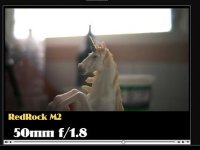
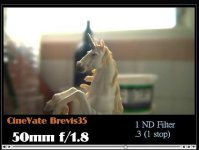
There does however, appear to be a contrast difference between a spinning and a vibrating GG. It is not down just to the camera. I often see this in side by side shootouts. There is a kind of exaggerated fringe or smear that appears more often on the edge of highlight zones from the vibrating or static adaptors. Same cam, same lenses, different outcomes. More ND or stopping down just shifts the exposure, but doesn't change the effect. People say that is because the M2 for instance has more "bleeding" and thus the highlights appear smoother. Here is an example (the exposure is slightly differnent to be fair but the result is exponentially different in the highlight zones-notice the "fringing"or "Smear" on the edge of the windowsill). What do you think?
 

Attachments

  • Redrock Unicorn.jpg
    Redrock Unicorn.jpg
    12.2 KB · Views: 0
  • Brevis Unicorn .jpg
    Brevis Unicorn .jpg
    15 KB · Views: 0
i can tel you from looking at that, it is not a difference between spinning and vibrating, but a different of the material being used for the GG.

Because those images are relatively small, it is difficult to truly compare them, but from what i see, the M2 has more vignetting and a slightly sharper bokeh, but the Brevis cuts less light, and has more of a diffusion property to whichever cinefuse is being used. Also, the reason you may see more smear in the Brevis, is also cause is no vignetting, unlike the M2, which gets dark around the corners, and as there is less light, there is less of that brighter smearing quality.

I can also fish around here to find some stills from The Last sone of Celeste, it gave some pretty good examples of the edge warping that i see in most, if not all M2 footage.
 
i can tel you from looking at that, it is not a difference between spinning and vibrating, but a different of the material being used for the GG.

Absolutely.
The GG is what is going to dictate the contrast, diffusion, and overall 'look' of the image.

Spinning vs. Vibrating may have some technical considerations (i.e. Shutter speed limits) - but I have yet to see anything that would lead me to believe that one method of movement creates a different look than another.

That's like saying a corvette will go faster than my civic because it's red as opposed to green.

The motor noise is a none issue unless you are using the onboard mic. If this is the case, you may reconsider your priorities on equipment.

:thumbsup:
 
Thanks guys,
Needless to say I will be getting a CF3L GG as well. Giving the other issues of the M2, probably the SGPro would be a more "modern" choice (better sharpness, less vignetting, apparently easier set up time) but I do like the overall look of the accessories at RedRock. The follow focus and mattbox look better to me as well. Ultimately i will have 2 units - lowlight handheld (Brevis-maybe Sony EX1) and an SGPro (HVX200) for the bright sunny outside stuff....
 
i think you would be surprised with the quality of the CF3L screen, may not need to buy two adapters, and quite frankly, unless you are really well off and like collecting toys, it seems slightly pointless. But if thats what u want!
 
I own both the Letus EX and the SG Pro Rev 3. Did some extensive testing - you can find my analsysis somewhere on this post under LE vs SG Pro Shootout (or something like that). But here's my two cents on the different methods.

Used Movietube Static system. It was well sealed so dust wasn't an issue. The biggest issue was the units unforgiveable softness and 2 1/2 stops light losss. Not sure this is a function of static technology or just piss poor design.

Contrary to Papa, I don't find the SG the sharpest of the lot. It truly think my LE is a tad sharper. But I like the SG's overall picture more. It's bokeh is more photographic, preserving my Nikon's natural bokeh, especially on longer lenses. I also like it's softer contrast. Which brings me to another point - because different diffusions have an effect on contrast, I do think the different GG densities (hence adaptors) effect latittude. I feel my LE has slightly less lattitude than my SG. It's GG is slighly higher contrast which I think accounts for it's increase in sharpness but decrease in lattitude. Afterall, at a near microscopic level, focus is function of contrast. However, the difference in lattitude in minimal. 1/3 to 1/2 a stop in the shadows at most. It had a different waveform pattern than my SG. Because of it superior light loss, I'm keeping the LE.

However, the difference in maximum stop and shutter is dramatic. I've shot my SG up to an F 11 plus before seeing any artifacts (use fresh batteries for this). Also, the furst generation PS technicks which were spinners could handle much higher stops and speeds. I can't get any higher than 5.6 on the LE. Also, I've gotten up to 1/500 th on my shutter on the SG where the LE begins to artifact after 1/100th. If in camera shutter, slo-mo, bokeh and high stops are a priority, the SG is the way to go. Light loss and sharpness - the LE.

I think spinning GG overall is superior to static or vibrating. Aside from flexibility in stop and shutter, it's not as susceptible to artifacts from dust. When you get dust on a vibrating GG, you won't see the particle when it's on but it will show up as an annoying extra blurry spot on your frame. I sold my Brevis because this was a chronic problem causing me to rebuild the unit constantly. I know they've improved it since but I'm not sure if they've improved the seal (which at the time, a year ago, was poor). The moment you open any unit, dust is an issue. Desptie having choices of GG with Brevis, you will not be changing them on set with the abandon one can change lenses or filters. You will need to be very conscious of dust and do it in as dust free environment as possible and have plenty of dust off handy. If this weren't the case, every manufacturer would offer different GG's. I just get the feeling the number of calls and hassles they'd get about dust isn't worth it - so they try to use the "perfect" compromise.

The real downside of a spinning GG I see its increased size of the unit and also if the spindle can come out of true more easily than misaligning a vibrating GG. I get a feeling PS went to vibrating for maintenance issues, not optical performance. A harsh knock or bump can take your spinner out of true causing it to lose speed and degrade the focus (it's happened to me - twice, the second time, I could never figure out what happened). A four inch platter spinning at extremely high RPMS must maintain a near perfect alignment on the spindle. If the platter is not at a right angle to the spindle in the slightest degree, a slight wobble takes place which over time (about 10-20 hours) multiplies and renders the unit unusable. In short - be careful.

Overall, I'm not a big fan of the vibrating GG performance for reasons above, but sometimes, out of need for speed and small size, I have to own one. The ideal would be for SG's beautiful image, LE's sharpness, light loss and Brevis size.

Tim Naylor - DP
 
Last edited:
Thanks Tim,
There was some new stuff there for me.
I have similar feelings about the SG. I am inclined to keep a Brevis for the same reason as you do with the Letus, greater speed and less dense diffusion look. Actually I have all three and won't decide till I check out the flips on all.Hadn't though about the SG getting knocked out of alignment. Yow!

Lenny Levy
 
That spinning alignment issue is what turned me off the spinner design in my own early explorations. That's not to say that I don't like spinners..because I do. The light loss and alignment issues just got me looking in a different direction after tweaking my early spinners for hours trying to get them perfectly perpendicular to the optical axis. The DOF relationship between an adapter GG and it's achromat is so finite, that the only way we could guarantee alignment within .001" was to use the Brevis design, and set it using CNC machined steel assembly jigs. I keep hinting at this, but the CINEFUSE R&D program is by no means finished, and having the interchangeable system means that the fruits of our labours will drop into any of our units in about 3 minutes :-) Guys like Lenny keep pushing us to do better, so the bowl of fruit will be larger very soon.
 
Back
Top