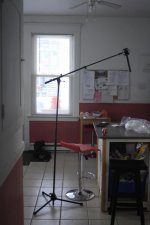
booming a talking head, without a boom op

Every once in a while I have the same problem come up. I need to mic your typical talking-head scene of a person just sitting in a chair. A standard interview.

The typical advice is to put a boom pole holder on a c-stand. Problem is, I don't have a boom pole. The vast majority of the time I'm a one man band. When I really need to boom sound, I have to hire it out. What I'm talking about here is just a static shot. I would normally use a lav, but I want better sound, so I'm thinking a decent hyper like an AT4053. The interview would sound better boomed, but it doesn't need a boom operator because the talent is hardly moving at all.

I can't be the first person to have this problem. So... what's the good low cost way to do this? Without buying a boom pole?
 
Not clear whether you are asking advice on microphone selection, or how to hold the mic in place?

As for microphone, it isn't clear whether you already have a shotgun or (?). The usual rules apply for a boom microphone. Proper long "shotgun" mics don't work well in places with near reflections because it confounds the directional discrimination of the mic. So hypercardioids are prefered "indoors". The AT4053 has a good reputation as an "indoor" boom hypercardioid mic.

As for positioning, a traditional "mic boom pole" is optimized for active positioning by a human operator. But you don't need most of those features (which cause good poles to be expensive). You only need something to hold the mic in position. What do you have for light stands? Do you haul C-stands around? Do you not have anything like a "hollywood arm" or a "gobo arm"? There are plenty of gadgets that allow you to use light stands and accessories to attach to 5/8-27 threaded mic clips, shock mounts, etc. Even the pipe portion of an ordinary mic stand would fit into a boom pole holder clip as you mention. For just holding a microphone in place in a static situation, there is nothing magic about a "boom pole".

There are even adapters for inexpensive "painter's poles" which screw into the handle of a paint roller and are available at any homewares or hardware or paint store.
 
Buy a boom pole and stand.
Put a mic clip on an extension arm on a stand.
Use a lot of gaffers tape.
Learn the ways of the Zen masters and levitate the microphone over your subject.
 
Not clear whether you are asking advice on microphone selection, or how to hold the mic in place?

Not mic selection. I've read the stickies! :laugh: This is just about how to get the mic in position without a boom op to hold it there.

Interesting thought about a c-stand and a gobo arm, but most of those are fairly short, maybe 40" is the longest standard size. Might just work though. I'll have to try that and see.

I was really thinking along the lines of a mic stand. A c-stand seems like overkill for something as light weight as a mic, and if this works out I would rather haul around a lightweight mic stand than yet another heavy c-stand. But... having an extra c-stand around is seldom a bad thing. Hmmm.....
 
You can find conventional microphone stand booms, but they tend to be either the short kind (that are no longer than a gobo arm), or else the big "studio boom" kind that are hardly the kind of thing one would haul around on location. That is why I suggested a conventional "floor stand" microphone stand. The kind that has a heavy round base and the telescoping pipes thread into the base. If you just took the pipe part of an ordinary stand (like an Atlas MS-10), it would work well with a boom pole holder mounted on one of your light stands.
 
I have always used a Manfrotto 420B Combi boom stand, which is a great light stand that extends to 13 feet, but also converts into a boom-stand in about 5 seconds. I use this with a Rycote shock-mount and my AT4053b mic. The sound quality is great and subjects are free to move around a little bit. It also makes it very easy to cycle through a large group of people, as they can just get up out of the interview chair and then the next person takes their place. If you use this stand with the orange 10 lb Manfrotto weight, you can wedge the stand right up against a wall or corner of the room, and still have 6+ feet of clearance for the boom. It's not the cheapest solution, but definitely one of the best.

Manfrotto 420B Combi Boom Stand (Black) : $183 at B&H Photo

Manfrotto 023 Counter Balance Weight - 10 lbs : $44 at B&H Photo
 
I use my AT4053b on an old stage mic stand for single person interviews or talking heads. It has a heavy base and a boom of about 80 cm and can hold the mic easily using the mic clip in the case. I often put it on the side of the fill light so that it doesn't cast a shadow on the subject.
 
Get a pistol grip and a manfrotto friction arm and back yourself to use a table, chair, furniture etc. with the microphone aimed up at talent. Or put the arm on your stand as a smaller boom pole overhead- be prepared to tighten framing to keep it out of the shot.
 
I've tried this with a conventional mic stand with a boom. They usually aren't long enough nor tall enough. You could frankenstein something together with grip and lighting equipment, but I honestly don't see why you would want to do that. I've been down that road. It's easier just to use the equipment made for the job. You can get a boom pole for pretty cheap if you are only concerned about it being on a c-stand. Then you just get a c-stand and a boom cradle and you are done. If you don't want to purchase the equipment, then just rent it.
 
As I said, this is the usual advice. And as I said, I'm looking for alternatives to the usual advice.
Why kludge together alternatives? The usual advice became usual because it's what works best. You needn't spend a fortune for a carbon fibre but a basic boom is such a fundamental piece of audio gear that I can't imagine why you're resistant putting one in your kit. An 8 foot or so ENG boom, a C-stand, a "fisherman's friend" holder like those in your links, a couple of sandbags, and for a few hundred dollars you're in business both for this shoot and in the future. If you're getting paid for these shoots you need to remember the professional impression you make with the kit you bring to the party is as important as the skills behind the camera. As I once saw on a card in a men's wear store window: "To get where you want to be you must look like you're already there."
 
Do your shots with whatever microphone stand you have place it in shot for optimum audio (yes in shot ! ) . Do not let the microphone come between camera & subject. Lock off camera on tripod use a prime lens or locked down zoom . Record interview. On completion of take with everything locked down shoot a "clean plate" of the scene without microphone stand .

Repeat the above process for Cu's, wide's, mids . Then in edit combine the shots together & remove the microphone. Hey presto optimum audio quality minimum effort.

Whilst the above process seems long it isn't it takes seconds..just remember to shoot a clean plate after every "gotake"
 
Im another person fond of a folding mic stand with boom arm (just like the above pic) works for 99.9% of stand ups, sit down interviews etc for 1 or 2 people that I do, with 3 people you've got problems.
I often look at pics and wonder why people use such long poles in some shots, as most shots are mid or MCU's.
 
Well the Horse is two steps ahead of me ...since I am still using my Manfrotto combi but I like the option of having a reflector holder that can double as a boom. But when the combi is too much of a pain to travel with this could be a great option. I often just hang the hyper by the cable from what ever I can rig including two light stands and a broom pole on one shoot. Couple of pony clamps and you are done. But I honestly do this more often in situations where I am doing several talking heads from the same "chair" and don't have time to wire a lav.
 
I use the combi stand for this purpose also, and it is likely the best compromise on function and price. Also use a 4053b and it has a pretty tight pattern, so if your talent moves, it will effect your sound. Boom out to the practical limits of 24 to 30" or use a wider pattern mic.

Grant

Edit: the only problem with the combi is that is longer that a typical small stand, so might require additional luggage.

I have always used a Manfrotto 420B Combi boom stand, which is a great light stand that extends to 13 feet, but also converts into a boom-stand in about 5 seconds. I use this with a Rycote shock-mount and my AT4053b mic. The sound quality is great and subjects are free to move around a little bit. It also makes it very easy to cycle through a large group of people, as they can just get up out of the interview chair and then the next person takes their place. If you use this stand with the orange 10 lb Manfrotto weight, you can wedge the stand right up against a wall or corner of the room, and still have 6+ feet of clearance for the boom. It's not the cheapest solution, but definitely one of the best.

Manfrotto 420B Combi Boom Stand (Black) : $183 at B&H Photo

Manfrotto 023 Counter Balance Weight - 10 lbs : $44 at B&H Photo
 
Last edited:
I also just use a basic mic stand with boom arm - I think it was $25 - with an AT4053b for sit down interviews. I've never needed anything taller or longer.

If they are really animated you may need to back the mic up a fraction so as not to lose them if they lean a lot.
And, just make sure one of the stand legs is parallel and directly under the boom arm and you won't have trouble with it tipping.
 
And, just make sure one of the stand legs is parallel and directly under the boom arm and you won't have trouble with it tipping.

Properly counter-balanced with a weight ( like the orange Manfrotto weight I listed above ) the boom won't tip in any direction.
 
Back
Top