Bolex D16: RAW, 16/Super 16 sensor size, costs less than MkIII

I'm not saying the images from the camera look bad. Not at all, I like them a lot. Reminds me of the Ikonoskop.
I just didn't like that particular rendition of the raw images. I prefer the ones from the D16 website. To each their own, of course. That's the beauty of raw images, correct?
 
I'm not saying the images from the camera look bad. Not at all, I like them a lot. Reminds me of the Ikonoskop.
I just didn't like that particular rendition of the raw images. I prefer the ones from the D16 website. To each their own, of course. That's the beauty of raw images, correct?

Exactly. I'm bored with the constant barrage of flat low contrast desaturated looks myself. Have any of you guys watched Moonrise Kingdom? Shot on S16 film. That is more to my taste.
 
Not too bad. Smooth (CMOS smooth?) to me as far as overall image goes, pretty noise free but it looks steady. Color isn't too shabby even in these conditions. All in all, much better than the first images and pretty promising.

Processed with an Input LUT I'm (attempting) to build around Blackmagic, two different Output LUTs used (click for larger o'course):


All just my opinion of course! hope they get the cameras out.
 
I must add, if we got an OLPF for Blackmagic to solve aliasing/moire and it turned out the images were about as soft as the 50mm image, I would be very much okay with that... I can't spot any moire at a few glances, which is a big one up for these guys.
 
Even though that is a year past their first anticipated release date, the camera is much better for the extended development time and that would still have to be a record of some sorts for rapid development of a completely new camera from the ground up. How long did it take Canon to do a minor update to the 5DII? Most cameras go through a 3 to 5 year development cycle. We are just not privileged to watch or participate in the process.

True. What fledgling cameramakers are hitting against is the Pareto principle, where it takes 80% of the time to finish the last 20% of the product.
 
To be honest, the corrected versions don't look good at all. The highlights are a bit much. I'd bring the levels down some.

Most video around the world is overexposed. To give yourself room for that luscious gentle roll-off, you must look like you are drastically underexposing when filming (unless you programmed in a suitable LUT, which almost everyone hasn't).

Film has neverending detail in the highlights. The shades get lighter and lighter, but it seems like forever until it finally goes to white. On the other hand, you've got to be careful with the shadows with film. If you underexpose, then you risk clipping your shadows (the film negative is perfectly clear on a spot, with no grains left) and there's nothing you can do in post.

Video (raw video) has neverending detail in the shadows. The shades get darker and darker, but it seems like forever until it finally goes to black. On the other hand, you've got to be careful with the highlights with video. If you overexpose, then you risk clipping your highlights (the wells are totally full on a spot, with no room left) and there's nothing you can do in post.

So, film and video clip at opposite levels, film at black, video at white --- but that's hardly surprising when you remember that raw film is negative, while video is positive.

Dynamic Range and Transfer Functions of Digital Images and Comparison to Film. Roger N. Clark pulls amazing stuff out of the shadows of a 10-year-old digital SLR, the Canon EOS 1D Mark II.
Adding Dynamic Range to Any Digital Camera. Ken Rockwell reiterates my point that by underexposing you can give yourself room for some of the highlight roll-off of film. He advises underexposing by two stops. (He also says this idea is patentable, which I think is just another example of why patents are stupid. I thought of this same thing years before reading his article. I found it tonight, while googling for Roger N. Clark's article, above. </rant>)
 
Last edited:
After reading 1269 posts all I can say is that I don't understand why the difference in image is apparent to only a few people. it seems obvious to me. perhaps it is all in my head. Don't know, don't care.
 
Video (raw video) has neverending detail in the shadows. The shades get darker and darker, but it seems like forever until it finally goes to black. On the other hand, you've got to be careful with the highlights with video. If you overexpose, then you risk clipping your highlights (the wells are totally full on a spot, with no room left) and there's nothing you can do in post.

There is a noise floor, which is the effective clipping point of the shadows. And there is a hard clip in the shadows due to ADC conversion: something is always placed at zero in the raw data. The notion of more shadow detail comes from the typical transfer curve which will generally use the higher (say) 9 stops of the DR of the sensor because they are the cleanest. The camera will generally also be tuned to meter for this upper part of the DR. Depending on the sensor, this will leave 1 or more stops of latitude in the shadows to play with when processing raw, albeit more or less noisy.
 
Any Kickstarter backer want to sell their slot? Would Joe do the transfer?

After reading 1269 posts all I can say is that I don't understand why the difference in image is apparent to only a few people. it seems obvious to me. perhaps it is all in my head. Don't know, don't care.

+1

At this point I don't think anyone would sell their slot. But they will take preorders for the second run when the first is shipped. 300-500 cameras. Joe anticipates they will do this on a quarterly basis for the first year of production anyway.
 
Not too bad. Smooth (CMOS smooth?) to me as far as overall image goes, pretty noise free but it looks steady. Color isn't too shabby even in these conditions. All in all, much better than the first images and pretty promising.

Processed with an Input LUT I'm (attempting) to build around Blackmagic, two different Output LUTs used (click for larger o'course):


All just my opinion of course! hope they get the cameras out.


Nicely graded Kholi, I'll PM you in August when mines ready......It's been a long wait but is starting to look like it was worth it.
 
There is a noise floor, which is the effective clipping point of the shadows. And there is a hard clip in the shadows due to ADC conversion: something is always placed at zero in the raw data. The notion of more shadow detail comes from the typical transfer curve which will generally use the higher (say) 9 stops of the DR of the sensor because they are the cleanest. The camera will generally also be tuned to meter for this upper part of the DR. Depending on the sensor, this will leave 1 or more stops of latitude in the shadows to play with when processing raw, albeit more or less noisy.


I think this is exactly true. A digital sensor is a linear meter, there's no such thing as mid grey point, shadow DR, or highlight DR: it's just a matter of how you decide to expose it. But it is true that most cameras have their metering systems set up so that you'll have your grey midpoint relatively high, so you'll have more headroom in the shadows than in the highlights. But if you're shooting RAW, nothing stops you from doing something different.
 
I think this is exactly true. A digital sensor is a linear meter, there's no such thing as mid grey point, shadow DR, or highlight DR: it's just a matter of how you decide to expose it. But it is true that most cameras have their metering systems set up so that you'll have your grey midpoint relatively high, so you'll have more headroom in the shadows than in the highlights. But if you're shooting RAW, nothing stops you from doing something different.

Ansel Adams zone technique for photographic exposure applies a 10 zone gray scale from white clip to black clip, with middle gray at the center. He used it to determine how to fit the dynamic range captured in film negatives to the gamma response curve and DR of the paper he printed on to achieve the visual result he wanted. It provided a way to match scene meter readings, his visual perception of the scene, and the tested exposure response of his films and print media to produce a predictable end result. This concept applies to digital media as much as it did to film even thought the response of the media itself is quite different.

With digital video, just as with a paper print, the gamma response, DR, and gray scale of the finished product are defined by display referenced standards, not by any camera. Adobe RGB, sRGB/ITU/REC709/DCI-P3 are all examples of display reference standards to which we all conform depending on our particular delivery format.
We still have to visually judge, measure, expose, and grade our footage to produce the end result we want to see, ideally on a standards calibrated display of one kind or another whether it is a consumer TV or a movie screen.
In camera or external light meters, automatic exposure tools, and the camera's photometric response at each available gain and gamma curve setting are all calibrated and referenced to a middle gray point that represents the center of the available DR between black clip or noise floor and white clip. But creatively, the photographer chooses where to actually place middle gray with manual exposure decisions to achieve a particular result. In the case of auto exposure, the camera chooses for you.
 
Yes. All I'm saying is that with RAW you can decide where you put the middle gray, as long as you adjust your image later with the grade. This is not the case with film or with video or jpegs that are not log: there's a curve already applied when you take your images, so you'd better respect where that curve wants you to put your middle gray.
 
In camera or external light meters, automatic exposure tools, and the camera's photometric response at each available gain and gamma curve setting are all calibrated and referenced to a middle gray point that represents the center of the available DR between black clip or noise floor and white clip.

From what I've seen mid gray is rarely in the center of the DR. Not enough tonal resolution in blacks to meter for the center of the DR and retain reasonable darks. Most display ready curves (jpeg, consumer video; any typical power gamma) will place mid gray some 3-4 stops below white clip, and compress 5 or more stops in the shadows.

Samuel H said:
This is not the case with film or with video or jpegs that are not log: there's a curve already applied when you take your images, so you'd better respect where that curve wants you to put your middle gray.

Film is essentially log. :) Its curve is predominantly flat over log exposure. Over- and underexposure, development, printing lights, print stock gamma are all tools for manipulating the combined transfer curve of the process. Placing mid gray above or below the metered exposure (sometimes up to 2 stops or more) is not uncommon.
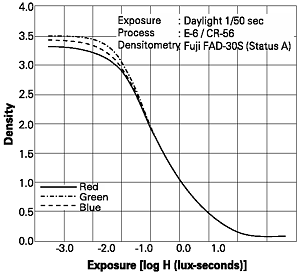
 
^ I don't agree that film is essentially log. It is log in the center, and that definitely includes 2 stops above and below the actual center, but it has a very particular rolloff in the highlights and in the shadows. That is, it has a very strong S curve.
Random graph from a quick google search:
Astia_curves.png
 
That's positive stock in your chart. Slide film is not particularly famous for wide DR. :)
Here is how a negative looks like:

kodak5219dr.png
 
ooops, should have spent a bit more time on that google search
So yes, that's closer to log, but it's still an S-curve somehow... let's leave it as a tie :)
 
Back
Top