Bolex D16: RAW, 16/Super 16 sensor size, costs less than MkIII

Latest report from JR.

1st we are already hard at work on the software, and hope to make it as user friendly as possible. There will of course be many improvements to the software both in functionality and usability after August though.

2nd the native sensitivity of the sensor is 400 iso, so we will only be reducing the gain to reach the 200 and 100 iso settings. Therefore 400 iso should still look very clean and nice!
Just about everything you guys are asking for will be in the software eventually if not at launch, with the exception of the option of deleting files. We would like you to do that in camera for several reasons. Other than that though we hope this will be one of the best raw format experiences to date.
This is the company building the software: http://pomfort.com/
They already make Silverstack a very nice raw media management tool.
Their biggest hurdle is the transcoding which is being modeled after RPP:
http://www.raw-photo-processor…..rview.html

There is a new 30 second ad posted shot with the current lab prototype. They are still waiting on the first complete production prototypes

.
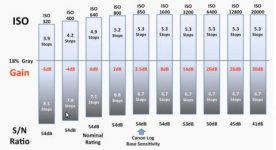
 
2nd the native sensitivity of the sensor is 400 iso, so we will only be reducing the gain to reach the 200 and 100 iso settings. Therefore 400 iso should still look very clean and nice!

Thanks for the update. What is to stop the gain being reduced further than ISO 100 or 50 to create a feature akin to a digital ND filter, so you can use 1/50 and a wide aperture in broad day light?
 
Thanks for the update. What is to stop the gain being reduced further than ISO 100 or 50 to create a feature akin to a digital ND filter, so you can use 1/50 and a wide aperture in broad day light?


Dynamic range suffers.

Gain happens after readout. A photodiode is a bucket. Regardless of the gain, it can hold only a certain number of photons.

The dynamic range is the difference between empty and full. Suppose it can hold 20,000 photons. The difference between 0 and 20,000 is its dynamic range: 20,000:1, which is about 14¼ f-stops (2 to the 14.29th power is 20,000). But that's assuming the chip has zero noise. The bottom is the noise floor, really. Let's say it's the equivalent of 4 photons. 20000:4 is 5000:1, which is about 12¼ f-stops.

But that's only if you process it so that empty is solid black on the TV screen, and full is solid white. This setting corresponds to a certain ISO and would be called the sensor's native sensitivity. Let's say it's 400.

If you change the ISO, you are re-mapping the relationship of chip photodiode fullness to TV pixel brightness. If you raise the ISO, say to 800, you are mapping something less than full to solid white. In this case, by raising it the equivalent of 1 f-stop (from 400 to 800), and so you basically are throwing away the top f-stop. If it were a 20,000-photon-per-photodiode chip, you would be mapping everything from 8,000 photons and higher, instead of 20,000 photons and higher, to solid white. It sounds like a lot. You're throwing away 12,000 photons. But f-stops, like human vision, is logarithmic, not linear. If you doubled the sensitivity again, from 800 to 1600, you would be throwing away only another 4,000 photons. And so on it decreases. Here's the complete mapping:

14: 16,384
13: 8,192
12: 4,096
11: 2,048
10: 1,024
9: 512
8: 256
7: 128
6: 64
5: 32
4: 16
3: 8
2: 4
1: 2

This is why it's important to record at high bit depths, to reduce banding if you stretch around your picture in post. It's also why recording 10-bit log is better than 12-bit linear. But that's another topic. Read this: http://www.normankoren.com/digital_tonality.html

Likewise, if you lower, instead of raise, the ISO --- say, from 400 to 200 --- it's the same thing, except you're throwing out the bottom f-stop instead of the top.

At least that's how I understand it. I'm not an electrical engineer, so it may be more nuanced. For example, I can't understand why Canon's C300 does not gain or lose more dynamic range at different ISO settings.

Screenshot from 2012-07-07 19:12:04.jpg

If someone understands the process more, feel free to let me know.


The optimum gain match for any type of analog sensor to ADC is set so that the maximum digital code value occurs at about the same point as maximum analog voltage of the sensor. You need at least 30 discrete digital values per stop of dynamic range to get adequate capture resolution to avoid banding artifacts. Regardless of what they encode to, better video cameras do the first stage ADC at as high as 14 bits internally to meet this requirement. Everything is linear up to that point. A raw camera like the Bolex simply stores this first stage full range linear data to a file unmodified.
A video camera processes the data internally to an RGB or YUV color space image, writes the resulting data to a standard video codec of some kind and records a finished image. The current linear DR range for HD encoded video in any format is about 7 stops, so all of the various "look" settings are just different compression schemes to represent wide DR data in a smaller DR and color gamut display space. Since you are doing this, a very wide range DR sensor provides a lot of headroom to manipulate the image data without seriously impacting the 7 stop display DR. Gain and noise reduction both play a role in this. It's not that you don't lose DR at higher ISO settings, you just have plenty to burn relative to what you can actually display. But once the video is encoded you are pretty much locked into the more limited DR and gamut of the video codec and limited to the applied gamma curves the camera maker provides in their software log or otherwise. If you boost analog gain before the ADC 6dB or one stop, The ADC can no longer encode the maximum sensor value at the top of the range so you lose a stop of highlight DR. Since analog gain can't distinguish between image voltage and noise at the low end, you also boost the noise floor by 6dB and lose a stop on the low end too. Again with enough total DR from the sensor this may not significantly impact encoded display images.

As to color gamut, any 8 bit video codec can display up to a maximum of 16.78 million discrete color values. A 10 bit codec can record 1.07 billion discrete color values.
12 bit linear raw capture can record 68.7 billion discrete color values and for a 12 stop DR sensor provides 341 discrete level values per stop. Very high tonal and color value resolution.
 
Last edited:
Another interview. More detailed look at the prototype CNC body and features.


Very interesting. Sounds good. But still a toss up between this and the Black Magic. I"m gonna wait till both are out in the wild and see some user reviews before pulling the trigger on either one.
 
Cannes or not, that flick still looks meh.
XLRs on the wrong side, like the BM camera - FAIL - what where they thinking?
Oh, wait, they are coming from DSLRs - I understand.

Why on earth don't they ask a DP, before they design a camera?
 
Cannes or not, that flick still looks meh.
XLRs on the wrong side, like the BM camera - FAIL - what where they thinking?
Oh, wait, they are coming from DSLRs - I understand.

Why on earth don't they ask a DP, before they design a camera?

I have to agree... Also that's one ugly camera that the design just seems wrong. Doesn't look like you can hold it with two hands or shoulder mount, it's set up like some Sci-Fi gun from the future or something. That's one ugly S.O.B. Also not impressed with the footage.
 
I have to agree... Also that's one ugly camera that the design just seems wrong. Doesn't look like you can hold it with two hands or shoulder mount, it's set up like some Sci-Fi gun from the future or something. That's one ugly S.O.B. Also not impressed with the footage.

It's also a curious decision to embed a SSD into the body and then write it out to SD cards. That seems like it would be super frustrating to shoot until you fill up the SSD and then wait for the camera to dump it all to an SD card before you can shoot again. Why not just make it write to removable SSDs in the first place?
 
i apologize for this in advance, but i just can't watch the the two design heads of the d16 and not have my hipster alarm go blazing.

again, sorry for that. i do really like the initiative in the camera and am happy that people are doing things like this, but i just have a certain tone that when my brain hears it, it unnerves me, it's the hipster tone, the way they talk and act, and i've been starting to call this the hipster cam.

the hipsters are invading astoria NY and i've been more irritated by them lately. some bring good music and food, but most seem to just bring the god awful stereotype that we associate with hipsters.

third time's a charm, sorry guys, i like your camera. cept a few, ok many things, that i as a DP am turned off by and have already been mentioned in this thread.
 
they said bolex has the final say after they see the first production run. what if they're not happy with the chinese made quality of the camera? (you can get great parts from china if you're a big player and invest heavily, pressure them to get it right and set up a top notch quality checking system)

will they just call it the digital bolix and release it anyway?
 
Usual negative bashing from the other side (BMC), wait where's your camera ?

Wouldn't it be more constructive to wait until BOTH camera's ACTUALLY arrive and then start discussing their strong/weak points.

By the way I've got a D16 on order and am one of the backers and i'd like to see how your gonna hold the BMD and keep it steady without a huge rig.
 
By the way I've got a D16 on order and am one of the backers and i'd like to see how your gonna hold the BMD and keep it steady without a huge rig.

It's called a tripod. The Blackmagic camera has the hole underneath it to mount it to the tripod plate.
 
Usual negative bashing from the other side (BMC), wait where's your camera ?

Wouldn't it be more constructive to wait until BOTH camera's ACTUALLY arrive and then start discussing their strong/weak points.

By the way I've got a D16 on order and am one of the backers and i'd like to see how your gonna hold the BMD and keep it steady without a huge rig.


So that's how you justify your purchase? I have no feelings towards either company but the BMC looks and operates imo more professionally. Also being bundled with a $1000 software program helps. Ultimately though I agree that we need to wait until both cameras are out before we completely judge, but based on initial impressions I do not like this camera (Bolex D16) for the reasons stated...
 
So that's how you justify your purchase? I have no feelings towards either company but the BMC looks and operates imo more professionally. Also being bundled with a $1000 software program helps. Ultimately though I agree that we need to wait until both cameras are out before we completely judge, but based on initial impressions I do not like this camera (Bolex D16) for the reasons stated...

Firstly I hope my 'Purchase' arrives and in a timely fashion, Secondly I'm a huge fan of Super 16mm cameras and have a large collection of expensive vintage glass so for me the Bolex D16 camera with (in my opinion) the better quality and size Kodak CCD sensor suits what I want. Also I like the body and will shoot a lot handheld so again that suits my needs. Regarding the Software, CinemaDNG is still out in the woods and I'm sure the software I already own by its inventors will catch up soon.
 
Back
Top