BlackMagic - URSA Mini

Yes they have dropped a clanger with the no ND, is this because the mini like its big brother has the ability to swap sensors and perhaps the the addition of an ND made the system too complex. As soon as he started with the size of a wok dish ND system the first thing I thought of was the Sony FS7.
 
Last edited:
I understand your position but there are some of us who work in situations that don't allow the luxury of time but still want the features of large sensor etc. There is nothing to prevent someone like yourself setting a camera with built in ND to 0 and using your own. Having just sold my FS100 with no ND and then looking at the Cion and passing on it because of no ND I am a hard sell on no built in.With all due respect, I seriously wonder if indeed as you say the quality of those ND filters is "cheaper" because I have some very nice 4x5 NDs and a lovely B+W variable all by Schnieder a reputable firm. I will have a look later at the built in on my PMW300 and compare it with the MB 4x5. So with the cost between the F7 and the Ursa Mini being not much less when you add the VF and the handle and base kit and the cost of CF cards, well the F7 is still looking very very good IMHO and its out there working right now.

I completely understand. I used to shoot a lot more live production stuff and back then I would want built in ND filters in a heart beat. Of course back then I typically used 2/3" ENG cameras for that stuff so it was a different game back then.

I guess my whole point is not that they will always be cheaper but that we don't always know what ND filters are used when built into a camera. I just know some film makers are extremely picky about ND filters and even a single manufacturer will have different levels of ND filters some that block out a lot more IR. My understanding is the higher the ND strength the more IR becomes an issue and can affect color and sharpness. Since built in NDs are a bit of an unknown I would question the ones Black Magic Design would pay for to add to the camera without seriously adding to the cost of the camera. BMD does not make glass and I'm not sure any of us really want them to start experimenting with their own glass. For those that do use their own ND filters it kind of sucks that they would be forced to pay for the ones built into the camera. A good set could add as little as $500.00 to the cost of the camera. It kind of takes away from the modular add what you can afford/want approach to a camera.

If the cameras with built in ND filters are of already high quality and one needs that then of course that should be a determining factor. The cameras that do have built in ND filters do tend to cost a lot more and the ND filters could actually be a big determining factor to that bump in price. You don't get high end IR glass for free.
 
Remember, the sensor's dropping into an URSA upgrade turret first... guess we'll have to meet at Tim's place soon.

See you there! I sold one of my GH4s and bought a Samsung NX1, so now we have both to compare it with :)

I would love to try it against a used FS700 fed into my Odyssey 7q+ in 4K 60p RAW mode too. If the FS700 prices drop below $3k used, it plus an Odyssey is actually competitive in price to these Blackmagic cams!

IMHO the F35 is still the thing to beat. Let's see if this round of BM cameras can do it. Last BM4K was interesting but not enough DR... and of course this time we can try recording the F35 into the 7Q+ in 12bit DPX 4:4:4 mode.

Bruce Allen
www.boacinema.com
 
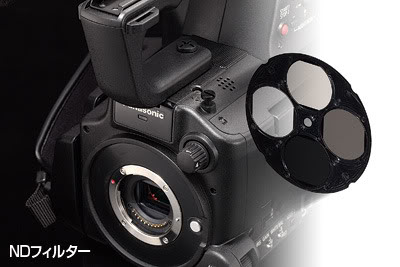
The Canon C300 ND filter assembly is actually quite complex. I remember being fascinated by it when I saw it in action at the Hollywood event. The mechanism is motorized with a mechanical backup. It flips the individual filters in and out sort of like playing cards. The traditional method on ENG cameras uses a manually actuated filter wheel.

BM seems to have very fast product design cycles. I wonder if maybe they are working on such a mechanism, but they just haven't perfected it yet in time for these products. Sony, Canon, etc. have decades of experience designing these kinds of mechanisms. Maybe some of them are patented.

C300 ND:
nd_filters__hero.jpg


Sony-nd-wheel.jpg
 
Speaking of built in ND filters it was hilarious to see Grant from GM gesticulating about how large a built in ND filter mechanism would be. Apparently he haven't seen Sony, Canon, Panasonic and Arri doing it...

And how much more do those cameras cost? And I'm sure he hasn't seen the engineering drawings as to how the others are doing it. He may have been exaggerating a bit but I think the point is that it may not be as easy of a thing to add as some of us think it is without dramatically driving up the cost of the camera. When you have a camera basically not much wider than the sensor mount how exactly does one fit a ND filter or set of filters that can be switched on or off? I know back when I used 2/3" ENG cameras the ND filters were on a wheel. The wheel takes up 2x the width and 2x the height of the sensor. On a skinny body that just seems difficult to me. I'm not sure how newer modern cinema cameras do it but if it isnt a wheel then it must be very complex to build. The FS700 seems to have a pretty large head in order to accommodate the ND filters.
 
The Canon C300 ND filter assembly is actually quite complex. I remember being fascinated by it when I saw it in action at the Hollywood event. The mechanism is motorized with a mechanical backup. It flips the individual filters in and out sort of like playing cards. The traditional method on ENG cameras uses a manually actuated filter wheel.

BM seems to have very fast product design cycles. I wonder if maybe they are working on such a mechanism, but they just haven't perfected it yet in time for these products. Sony, Canon, etc. have decades of experience designing these kinds of mechanisms. Maybe some of them are patented.

C300 ND:
nd_filters__hero.jpg


Sony-nd-wheel.jpg

Thanks for posting this. I have always known then to be used the older way with the wheel. I wasn't aware of the system Canon uses. That is pretty neat and could be something BMD could design eventually. Still can't be a easy or cheap thing to design however and adds a complex layer of moving parts that has to be done just right so things don't go wrong. Plus after factoring in the cost to BMD of OEMing really good high quality ND filter glass this cann't be a cheap or easy option for how they currently build cameras.
 
The Canon C300 ND filter assembly is actually quite complex. I remember being fascinated by it when I saw it in action at the Hollywood event. The mechanism is motorized with a mechanical backup. It flips the individual filters in and out sort of like playing cards. The traditional method on ENG cameras uses a manually actuated filter wheel.

BM seems to have very fast product design cycles. I wonder if maybe they are working on such a mechanism, but they just haven't perfected it yet in time for these products. Sony, Canon, etc. have decades of experience designing these kinds of mechanisms. Maybe some of them are patented.

C300 ND:
nd_filters__hero.jpg


Sony-nd-wheel.jpg

People don't realize this... it would add a pretty significant cost ot the camera to actually build one that's up to the standards of filters you can purchase for Matteboxes.

Ryan Walters did a comparison of the C300 internals versus TrueNDs... the TrueNDs won out. Just knowing that information, I would still choose to use external NDs as much as possible.
 
I understand your position but there are some of us who work in situations that don't allow the luxury of time but still want the features of large sensor etc. There is nothing to prevent someone like yourself setting a camera with built in ND to 0 and using your own. Having just sold my FS100 with no ND and then looking at the Cion and passing on it because of no ND I am a hard sell on no built in.With all due respect, I seriously wonder if indeed as you say the quality of those ND filters is "cheaper" because I have some very nice 4x5 NDs and a lovely B+W variable all by Schnieder a reputable firm. I will have a look later at the built in on my PMW300 and compare it with the MB 4x5. So with the cost between the F7 and the Ursa Mini being not much less when you add the VF and the handle and base kit and the cost of CF cards, well the F7 is still looking very very good IMHO and its out there working right now.

Also keep in mind the PMW300 is a 1/2" camera. Those sensors are a lot smaller than a super 35mm sensor and do not require as much glass or space and therefore exponentially cheaper to add to the camera. That and a fixed lens really helps as well.
 
wonder if we can use the ursa viewfinder on the bmc 2.5k ? i can not identify the connection, is this SDI ?
 
Perhaps I missed something but it seems the Mini has a histrogram but no waveform or false color.

For whatever reason Blackmagic has not added these items to their published specs yet.

Someone said their Video Assist recorder does indeed have Peaking, Histograms, etc...but none of that sort of thing is mentioned at all in their published info yet.
So the URSA MINOR may have all that.
 
IMHO the F35 is still the thing to beat. Let's see if this round of BM cameras can do it. Last BM4K was interesting but not enough DR... and of course this time we can try recording the F35 into the 7Q+ in 12bit DPX 4:4:4 mode.

Yeah I also think the F35 is the look to beat. But I also think the CCD has a lot to do with that. So I'm not sure I would hold my breath about the Ursa 4.6K beating it. It's not only dynamic range. I think also the color because the F35 CCD outputs 444 for real since it's not bayer. But I'm definitely curious to see footage from this new 4.6K sensor and know more info about the rated ISO.
 
Maybe I missed it, but I see 160fps in HD mentioned in the description, but not in the tech specs. Is that for all 4 models or just the 4.6k?
 
Back
Top