Blackmagic Raises Price of Many Items

I read an article a while back that said part of the skyrocketing real estate prices and inflation problem were because of millennials. They went "without" for so long, and then they finally hit a point in their lives where they had some money and were tired of doing without, that when they wanted something that they would buy it, no matter the cost(i.e: bidding wars that drove $250K houses to $450K, etc).

Eat my shorts, bro. I read this today:

Older buyers are now dominating the housing market. People from the ages of 55 to 74 accounted for 42 percent of home buyers, while the share of people from the ages of 25 to 34 accounted for only 14 percent of buyers during the survey year, a 10 percent drop from the same time period a year earlier.
https://www.nytimes.com/2022/11/03/realestate/housing-market-buyer-wealth-race.html

The survey year was July 2021 through June 2022
 
And I don’t fit into any of those demographics…. Lol

yes, I was just replying it to your post because you hypothesized that millennials had driven up prices, but it looks like it was actually boomers. basically, it looks like they're collectively cornering the market. but I do think that, as has been said, institutional investors planning to rent out homes bought a lot of property as well. I just don't know the numbers
 
Here's a National Association of Realtors report from last year on the home buyer demos.

https://www.nar.realtor/sites/defau...nd-sellers-generational-trends-03-16-2021.pdf


Since 2013, the National Association of REALTORS®has produced the
Home Buyers and Sellers Generational Trends Report.This report
provides insights into differences and similarities across generations of
home buyers and sellers. The home buyer and seller data is taken from
the annual Profile of Home Buyers and Sellers.

New to this year’s report is the share of Gen Z buyers and sellers aged18
to 21. While the share is just two percent for both buyers and sellers, the
sample was too small to show unique characteristics. However, this is an
indicator that home ownership is important to this generation and next
year’s report may contain a larger sample of Gen Z buyers.

Millennial buyers 22 to 30 years (Younger Millennials)andbuyers 31 to 40
years (Older Millennials)continue to makeup the largest share of home
buyers at 37 percent: Older Millennials at 23 percent and Younger
Millennials at 14 percent of the share of home buyers. Millennials have
been the largest share of buyers since the 2014 report

.

I also hear from unreliable sources that the Millennials are the ones buying Red Raptors. Still waiting to be confirmed.
 
Here's a National Association of Realtors report from last year on the home buyer demos.

https://www.nar.realtor/sites/defau...nd-sellers-generational-trends-03-16-2021.pdf

I also hear from unreliable sources that the Millennials are the ones buying Red Raptors. Still waiting to be confirmed.

that report is for 2019/2020 ("July of 2019 and June of 2020.")

their new report just came out. the article I read talked about the shift in the composition of buyers for the most recent year, from "July 2021 through June 2022"

https://www.nytimes.com/2022/11/03/r...alth-race.html

it indicates, or at least implies, that boomers priced millennials out of the market by bidding houses up
 
their new report just came out. the article I read talked about the shift in the composition of buyers for the most recent year, from "July 2021 through June 2022" .. it indicates, or at least implies, that boomers priced millennials out of the market by bidding houses up

Obviously. The 55-74 age group has accumulated far more wealth than younger generations over their lifetimes. The NYT piece is scrambling for numbers to fit the desired narrative. The NAR is actually trying to make sense of the available statistics.
 
I think this chart explains skyrocketing house prices:


I wonder how much people living longer, now, plays into there being less houses available? And honestly, outside of houses built by/for the really wealthy, I wouldn’t want to buy a “modern” built house. I’d be looking for something built 40-50 years ago or even more. The materials and workmanship(I can’t say craftsmanship) are just so shoddy today, it’s mind boggling, and people are paying premium prices for them, still.
 
Obviously. The 55-74 age group has accumulated far more wealth than younger generations over their lifetimes. The NYT piece is scrambling for numbers to fit the desired narrative. The NAR is actually trying to make sense of the available statistics.

What are you talking about, bro. The NYT piece is basically just a recap of the NAR report. Also, who do you think reads the Times? Boomers.

Nobody's surprised that boomers are richer than millenials. But it sure seems like many younger folks won't be getting on the path to homeownership because many older folks are buying investment properties
 
. I’d be looking for something built 40-50 years ago or even more. The materials and workmanship(I can’t say craftsmanship) are just so shoddy today, it’s mind boggling, and people are paying premium prices for them, still.

Yes, my house is from the mid-50s. Plaster walls, solid wood doors, solid steel tub. And all the VOCs have long since off-gassed. But there are layers of lead paint everywhere that we had to have encapsulated. For that reason alone my wife (and I as well) wishes we had bought something built in 1990 or later but it was out of our price range. Personally, I'm fond of '60s-'70s style, but our ranch has a lot of charm as well. It has a ton of metal windows with many small panes that remind me of Paris/French style (maybe because so much of that was rebuilt in the 50s, so they're contemporaneous?)
 
I wonder how much people living longer, now, plays into there being less houses available?

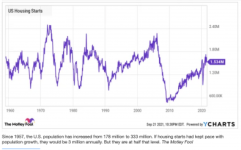
Probably. But also, for some reason, the rate of housebuilding is not keeping pace with population growth, which would probably lead to diminishing supply even if life expectancy stayed flat. this chart claims we're building at half the rate required to keep up with population

Screen Shot 2022-11-05 at 5.44.34 PM.png
 
My house was built in 1957, but oddly has drywall rather than plaster.

There's a lot of stupid, nonsensical stuff in the building codes, but also some good stuff that makes for a better home, and many of those revisions weren't in place until the 1990s.

My house doesn't have insulation in the exterior walls, which is a very poor decision for a region that gets down to -25° Fahrenheit, but the building codes didn't require it back then.

in the 1980s they switched from old growth timber to young growth, which is more prone to knotts and warping/twisting.

I believe that suppliers were allowed to sell old-stock materials containing asbestos after the ban, so a 1980s home could contain asbestos in it's linoleum and mastics.

There are some materials that were a bad idea from the start that should have never been used in constructions: masonite should never have been used for siding, orangeburg should never have been used for sewer lines, lead should never have been used for water supply lines, etc.
 
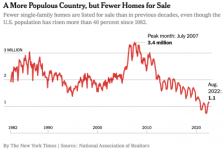
I think this chart explains skyrocketing house prices:


I really like statistics, but they can also be misleading. The graph you posted is for single-family houses. Sure, it does seem dramatic to see such a decline and I'm scratching my head wondering what that's about. But if you look at total house sales (condos etc.) the picture is different.

House sales.jpg
 
I really like statistics, but they can also be misleading. The graph you posted is for single-family houses. Sure, it does seem dramatic to see such a decline and I'm scratching my head wondering what that's about. But if you look at total house sales (condos etc.) the picture is different.

Well, total sales could just reflect churn, such as investment properties changing hands. Bigger volume when including condos could reflect increasing urbanization of the population, in which case you're right that there's nothing to see here. But I think that the chart I posted about homebuilding really does indicate that there are fewer single family homes relative to the population now than there used to be, even though demand for them seems quite healthy.
 
Price gouging, cars edition, aka there's a sucker born every minute

"Wholesale used car prices plummet as retail prices soar"

The wholesale price of used cars is falling off a cliff while the retail prices that car shoppers are paying is way up, suggesting dealers are making a killing while consumers are taking a bath.

Used car prices declined 2 percent from September in the first half of October and are down 10.3 percent from a year ago, according to The Manheim Used Vehicle Index published on Monday.

Wholesale used luxury car prices are down 13.5 percent while used sport utility vehicles are down 12.3 percent and pick-up trucks are down 8.4 percent.

Meanwhile, the retail price that car shoppers are paying for used cars has increased 7.2 percent since last year, according to the Department of Labor’s latest consumer price index.

The fact that dealers are paying less for cars than they were a year ago while shoppers are paying more suggests that dealers are holding onto the difference and are driving inflation in the used car market, economists say.

“Dealers don’t have to pass it on. They can make bigger profits,” Claudia Sahm, a former Federal Reserve banker and founder of Sahm Consulting, said in a message to The Hill.

“At the end of the day, inflation and how much prices go up – these are decisions made by businesses. Inflation does not just come down from on high,” she said in an interview. “You’re in a capitalist economy, so whether it’s a small business or corporation, they get to decide when they pass a price increase or a price decrease on.”

https://thehill.com/policy/finance/3723117-wholesale-used-car-prices-plummet-as-retail-prices-soar/
 
Back
Top