BlackMagic Hypershuttle vs. FS100 AVCHD

Postmaster

Dark Side of the Camera
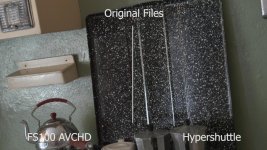
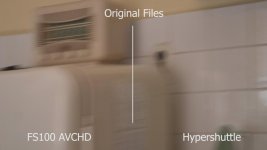
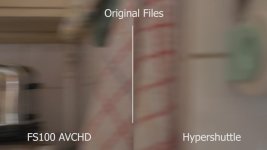
Okay, here comes the promised comparison between uncompressed recording via BlackMagic Hypershuttle and Sony´s flavor of AVCHD recorded to SD card in camera.

As you can see, you can´t see barley any difference at all. Only in fast motion some minor differences are visible. Eveb with excessive grading to the material (much mor that you would normally do) both material holds up about the same, before it falls apart.

That is good and bad. Good, because you can use cheap SD cards and AVCHD almost every time. Bad because I was spending money on the Shuttle and SSDs that I will use very seldom.

Actually I´m shocked how good Sony´s implementation of AVCHD is.

Frank

 
Thanks for posting and testing. More often than not the people who make the cameras are usually correct in offering their products. It is the internet fear of random numbers and comparisions to major motion pictures/broadcast that make us think bigger is always better. It is tests like this that really help to keep within a budget and still produce quality images.

The only thing I do not like about AVCHD is the stitching together of clips after a long record time. In Edius I can edit easily in realtime but if a recorded piece spans two clips some frames are missing at the end of the 4GB clip. So I need to run them through a clip join program to get the GOP straightened out. Not a huge deal but if you shoot a lot of longer situations it can be just more to do.
 
It is hard to judge from that video, but easy to get a headache.
A couple of questions. I understand that the Shuttle can only use SSDs, correct? and How many GB/hr for 1080p24?
 
That's why I'm going for the F3. Yes, a world of difference in price, but better internal processing and 10 bit set it really apart. If going for a "proper" camera vs a DSLR, I figure I might as well go for the best in class (by class I mean sub 15K)
 
Okay, here comes the promised comparison between uncompressed recording via BlackMagic Hypershuttle and Sony´s flavor of AVCHD recorded to SD card in camera.

As you can see, you can´t see barley any difference at all. Only in fast motion some minor differences are visible. Eveb with excessive grading to the material (much mor that you would normally do) both material holds up about the same, before it falls apart.

That is good and bad. Good, because you can use cheap SD cards and AVCHD almost every time. Bad because I was spending money on the Shuttle and SSDs that I will use very seldom.

Actually I´m shocked how good Sony´s implementation of AVCHD is.

Frank

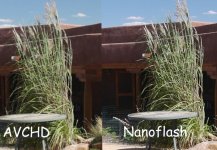
Interesting. I see the same indestinguishable differences between native FS100 AVCHD and the Hyperdeck. I also made a comparison between the Native AVCHD and my Nanoflash recording at I-frame only 280 MBPS. The results were rather astonishing. Here's an image saved from After Effects comparing the two...
AVCHD-Nano.jpg
 
Interesting. I see the same indestinguishable differences between native FS100 AVCHD and the Hyperdeck. I also made a comparison between the Native AVCHD and my Nanoflash recording at I-frame only 280 MBPS. The results were rather astonishing. Here's an image saved from After Effects comparing the two...
View attachment 38192

Wow. Major difference. Perfect test. High detail. Nanoflash does a great job.
 
Last edited:
Interesting. I see the same indestinguishable differences between native FS100 AVCHD and the Hyperdeck. I also made a comparison between the Native AVCHD and my Nanoflash recording at I-frame only 280 MBPS. The results were rather astonishing. Here's an image saved from After Effects comparing the two...

cuervo - Did you do your tests with the hyperdeck on the same shoot as the nano under same conditions ? I suspect you would see differences under the same conditions with the hyperdeck
 
no....they were different shoots

I gotta say that I'm feelin' a little uncetain about this "uncompressed" QT that the Hyperdeck uses. It's not recognized by many players, in fact, I can get it recognized only by After Effects. To call it "uncompressed" is a little misleading, since it really is 4:2:2. But, it's 10 bit recording an 8-bit source, as where the Nanoflash is 8-bit 4:2:2. I would hope the Hyperdeck just adds zero's to the 10 bit data stream, and not some Orwellian scheme. But, I am seeing much better images with the Nanoflash. Bitrates compare with a factor of 10x, i.e. the Hyperdeck bitrate is 10x the Nanoflash bitrate; and file sizes also differ by 10x, as one would expect.
 
Last edited:
hey Frank
could you provide a screen grab as in previous example with Nanoflash. It is too hard to judge when vimeo compression kicks in.
a high detail steady grabs would be perfect in full rez.

i am sure we will see some sort of differences between uncompressed and native codec.

thank u for your time
 
can you/ did you try secondaries on a fastish moving shot to look for compression artifacts in the real world?
 
cuervo,

Regarding I-frame MBPS settings on the nano. I believe 280 is the highest, in your opinion is there a really significant difference between say 100 and 280 MBPS?
 
Last edited:
hey Frank
could you provide a screen grab as in previous example with Nanoflash. It is too hard to judge when vimeo compression kicks in.
a high detail steady grabs would be perfect in full rez.

i am sure we will see some sort of differences between uncompressed and native codec. thank u for your time

Here you go:

These are JPEGs, since the Shuttle records interlaced, I deinterlaced the pics - loosing resolution on the way of course.

Sequence-02.Still004.jpgSequence-02.Still001.jpgSequence-02.Still002.jpgSequence-02.Still003.jpg

These are uncompressed and not deinterlaced straight from the timeline:
Download for uncompressed TIFFs: http://www.file-upload.net/download-3652175/Sequence-02.Still001.rar.html

Frank
 
no....they were different shoots

I gotta say that I'm feelin' a little uncetain about this "uncompressed" QT that the Hyperdeck uses. It's not recognized by many players, in fact, I can get it recognized only by After Effects. To call it "uncompressed" is a little misleading, since it really is 4:2:2. But, it's 10 bit recording an 8-bit source, as where the Nanoflash is 8-bit 4:2:2. I would hope the Hyperdeck just adds zero's to the 10 bit data stream, and not some Orwellian scheme. But, I am seeing much better images with the Nanoflash. Bitrates compare with a factor of 10x, i.e. the Hyperdeck bitrate is 10x the Nanoflash bitrate; and file sizes also differ by 10x, as one would expect.


First, thanks cuervo and Frank for sharing these tests and results


cuervo - Can you elaborate on "much better images with the Nanoflash" ? In what way?
 
since the Shuttle records interlaced, I deinterlaced the pics - loosing resolution on the way of course.


That could be the difference between the nano results that cuervo was seeing if he was deinterlacing it.

Frank - are you sure it's interlaced? Or is it hard telecined , or 24 PsF ?

How is your software/timeline interpreting it ?
 
Last edited:
hmmmm....
OK, let me try to define some specifics...
The FS100 AVCHD native files were imported directly into After Effects. I shot 720p60 footage with Frank's outdoor profile. Note: everything was shot progressive. The Nanoflash will accept progressive output footage if it is of the 720 variety, since that is part of the old HDMI specification. It's the 1080p60 stuff that is non-standard. The FS100 uses 1080p60 as the progressive HDMI output at 1080.
The Nanoflash footage was recorded to mxf. Since AE won't accept Sony 422HD mxf footage, i had to convert to DNx220x(10 bit 4:2:2 720p60) which was then imported into AE. No other intermediate steps were involved. Everything was imported into a 32 bit float project in AE. A comparison of the raw AVCHD footage to the MXF footage played back thru the Sony Clip Browser shows the same difference in detail sharpness as the image I posted.

As far as the Nanoflsh is concerned, my experience is that there is a continuous improvement in resolution as you increase the bitrate. You reach a point of diminishing returns around 220mbps. I'd be hard pressed to pick between 100mbps and 220mbps for static shots, but, if there's any panning motion, the 422HD codec starts to reach a bandwidth limit in the 100mbps. IOW, when interframe motion is involved, the higher the bitrate, the better. Bitrate choice selects overall bndwidth. So, if there is interframe motion, the compression algorithms get stressed more than for static shots. This manifests most when there's a lot of detail in the shot and a lot of horizontal panning. And all this goes without consideration for keying 422 over 420.

In terms of qualitative assesment of the differences in the images.....the nanoflsh 422HD mpeg 2 at 280mbps shows significantly sharper detail than the native avchd footage. I see no quantization artifacts with either format, and that blockiness is really noticeable with the 422HD footage at 35mbps.

I hope this helps everyone.
 
cuervo - I've used nano with other cameras, and I agree with your assessment

But my question was regarding your statments comparing the hyperdeck with nano. I'm at a loss as to why nano results would be much better than hyperdeck. If anything , I would have expected the other way around. ~250Mb/s I-frame MPEG2 is visually lossy, but you can still see significant differences between uncompressed if you pixel peep (or am I just misreading what you said earlier ?)
 
PDR...
I admit, I'm at a loss to explain why the Hyperdeck footage doesn't perform as well. I would have expected it to look really good. As I posted earlier, I know very little about the technical details of this "uncompressed QT" format. But, the more I play with the Hyperdeck, the more insecure I'm getting with that footage. I have no explanation other than empirical experience.

I really need to spend some time with the Hyperdeck and my EX1. I just haven't found the time, yet.
-Bill

edit:here's another bit of random info:
I ran a comparison test of the hyperdeck and the nanoflash with a sony NEX-VG10. In that test, the nanoflash showed worse moire than the native VG10 AVCHD. Curiously, the Hyperdeck footage looked really clean, i.e., not as much moire. I just was baffled by this result as i would expect the level of moire to be identical between the nanoflsh and the hyperdeck.....and I may just need to spend more time with the Hyperdeck.
 
Last edited:
Back
Top