Black Friday Specials

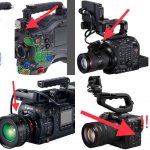
I find interesting that most pro video cameras, and even a lot of prosumer ones, have always put the EVF/LCD port on the front of the camera near the lens mount. But some reason cameras these days either have the HDMI port stick out on the operator's side, or straight out the back of the camera.
A6F2F1AB-B527-436A-B714-113285D53999.jpg
 
Ports on the operator side is a hangover from the DSLR days, that's why the C70 got it wrong?

As for straight out the back, that's because you're likely sending it out to a client/director's monitor.
 
Ports on the operator side is a hangover from the DSLR days, that's why the C70 got it wrong?
Assuming the C70 is just trying to not rock the boat, and going with the mirrorless layout. But Black Magic Pockets did it too.

As for straight out the back, that's because you're likely sending it out to a client/director's monitor.
Zcam has the HDMI straight out the back, right over the batter. Given the size they went for, idk if they could have put it anywhere else.
 
Assuming the C70 is just trying to not rock the boat, and going with the mirrorless layout. But Black Magic Pockets did it too.

Of course, the Pockets (the original and the 4K/6K too) was BMD's response to the DSLRs/mirrorless cameras. and their inspiration was taking directly for those. To make users the most comfortable when transitioning over.
 
maybe they don't consider it to be the operator's side because they expect you to hold it by top or side handle and not shoulder mount it. going back to the c300mk1 clamshell monitor and audio controls - that might be the only explanation. i've always had a devil of a time operating those audio controls. it really only makes sense if you're holding the camera by the top handle
 
Back to the deals subject, Menards has a 30-Gun Fire Safe on clearance for $380 (price might be different in other states). It's a little smaller than mine, but I think it will fit a Pelican 1510 laid horizontal. It's a budget safe, it will probably protect your gear from a common burglar, but not from someone who really wants to get in.
 
Good timing! I just posted something about ActionVFX.com and their deals on the post-production forum. You can get 50% off stock there. i was very pleased with the explosion elements I got
 
maybe they don't consider it to be the operator's side because they expect you to hold it by top or side handle and not shoulder mount it. going back to the c300mk1 clamshell monitor and audio controls - that might be the only explanation. i've always had a devil of a time operating those audio controls. it really only makes sense if you're holding the camera by the top handle

Even traditional SLR's put ports on the front or top of the camera body. It wasn't until HDMI moved in where the USB mini plug was that the left hand side of a DSLR got taken over by I/O ports.


SLR, Range finder, DSLR, and mirrorless would never put a port there if it were needed during hand held operation. The flash is on top, with a hot shoe, despite the fact that many people like offset flashes, there is no side port for a strobe or flash.
82fm2.jpg
Most of the reasoning for those ports on the side were for data transfer. Occasional tethering is done, but I can' imagine it is the favourite place for a plug to be sticking out during a handheld shoot. Maybe Sam Morgan can chime in about stills. Majority of the BTS I see of stills shoots being tethered is on a tripod.


With video in the field, I find even on a tripod, I prefer to be slightly offset to the left of the camera, not directly behind it. it allows me to see beyond the camera and get a sense of what to anticipate, as well as keeps my self closer to the CG of the pan, as well as keeping me close to the tripod adjustments of height and level. Not sure how many others get next to the tripod when adjusting the boom height of the legs, and your torso/face/head ends up pretty close to the camera at times, and if there is an HDMI cable sticking out, it can get knocked or bent pretty easily there. not that I have done that, but I certainly have to think about it when adjusting the tripod.

For how small the real estate is, Kinfinity did a good job with I/o ports, I feel.

Screenshot-2020-04-25-at-9.30.06-AM-740x571.jpg

Controls are on the side where hands and eyes need to be, and ports are on the front of the camera, a place where a photographer almost never needs to look or grip during filming. The rear ports are angled outwards, so that if handheld (camera in front of body), the operator can bring the camera close to their belly or chest without getting stabbed by an HDMI tail.

Sensor in a box is not my favourite, but if one is going to do sensor in a box, few have done it as well as the Kinfiinity Edge.

The Komodo claims to be "medium format/hasselblad forma factor" but when that camera is held, there are no controls on the side of the body. A Hasselblad is operated from the sides of the body, not the top. So, the Komodo is not a modern Hassy, it is an action cam.
 
Last edited:
Yes, mavo edge is a masterful design

Those front ports are usually plugged by right-angle cables. If you had a similar cable coming out the back or side, it wouldn't be as bad as an HDMI tail, no?

You can shoot tethered handheld. My pupil does (well, she's not really my pupil anymore. Now I'm just her occasional assistant)

Shooting stills handheld is often one hand on lens barrel, one hand on grip. Side cables somewhat less an issue there. Could be 2 hands on body, then more of a problem (but wireless tethering is becoming a thing anyway)

For stills it's all about right hand on grip- aperture SS AF-placement and shutter release are all there. ISO and wb are immaterial

But that's why I think its such a crap layout to bring to video: your hand won't be there and there are way more controls you regularly need

But still I think "operator's side" and left side/front placement is all about mounting on your right shoulder. If you're not doing that, I'd just like to have all the controls available and logically organized

I like the Sony interface with custom buttons and onscreen custom menu. It puts a lot of customizable controls within a couple presses. No way you could do it with gloves though...well, maybe some
 
Those front ports are usually plugged by right-angle cables. If you had a similar cable coming out the back or side, it wouldn't be as bad as an HDMI tail, no?
Sure, but need to have industry standard plugs on the rear, and they have to be made knowing that straight angle cables will often be the option available to the operator. It would be very annoying to have HDMI or SDI replaced by a proprietary Lemo port.
 
But still I think "operator's side" and left side/front placement is all about mounting on your right shoulder. If you're not doing that, I'd just like to have all the controls available and logically organized

No. The hands gravitate to the sides of a camera body. A camera is sometimes above eye level. So, having controls on the side is a good thing. have to pick a side based on cinema or OMB. Then a flippy touch screen for the rear style operators.

No use in confusing the matter. If someone wants to reinvent the QWERTY keyboard they should do it well. But until someone does, let's just stick with the QWERTY keyboard.
 
No. The hands gravitate to the sides of a camera body.

Not sure I agree... but my first camera was a 7D and I'm awfully used to having controls on the back and top. The canon DSLRs are pretty well laid out that you can push buttons without looking

But I agree that the left side is the best side generally. Good for shoulder and good for tripod. Rear might be good for tripod but not good for shoulder.

Part of the problem is how many damn buttons we need. If we used as few buttons as photographers, they could all be on the FS7 handgrip and be done with it

And there are so many configurations we shoot in... for shoulder or tripod I wouldn't mind having cables out the back. For palm holding and gut cam it's a problem

So yes, I agree with all your conclusions about left side controls and also cable placement. I guess I'm just talking about what works for me
 
To hold or to push buttons? There are no buttons on the sides of any stills cameras that I have used...or maybe there was a shitty little record button that was hard to push on some Sonys... I just think the statement is a little broad if an entire class of cameras lacks side buttons
 
To hold or to push buttons?

Look, if you are not holding a camera then why even have this discussion. When I am shooting in a car with a Russian arm, I am not going to care about whether the camera has a sculpted handle. Of course we are talking about cameras that are held. Until they invent silent flying drones, handheld makes for a very versatile way to capture images. There are plenty of ways to operate that require a different way of incorporating ergonomics. But typically, the physical controls end up where the hands are.
 
There are no buttons on the sides of any stills cameras that I have used...
Those buttons for DSLR's are on the side grip that is held from the side where the hand naturally holds and supports the box.


The stick gimbal has buttons where the hands naturally hold the stick.


The hasselblad is a tiny box, the controls are where the hands naturally hold and support the tiny box.


As far as "no operator side", how many DSLR's have the main grip on the left hand side?
 
. But typically, the physical controls end up where the hands are.

Agreed

.
As far as "no operator side", how many DSLR's have the main grip on the left hand side?

Agreed.

But - just to be a stickler - if you're shooting shoulder mount and your left hand is on the lens barrel or on a follow focus, you'll have to reach back to touch the side. You could instead have a control pad rigged beneath/beside the lens or hanging on your chest. It's not as if the buttons are already beneath your fingers in that case

Let's say you're cradling the camera in left hand and gripping side handle with right. You still have to reach over to the left side to push buttons. Pretty convenient. But if the buttons were on the bottom of the camera, you wouldn't have to move your hand. Unlike with a photo camera, there are a lot of shooting orientations, so the maxim of physical controls ending up where the hands are can never be true. But left side is the best side
 
But - just to be a stickler - if you're shooting shoulder mount and your left hand is on the lens barrel or on a follow focus, you'll have to reach back to touch the side. You could instead have a control pad rigged beneath/beside the lens or hanging on your chest. It's not as if the buttons are already beneath your fingers in that case
Whether shooting 8mm with a pistol grip, SLR, hasselblad, gimbal, or shoulder mount, the right is essentially the "support" hand. It is typically the more grounded of the two hands, and is most often controlling the trigger for rec or shutter release.

The left hand is the "free" hand and it is for controlling some of the camera settings and manual lens focus on the fly.

If the left hand is too busy focusing manually to reach back to change the ND, then you probably shouldn't be changing the ND at that moment anyway.


Best not to over complicate things by being confused. Tools are not a part of our body. They will always be a little uncomfortable. Typing on a keyboard is uncomfortable. Driving a car is uncomfortable. Using a shovel to dig dirt is uncomfortable. So, until cameras can tap into our brains, and as long as we have to physically interact with a sensor in a box, then things are never going to be perfect. But there are things that are more natural and inline with simple physics and human anatomy and nature. iPads now have qwerty keyboards.... but if our hands naturally land on our lap, shouldn't we have pants with half the keyboard on either pant leg so our hands can naturally type without having to be on a desk??? No. that is overthinking it and making something waaaaayyyyyyyy too specialized. There are things that work for the greater number of shooters, and they simple ideas that have been around since film.

One issue is, that design is not just functional, but it is also symbolic, and camera design often gets caught up in the idea of looking a certain way, so that consumers respond and purchase.
 
Last edited:
Let's say you're cradling the camera in left hand and gripping side handle with right. You still have to reach over to the left side to push buttons. Pretty convenient. But if the buttons were on the bottom of the camera, you wouldn't have to move your hand. Unlike with a photo camera, there are a lot of shooting orientations, so the maxim of physical controls ending up where the hands are can never be true. But left side is the best side

...so this camera design can never be mounted on a tripod? =)

Even if a camera is never going to be mounted on a tripod, you still have to work with physics. Have you ever picked up a cardboard box when moving things? Are you hands only underneath, or are some of your fingers or thumb wrapped up on the side? Which fingers are more mobile and tactile? The ones supporting the weight of the box, or the ones on the side, stabilizing the box? Chances are the the index finger and the thumb have more mobility than any of your other fingers in that situation. A camera can often be lighter weight, but you still don't want gravity working against you, I assume. So, having controls on the side still make sense for most camera designs.


Why reinvent the wheel?
 
I believe we're in agreement. I think the only outstanding question is if the shoulder-mounted position is considered the default, and if an alternative default was the reasoning behind some of these wacky camera choices, such as the c300 clamshell audio and, similarly, the FX6 audio inputs on top handle. Both those designs suggest to me that they expect people to spend a lot of time holding it by the top handle. Which I rarely do except for transport, and those choices displease me.

BUT if the shoulder mount is not default, the cable placement is somewhat less of a disaster to stick out the left side. Doesn't bother me at all on gimbal, for example, until I have to rotate the camera 90 degrees for vertical shooting (which the RS2 solves by having a vertical mode)
 
Back
Top