Biggest problems with the A7S Ii

As for the "test" you're referring to, if the shot is a close-up or wide shot with no context, and no comparison shot, who on earth can tell if it's APS-C or Four-Thirds?

But watching films or a TV program is exactly the same. You don't have a side by side comparison for every scene - each individual shot stands alone in exactly the same way as those photos in that test did. So by your own admission, you can't be expected to know the difference between FF and s35?

Where can I get one of these editing Leprechauns, by the way? Sounds like he could really liven up my edit bay on those all-nighters!
 
Last edited:
But watching films or a TV program is exactly the same. You don't have a side by side comparison for every scene - each individual shot stands alone in exactly the same way as those photos in that test did. So by your own admission, you can't be expected to know the difference between FF and s35?

Where can I get one of these editing Leprechauns, by the way? Sounds like he could really liven up my edit bay on those all-nighters!

Ah, but c'mon, not every shot in a film looks the same and there's context all over the place.

But I failed the test so how would I know what full-frame looks like? And my drunken midget Ray does all my full-frame editing so that gives him all the experience, not me. I just follow his commands.

So maybe you're right. What I've learned in this thread is that there is no "full-frame look". The guys shooting with full-frame cameras just have a little less depth of field in their shots sometimes.

So all the guy shooting the tv crime drama on Super 35 has to do is open his aperture a stop or so more every day and he's shooting full-frame now too.

In fact, he's been shooting full-frame all along and he just didn't know it. He's been shooting full-frame like a guy shooting full-frame with a little bit more depth of field, you see? So basically, everything everyone sees on tv is full-frame.

He should charge more and tell everybody he bought a full-frame camera. Just open up the aperture a little. He can turn in his memory cards to the editors at the end of the day and confidently tell them it's full-frame footage and they won't notice a thing.

(Ray just got insanely angry when I said that and started screaming and shaking his cage like crazy so I shot him with a tranquilizer dart to put him down for a while. I need to keep the gun close to me at all times.)
 
Last edited:
Ah, but c'mon, not every shot in a film looks the same and there's context all over the place.

Exactly. That is what cinematography is all about. Creating different looks and different shots in each scene that help tell your story. I'd warrant a guess that it is those different looks and techniques that you are actually seeing and noticing, as opposed to a FF camera used on a certain shot.

Perhaps some examples would help? What particular films or shows have you watched recently where the FF shots jump out to you?
 
What particular films or shows have you watched recently where the FF shots jump out to you?

Since you ask, "The Exorcist" (1973) is on Blu-ray in the background as I type this. Love the cinematography. Very dark, crushed blacks. Love Georgetown in the fall. Great colors. Great use of pan/zoom combo in the Iraq sequence and couple other places. I love the first half then I usually turn it off. Not because I'm grossed out or scared but because I find being stuck in that bedroom for an hour with that girl a little tedious after seeing it a few times.

I also love "Rosemary's Baby" (1968). That's probably my favorite film of all time. Favorite time-frame of films is late-60's to 1980. The closer I can get my digitally-shot stuff to look like that the more I like it.

"The Omega Man" (1971) is another big favorite--hence my screen name. Lots of cool 70's zooming.
 
Last edited:
Since you ask, "The Exorcist" (1973) is on Blu-ray in the background as I type this. Love the cinematography. Very dark, crushed blacks. Love Georgetown in the fall. Great colors. Great use of pan/zoom combo in the Iraq sequence and couple other places. I love the first half then I usually turn it off. Not because I'm grossed out or scared but because I find being stuck in that bedroom for an hour with that girl a little tedious after seeing it a few times.

I also love "Rosemary's Baby" (1968). That's probably my favorite film of all time. Favorite time-frame of films is late-60's to 1980. The closer I can get my digitally-shot stuff to look like that the more I like it.

"The Omega Man" (1971) is another big favorite--hence my screen name. Lots of cool 70's zooming.

I think perhaps what you are responding to is the fact they were shot on film.
None of those films you mention were shot Full Frame. The Exorcist and Rosemary's Baby are 1.85:1 aspect ratio, which is standard 35mm aspect ratio. Essentially Super35.
Omega Man was shot anamorphic 2.35:1. Anamorphic looks characteristically different because of the shape of the lens and the de-squeezing needed to stretch the image horizontally. Perhaps the richness of blacks and the organic grain and the difference in lighting style from the 1970s (film was at least two stops less light sensitive back then compared to today) is what you are responding to.

Lenses were not as sharp or contrasty either, because they didn't have the anti-flare coating of modern lenses. To attain that look, I suggest using lenses made in that time period (which I think those Minoltas you own qualify), lighting with less fill light to create richer, darker shadows, and shoot at 320 ISO or lower.
William A. Fraker, the DP of Rosemary's Baby was also a big fan of diffusion on the lens. You could experiment with different types of lens filters to see what you like.
 
Last edited:
" ... 1.85:1 aspect ratio, which is standard 35mm aspect ratio. Essentially Super35."

Huh? But if you translate that to today's digital world, isn't Super35 more like a APS-C sensor and using a smaller lens glass? Or in the case of a full-frame lens, using a piece of the glass cropped from the center? And if so, the end result is that it doesn't look the same to me as using a full-frame lens and full-frame sensor.

Lenses were not as sharp or contrasty either, because they didn't have the anti-flare coating of modern lenses. To attain that look, I suggest using lenses made in that time period (which I think those Minoltas you own qualify), lighting with less fill light to create richer, darker shadows, and shoot at 320 ISO or lower.

Yeah, I've noticed that too--hence the Minolta's. They fit into my meager budget as well. I wish I could shoot at 320 ISO but I can't get the DR I need. Been using S-log3 and a LUT and it's the closest I can get with with the 8-bit A7SII. I can't get the fat look of film but I keep trying. The A7SIII with 10 bit would help!
 
Last edited:
Huh? But if you translate that to today's digital world, isn't Super35 more like a APS-C sensor and using a smaller lens glass? Or in the case of a full-frame lens, using a piece of the glass cropped from the center? And if so, the end result is that it doesn't look the same to me as using a full-frame lens and full-frame sensor.

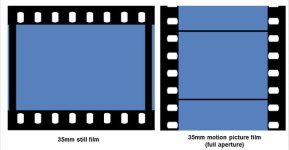
I'm a bit confused by your question. The size of 35mm film negative that movies are shot on is roughly the size of an APS-C sensor. Movies are not shot on a Full Frame size negative. Unless you count movies shot on 65mm or VistaVision, which are rare. 35mm movie cameras run the film stock past the lens vertically, so the frame size is roughly APS-C. Still images taken on 35mm still cameras (which Full Frame lenses were designed for) run the film through horizontally, so the negative size is larger. That is Full Frame.

CropperCapture88.jpg
 
Last edited:
I think I've caused the confusion because I've been referring to "full-frame glass" and "full-frame sensor" interchangeably. This probably comes from me using Sony digital cameras where they call some of their sensors "full-frame". I thought you were equating the Super 35 film process and look it achieves with the digital equivalent of Super 35 digital (basically APS-C) and saying it was the same. If that were true, the film guys would have had to not use the whole lens but crop from the center, correct?
 
I think I've caused the confusion because I've been referring to "full-frame glass" and "full-frame sensor" interchangeably. This probably comes from me using Sony digital cameras where they call some of their sensors "full-frame". I thought you were equating the Super 35 film process and look it achieves with the digital equivalent of Super 35 digital (basically APS-C) and saying it was the same. If that were true, the film guys would have had to not use the whole lens but crop from the center, correct?

Cinema lenses for 35mm film have a smaller circle than Full Frame lenses. They are designed for the size of Super35 film gate. So their sharpness and resolution are optimized for that size.
It's only been since the DSLR revolution that still lenses have been used for cinematography.

The reason high-end cameras like RED and ALEXA use a Super35mm sized sensor as opposed to Full Frame is largely because existing cinema lenses are optimized for that size, and because cinematographers are used to them (i.e. they know what field of view a 24mm will give them on an APS-C sized sensor because it's the same as a 35mm movie camera.)

To clarify, if you put a classic cinema lens on your Full-Frame Sony A7Sii, it would porthole. It wouldn't cover the entire sensor.
More modern cinema lenses have been designed with a wider circle to cover Full Frame sensors.
 
Last edited:
Interesting stuff. Thanks. I really like the look of these big still lenses so I'm happy to use them. Given my budget, I like the Minolta's for now and I don't even want to look at anything more expensive because I get that "not good enough until I buy 'X'" feeling that stops me from shooting.

There's a pro audio forum on the web filled with A-List sound guys and a DSLR guy came on boasting that he'd spent $7,000 on lenses for his feature film and now wanted help with sound. One of the sound guys replied, "$7,000? Is that the 20mm?" LOL.

Yep. I bought a set of Nikon primes from the 80s. And I have an odd assortment of old lenses. Some better than others. But the Nikons really nail the look of my favorite films from the 70s and 80s. With proper lighting and composition, of course.
 
I wish I could shoot at 320 ISO but I can't get the DR I need. Been using S-log3 and a LUT and it's the closest I can get with with the 8-bit A7SII. I can't get the fat look of film but I keep trying. The A7SIII with 10 bit would help!

Do you use ND filters when shooting SLog3 outdoors? My 320 ISO comment was more about the style of lighting for indoor stuff. Shooting at lower ISOs and then using bigger, brighter lights replicates the look of older films because at higher ISOs, more ambient light from the surroundings tends to creep into the shadows, creating a less contrasty look.

Also, I use a Sony FS5 and an A7Sii, and I have found one way to make it look more filmic is to crush the shadows a bit. Adding the LUT works, but it still seems to have more shadow detail than film. So I add fill light by using bounce or an actual fill light, then crush the shadows using curves in post. It looks more filmic to me.
 
Do you use ND filters when shooting SLog3 outdoors?

Yes, all the time.

My 320 ISO comment was more about the style of lighting for indoor stuff. Shooting at lower ISOs and then using bigger, brighter lights replicates the look of older films because at higher ISOs, more ambient light from the surroundings tends to creep into the shadows, creating a less contrasty look.

Yes, but even indoors I prefer log for the extra DR I need for light bulbs in the shot, daylight windows, etc..

Also, I use a Sony FS5 and an A7Sii, and I have found one way to make it look more filmic is to crush the shadows a bit. Adding the LUT works, but it still seems to have more shadow detail than film. So I add fill light by using bounce or an actual fill light, then crush the shadows using curves in post. It looks more filmic to me.

I haven't tried that. I know what you mean about using a LUT and there's still too much shadow detail. To really crush the blacks, I've been adding something called "film gamma" from the NewBlue ColorFast plug-in. It looks similar to contrast but it doesn't blow out the highlights.

I've tried methods like changing the contrast center on a contrast plug-in but I couldn't get good results. I've also tried lowering the "narrow" black gamma in-camera. That gets me closer to crushed faster so I might go back to that method--but it's baked-in so I would test it first.
 
Yes, but even indoors I prefer log for the extra DR I need for light bulbs in the shot, daylight windows, etc..
Cool. Log workflow definitely helps maximize a camera's DR. And a less contrasty look with more information in the shadows is one of the characteristics of a modern, digital look. It's not better or worse than film. It's just different.

My idea of shooting at 320 ISO isn't always practical. Usually it's about lack of budget or lack of time to light with bigger, brighter instruments. So I get it.

I just want to bring up one thing. If you are lighting a room with movie lights that also has practical light bulbs and/or daylight windows in the shot...and you are lighting the subject in the frame to be exposed properly at 3200 ISO, then you will definitely need the extra DR of SLOG3 to handle the highlights of the bulb and the bright window.

However...320 ISO is 3 and 1/3 stops less sensitive to light than 3200 ISO. So if you set your camera to 320 ISO, and lit and exposed the subject for that, your light bulb and your daylight window would now be 3 and 1/3 stops less bright. So lower ISOs tend to tame bright practical sources, if you light with brighter lights, thus squeezing the world into a narrower dynamic range the camera can handle. And because stray light coming from the windows and practical lights is now 3 and 1/3 stops less bright, your shadows become darker and contrastier. Like film.

To get the best of both worlds, you could shoot SLOG3 indoors with an ND filter on the lens. Then you'd need to use more light, thus squeezing the world into a narrower DR, but the log curve would still render pleasing DR and highlights.
 
Last edited:
Huh? But if you translate that to today's digital world, isn't Super35 more like a APS-C sensor and using a smaller lens glass? Or in the case of a full-frame lens, using a piece of the glass cropped from the center? And if so, the end result is that it doesn't look the same to me as using a full-frame lens and full-frame sensor.

Yes, Super 35 (either film or digital) is similar in size to APS-C sensors. Motion picture film is run vertically through the gate, rather than horizontally as is stills cameras, which reduces the available width and image size. Super 35, the standard film format that most Motion pictures of the past few decades has been shot on, was adopted as the standard size for digital cinema cameras as well. Other film formats such as Academy, Widescreen, etc had similar widths but different heights - essentially all roughly the same size though. Motion picture film is and has always been a smaller image size than full frame photos. This stands true in film as well as digital, save for rare exceptions shot on 65mm film (which is a larger specialty size analogous to Medium Format stills cameras).

Full frame had nothing to do with motion pictures until the 5DmkII included a video mode about 8 years ago. An A7sII of today has a much larger image size than the film cameras used to shoot pretty much every major motion picture - from Citizen Kane to Star Wars to Apocalypse Now to Titanic. Though Super 35 is still the accepted standard size for films. You're more likely to see full frame footage on Discovery or National Geographic, where they may be using 5Ds or A7's as smaller B/C cams or crash cams in difficult doco conditions. You're probably even more likely to see full frame footage on the news these days than in films, as many field journalists use something like a 1Dx to shoot both stills and video while on assignment. In those situations, you'd probably never know it was full frame, because they will be shooting deep-focus ENG style.

I thought you were equating the Super 35 film process and look it achieves with the digital equivalent of Super 35 digital (basically APS-C) and saying it was the same. If that were true, the film guys would have had to not use the whole lens but crop from the center, correct?

Super 35mm film is the same as Super 35mm digital/APS-c. And they've never had to 'crop' the lenses because cinema lenses have always been designed for the smaller film formats used in motion pictures.


So, knowing all that, do you still think it is full frame that you are seeing when you watch AMC or Turner Classics?
 
Super 35mm film is the same as Super 35mm digital/APS-c. And they've never had to 'crop' the lenses because cinema lenses have always been designed for the smaller film formats used in motion pictures.

That's what I gathered from his previous explanation.

So, knowing all that, do you still think it is full frame that you are seeing when you watch AMC or Turner Classics?

From Wikipedia: "Super 35......was adopted by Hollywood starting with Greystoke in 1984, under the format name Super Techniscope. Later, as other camera rental houses and labs started to embrace the format, Super 35 became popular in the mid-1990's..."

This all started because I said I believe I can see a difference between smaller sensor/lens footage and larger sensor/lens footage. I'm excluding close-ups and wide shots, shots with no context, etc.. We can argue forever. So what?

The fact that the audience (the most important people of all to me) couldn't see or care about any of this reminds me how pointless it is.
 
Last edited:
From Wikipedia: "Super 35......was adopted by Hollywood starting with Greystoke in 1984, under the format name Super Techniscope. Later, as other camera rental houses and labs started to embrace the format, Super 35 became popular in the mid-1990's..."
.

Here's where multiple meanings of the same term cause problems. The Wikipedia entry is referring to what is also known as "3-Perf Super 35", which is a widescreen alternative to anamorphic widescreen. Previous to Greystoke, 2.35:1 widescreen was attained only by shooting with anamorphic lenses. "Super 35" in this definition, only used 3-perf instead of 4-perf, so the aspect ratio was 2.35:1 but it used spherical lenses and, more importantly for the studios, it used less film.
James Cameron was a big reason for the success of Super 35 (the widescreen definition), as Terminator 2, True Lies and Titanic were all shot in that format.

Honestly, this was the only definition of Super 35 I knew about until the DSLR revolution, when movie film size needed to be differentiated from still camera film size. So, yes, confusing!
 
DVBrother, if you want to delve further into this, here's a couple of camera guys talking about anamorphic and Super35 from here:

http://www.cinematography.net/edited-pages/[cml] Anamorphic or Super 35.htm

"It seems to me that there is more of a difference between Anamorphic and Super 35mm 2.35 films looks than can be explained by either the distortions inherent in anamorphic taking lenses or the depth of field. They seem to render things in a much more dimensional way. I shoot frequently with anamorphics ( I own a russian set ) and whenever I investigate doing a project in Super 35, I put up the lenses, look through the finder and instantly feel somewhat disappointed with what I see.

Hypothetically say you shot with a: 50mm anamorphic at T8-5.6 and a 24mm flat prime lens at T2 in the super 35mm 2.35 format both focused at 10 feet. The lenses / formats would produce a very similar horizontal and vertical field of view. The depth of field would also be very similar. Would these images be nearly identical? I know that those might not be any ones real world stops for the same scene... But what would account for any differences?"


"The perspective will not be the same. The angles may match but your relationship (the cameras relationship) to the angle will not be the same. That is to say, if you picture a wedge representing your field of view, in the anamorphic scenario you will be further inside of the wedge than in the non anamorphic. In the non anamorphic you will be closer to the 'point' of the wedge. Therefore the sense of peripheral vision as will not be the same. Some would argue that this is why anamorphic looks more natural or realistic than non anamorphic."
 
Some would argue that this is why anamorphic looks more natural or realistic than non anamorphic.

The bokeh is completely different between these two set-ups, and I wonder if the unusual anamorphic bokeh is partly why the anamorphic image might be more interesting.
 
DVBrother, if you want to delve further into this, here's a couple of camera guys talking about anamorphic and Super35 from here:

"...Therefore the sense of peripheral vision as will not be the same. Some would argue that this is why anamorphic looks more natural or realistic than non anamorphic."

Yes, there's a big difference in look between spherical lenses and anamorphics. And between these two, I'd say there's an empirical difference between two shots with identical field of view. For exactly the reason the posters in that thread mention. Anamorphic oval bokeh has always looked cool. And the flares are cool. And the way shallow DOF looks. Plus, so many of our favorite movies are shot anamorphic, so shooting that way on your own projects imbues them with a "blockbuster" look.
However, they are a pain in the ass to focus. And very often, the budget solutions for anamorphic on DSLRs (like SLR Magic Anamorphot) just look soft or weird. I have yet to shoot anamorphic because I have yet to figure out how to use them in a way where the deficiencies of budget solutions don't undermine using them in the first place. And honestly, doing a focus rack on an anamorphic is impossible. I admire those who have fought through the pain and used them on a project.
A cheap solution to creating the sexy oval bokeh is to cut out an oval on black construction paper and attach it to a clear glass filter and then put it on the lens.

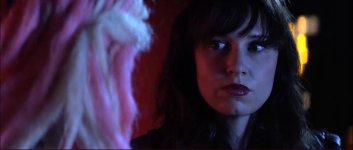
I have done this on a few projects. Here are some examples from one.
Screen-Shot-2017-01-30-at-12.08.42-PM.jpg

Screen-Shot-2017-01-30-at-12.09.33-PM.jpg
 
Back
Top