Best Solution For Very Large Green Screen in a Sound Stage

NBside

Active member
Hey everyone..I feel like I have been posting a lot for tips and suggestions since I started production on this new film project.. but here goes..

I recently acquired a large space, formerly a high school gymnasium, for the purposes of developing a sound stage. Over time, we will be working to acoustically treat the space, painting, building a lighting grid, and etc.. My big question, however, is this...

I want to build a very large green screen in the space. Aside from my own projects and productions, I want to have the facility available to rent at a very cheap price to other filmmakers in the Pittsburgh and surrounding areas. I do a lot of green screen work, but Id also like the space to be useful for building sets and other production requirements. Initially, my thought was to just build a gigantic wall and paint it with the green. I started thinking though, that it might become an issue for projects that dont require any chromakeying (i.e. constructing interior sets). Typically, most sound stages are painted flat black. In addition, when I have been in some of the major Hollywood studios (Sony in Culver City, for example), they typically had constructed giant green screens on trusses that were placed wherever needed inside the stage.

What would everyone suggest to be the best method? Just building a permanent chromakey wall, or finding a way to construct large, moveable, green walls? Obviously, I would prefer the latter, but Im not quite sure of a method to doing so. The ones I saw at Sony, for example, were fabric...much like the small kits that we are all accustomed to. In my searches, however, I haven't been able to find a fabric larger than 15'x45'. Ideally speaking, I would like to have a screen that is roughly 20' in height, 50+ feet in width, and about 50-60 feet in length away from the screen.

Developing this space is going to be a lengthy and time consuming venture, but I would like to do it right. My area outside of Pittsburgh is very limited on production resources, so hopefully I can turn this into a great asset for all aspiring filmmakers in my region.

Any tips or suggestions?

SIDE NOTE: The space also has a beautiful stage at the end of the basketball court space that is roughly 50'x35', also, it comes with a fully equipped cafeteria...score! Furthermore...running parallel to the basketball court is 12 rows of raised bleachers that I think would be a great place to position lighting, and build a fixed dolly track. I will post pictures over the coming weeks. Once I do measurements I will post a rough-to-scale diagram of the space as well! Thank you all for your great insight and knowledge!
 
32Ten (formerly Kerner, formerly Industrial Light and Magic), has extensive experience with blue/green screen. Up until their life as 32Ten, they often used very large cloth screens on the stages. Of course, they also used hard screens as required for whatever they were shooting. Hard screens are used outdoors.

In their current facilty, they have a two wall green CYC. Take a look here for ideas: http://www.32ten.com/. The stage with the CYC is perhaps the most historic stage for groundbreaking special effects over the last 20 years.

There is nothing special about the space except it has a lot of power for the lights and a grid. It is not painted black. It has no sound treatment (hard walls). Take one of their classes and get a first-rate lesson on how the best in the business do it.
 
The Rag Place 818-765-3338, can make any size custom. This year I worked on a tv series which setup a 60' wide by 20' high green in a warehouse. They just ran lines to the perms to hang the rag, nothing special, worked great, cheap, and much better acoustics vs a hard cyc.
 
Thanks for all the replies!
Ive heard of 32Ten before, actually, though I never thought to check them out, and I didnt know they had classes. So very impressive and undeniably legendary!
I'm going to have to look into some of their classes for sure!

Like I said, developing the space is going to be a long-term project, however, the first thing I am going to do is get the green screen stage underway. Ideally, I would like to use it for my project shooting late summer. I will end up painting it though, because well...its painted like a school basketball gymnasium right now, so if for any other reason, Id like to give it a different look, and hopefully a more practical one. Also, being a gym, it has the traditional basketball court echo to it. My original background is in audio engineering, so treating the space wont be too much of a chore. It doesnt have to be perfect, but at least resolve the reflections.

As it pertains to the screen...Im thinking right now, that I may do both. Im thing perhaps building a CYC on the back wall, and let it extend out to maybe 30& of the stage floor. Then, build a couple of different fabric screens of various sizes that I can move around as needed, or break them down entirely when the space is needed for set construction.

You're absolutely right, David, budget is the primary dictator of this, well, any project. Unfortunately, prior to obtaining this space, I had leased another large property that I had been developing over the past year and a half. It was an amazing and beautiful building with over 30,000 sq feet of usable space, however, we continued to run into roadblocks with massive structural problems with the property getting uncovered as work progressed. So sadly, I dumped a ton of money into a space that I eventually got rid of, so now Im having to work on a lot tighter budget.

So, when it comes to building a Cyc... would the best suggestion be to just frame off the space with 2x4s and cover it with, say, particle board, and paint it up? Ive been trying to think of the most effective yet affordable method of working that out.

@davidwinters.... Thanks for the suggestion on The Rag Place...I will definitely look into them for the fabric screens. Im amazed at what some companies try and charge for just a 10'x30' fabric...I saw upwards of $300! I only paid $100 for mine, with stands!

Thanks again for all the input!
 
David is correct about better acoustics using rags vs hard cyc. I worked a very large studio that had large hard cyc as well as acoustic curtains on runners. A few years back a fresh new crop of young crew moved in and decided to remove all of the "old school" moveable curtains. Now the studio sounds like a live drum room.
 
Absolutely. Fabric will certainly go a long way in helping to balance out the acoustics of the space. Fortunately, i still have a bunch of acoustic treatments left over from building my audio and editing suites. Once I RTA the space, ill be able to surgically treat the walls, corners, and ceiling. Theres no way ill be able to completely flatten out such a large space (brick walls, concrete and wood floors, and large steel ceiling), however, taking the edge off of it is all i can ask for.

Whether i end up building a cyc or not, im definitely still going to build some large moveable screens out of fabric, especially since i would like to have some large blue screens built as well.
 
4x8 sheet materiel used for a hard cyc is typically 1/4" luan, possibly thinner in corners. Luan is less costly vs plywood and has a smooth finish which is easy to paint.
 
Thanks for the tip on the boards, David..I appreciate it! Im going to have to google around, and see if someone had posted build plans for building a medium sized cyc. Im sure they exist out there somewhere. Generally speaking, its not hard, but would be helpful to see how others have done it.

@Dadlin...You know, to be honest...Im not sure if the facility is equipped with 3 phase power or not. I know when originally inquiring about the electrical, my associate who looked at it for me said it should be more than adequate. They had a stage in the facilities at one time, and had a pretty descent lighting setup of their own. Plus I know that prior to us going in, the county had been using the space for a variety of purposes and upgraded it significantly, including HVAS, plumbing, and a new roof to my knowledge, so perhaps the electrical has been upgraded at some point as well. I will most definitely look into it, and you're right, that it a very serious factor.
 
Many of the cycs I've worked on are made from the back-side of linoleum, as it can be curved nicely.

One problem with fabric - shooting on a RED or doing high-end film scans, seems like you can key anything. With a more "average" 1080 camera, wrinkles really need to be fought with. Fabric panels need a way to tighten the fabric as it's steamed if you want 'em perfectly flat. After shooting a lot of greenscreen this year, I'd much prefer hard painted set walls. Seamless chroma paper is nice, but the color is a little dull in my experience.

Good luck with your facility though - sounds awesome!
 
Hey Michael, thanks a lot!

Ive actually been doing a ton of Google'ing and have come across many methods of building rather affordable cyc walls. From what I have seen, masonite appears to be the preferred material, however linoleum is a great suggestion as well. Just out of curiosity...considering this is a green screen cyc, and not the traditional white cyc, I wonder how important the typical "curve" factor is. Im curious if just building a standard straight wall, and then a flat floor that meets at the bottom, would be adequate. Then, I could figure a way to build a smaller curve to connect the two if need be. The only reason I say this, is because this appears to be the most complicated and expense portion of the build. Granted, I dont have any plans on skimping anywhere on this project, but that was just a random thought.

I agree with the fabric point, too. I shoot mostly on DSLR's right now, and wrinkles in fabric are one of my greatest headaches. I pretty much have to de-wrinkle after every couple of shoots. I thought about even building hard walls for my portable screens, and just putting them on frames with casters on the bottoms. I havent used the chroma paper yet, though I have used neon green poster boards before when shooting some car scenes and didnt have my full sized screen handy. It worked, but isnt something Id like to do if I dont have to.

Thanks again for the reply!
 
For future readers of this thread.........someone should chime in and describe what a CYC is. They can be built very small scale (I built a 4' wide one for product photos) and larger than 20' wide.

But I will let you guys describe it and why they can be an invaluable VFX/Film tool.

NBside, the curve is crucial to a CYC. when you don't have one, it's not a CYC. The curve is there to eliminate the horizon line and blend the color between the horizontal and vertical planes.

Without the curve, then it just a room painted or backdropped with Chroma color.
 
Last edited:
The curve - for greenscreen - would be pretty nice; it's much harder to get an even green in a hard corner (done it before) and then you will always have a hard floor line to rotoscope out.
 
@Doc... You're correct. The curve is what makes a Cyc a Cyc. I should probably have explained myself better when stating my question. What I really meant to say was, Im curious if just building a flat green wall and floor would be as effective. Not only for the fact of having to build the perfect curve, but mostly, for the fact that if I needed the space for something else, I could just cover up the floor...or build one thats can come apart rather easily, so I can use all of the space for set construction. Re-reading my post, I guess I really didnt detail that well enough. My apologies.

I am, however, still leaning more towards the thought of building a cyc...even if I have to scale down my initial plan for size, I think it will be most adventageous. That, and several moveable fabric screens or walls.

@Michael...You're right about the hard corners, too. That why I was thinking, that even if I did just build a flat wall and floor, that I would stretch fabric over the corners to simulate the curve. Like I said, mu biggest concern was the ability to use as much of the space for every facet of production possible. I didnt want to limit my set construction area, for productions that dont require the green screen. However, Im going to have to bite the bullet and decide which is most important and do it right.
 
Oh.. and for future readers.

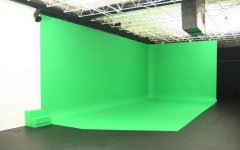
A "Cyc" or "Cyclorama" is a background wall constructed of curved surfaces to create the illusion of no perceived end or beginning, and eliminates a horizon line. This makes it impossible to differentiate between where the floor ends and the wall begins. Some cycloramas also incorporate a curve at the top, to prevent distinguishing where the wall ends and ceiling begins. Cycloramas can be done in any color, and not used solely for the purposes of green screens, to create an infinite background. Commonly, cycloramas for film purposes are generally "chroma-key green" or white, however, it is possible to create the illusion with any color. A lot of people compare a cyclorama to be like being inside of a giant egg.

The below image is an example of a chroma-key cyclorama.

page13_2.jpg

**image borrowed from digitalfilmstudios.com**


-I hope my definition was descriptive enough...perhaps someone can add to my explanation-
 

Attachments

  • cyc.jpg
    cyc.jpg
    21.2 KB · Views: 0
I should also note, that a cyclorama can consist of as many walls as the builder sees fit. From one flat wall with a curve connecting to the floor, to two walls, like the image at the bottom of my previous post, to 3 or 4 walls. Also, as Doc mentioned, they can be built in a wide range of sizes. From a few feet in width, to some of the larger 100+ feet walls used in major film studios. The design and size is all up to the builder and what meets their desired needs.
 
You might check out a vendor like Rosebrand. They sell keying fabrics and could probably sew up any size you need
 
Back
Top