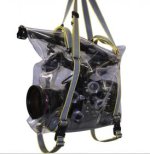
FS7: Best protection against rain and spray-water?

Publimix

Veteran
I have to film on a boat, salty water. What is the best way to protect the camera from spray-water?

I know the Ewa marine bag, but that is a bit expensive (need it only 1 or 2 days).

Is there some home-made solution or less expensive solution to avoid water getting in the camera?

Thanks
 
Last edited:
I lived on sailboat year around for 4 years (North Atlantic) much of that time spent shooting a seafaring film. (the other half spent having the time of my life). I had the EX1 most of that time with some various B cams.
First question is what kind of boat? Makes a big difference. I knew how my hull behaved in a seaway so I could predict most spray and wind whip.
Get to know the vessel and as you do - you can in a few days be almost totlally free and shoot normally. I was all over the boat all the time, in the dingy (best place often)
First comment is dont over worry it, cams on boats are a fine fit -you just need to take some disiplined precautions that you never vary from.
Pre-eminent on that list is bagging the cam alow and aloft (above and below deck)

allows keep an open stash bag at hand above deck in the helm area - when you go forward underway just use your body to block unexpected spray. dont try to carry much with you forward- have a care for yourself first. the rule is one hand for yourself and one for the ship. dont get caught have duty to perform and shots to get. in stash bag keep a big towel. cams will take some splash and it's removed well fast you might be ok. salt is a killer yes- but you still have a chance. keep 1 Qt of alcohol in stash bag and douse it if it gets whacked. then dry. TURN IT OFF is first thing on exposure to salt. but remember in 4 years THAT never happened to cam - it did happen to other junk. Thats how I learned.

Don't try to shoot with it bagged except in rough conditions. Then, a roll of saran wrap is about the best thing, you can preserve alot of function. and keep cam so you can hold it.
I used many 5lb ziplocks - the Blue ones - three to a box maybe they are 25 or 50 lb- just big damn zip locks

Rice - in all kit boxes keep a cup of rice in an old sock- its an effective deccessicant. in emergency (like with ihpone) turn off power. douse with alcohol - dry with towel - plung into tupperware or ziplock of rice- keep it sealed tightly 24 hrs.

what else?
 
Hi Caleb thank you.

The boat is a fishing trawler. Spray wil be the enemy. Had to use google translate for the saran wrap. I'll take it with me, and some rice, and rubber bands.

And if it gets rough i'll use the gopro.
 
The FS7 has air ports for cooling on either side of it's body that probably shouldn't be covered tightly. I've heard the FS7's internal fan kick into overdrive when I blocked one, perhaps both, while cradling the camera.
 
I have nowhere near the on-boat experience of Caleb. But when I've been in splashy environments (standing in water at the beach, heavy rain while shooting sports, a bit of boat stuff), I've had good success with ewa-marine PVC bags. Waterproof to about 10 meters, some access to controls (enough for us). Note that I haven't used one of their bags with an FS7.

Worth at least a gander, I think.

More info an a couple pictures here:
http://www.ewa-marine.com/index.php?id=742&ca=&ra=&ext=&model=Sony PXW-FS7&L=0

ewa-marine_fs7_bag.jpg
 
you can cut the saran wrap roll into more usable lengths on a band saw if you need to get under top handles and in and around things.

My son , an AC, uses clear 55 gallon trash bags (from amazon) and gorilla tape for proofing Alexas/Dragons to get hands up inside but maybe not so much a seagoing rig, the clear bags and gorilla tape may be worth looking into. Point is to keep the grabability quotient high. nothing loose or flapping for me
 
Publimix,

I would buy a rain cover or if you are getting doused all the time a under water housing. Having filmed on and around boats for 35 years, I buy quality covers. Having the bottom of the cover open at your arm is important to me for air movement. And when you go below between shooting take it out of the cover and check everything every time. Then when you are done with the shoot every day, clean your gear with very light damp lens cloth and then buff it out with a lens cloth. This is good practice around the water or not.

It would be a snake of a move to rent a camera and let it get wet take it back and not care. I would never do such a thing, and hopefully the rental company would protect them selves.

Have quality insurance and let them know what you are doing. And take excellent care of your gear. I have never had a camera problem due to my shooting on and around the water. You just have to be prepared. And do not spray anything on your camera.
 
I'm not saying screw the rental company I'm saying that I simply wouldn't use my gear on such a production. I have worked in harsh maritime condition and can tell you that once electronic equipment is in the vicinity of salt water it's just a matter of time regardless of how carefully you wrap it. Back then we shot on used Sony Z1's and we went through 3or 4 bodies in a matter of weeks.
 
also an fs7 seems to me like the wrong tool for that specific stretch of the job.
I would go with sometng small and compact + some action cams. Maybe a Sony Handycam with image stabilisation or a a7r2 with a standard zoom recording audio separately.
 
I recently shot on an island where we had rain for 3 days straight. First we used an FS7 porta brace rain cover (https://www.bhphotovideo.com/c/product/1107784-REG/porta_brace_rs_fs7_rain_slicker_for.html) but it was kind of impractical since I change lenses a lot and some of the buttons (like the ND filter dial) where hard to control. We ended up using garbage bags for the remaining shoot. Since Canon L glass is mostly water proof we left the lenses exposed to the conditions without any problems.
Last year I was on a shoot where we were surprised in the middle of a shot by a torrential down pour, we decided to finish the shot , leaving the camera without rain protection for a good 5 mins. Around an hour later the camera shut down and wouldnt start up anymore. Luckily leaving it sitting around for half an hour made it work again and we didn't have any issues later that day.
FS7's are pretty resilient when it comes to rain.
 
Grangers Fabsil Waterproofing Spray

Grangers Fabsil Waterproofing Spray

Thanks for the advice, although I didn't follow any of it yet, I found out that the camera is just to heavy to use on a rolling boat full of obstacles and life threatening metal parts swinging around.

In the end I didn't rent a camera, nor rolled it in saran wrap nor sprayed it with Grangers Fabsil Waterproofing Spray, didn't buy a rain cover. I do nevertheless have a good insurance. But I found out that I miss one hand on board of a fishers boat. It is an old sailors saying that one should have one 'hand for the ship and one for oneself'. Well educated readers calculated that there are no hands left for the camera.
In order to fight the spray and protect myself from falling or slipping I use a small Lumix camera with a neck-strap and keep the thing (except during filming) under my coat. And this small panasonic camera can be operated with one hand. Not the ultimate image quality but for this project it is good enough.
 
Last edited:
Back
Top