Benefits of monitors for post?

I come from a stills background, and in the last couple of years have been responsible for concurrently shooting video destined for web. I've decided I haven't paid enough attention to audio. I'm still a bit of a novice with audio post and am currently editing with Adobe CC and have spent a fair amount of time reviewing Audition.

I'm shooting a C-100 with Senn G3/AT875R mics and part of my upgrade will include a better lav mic and one MKH50/CS-3/CMC641 (Most of my interviews are inside.)

I'm currently using Altec Lansing computer speakers on my Mac, I'm wondering the benefits of something along the lines of the Focusrite 2i2 with a pair of yet-to-be-determined 5-7" monitors. I do have headphones for editing, but with my hearing aids, I hate using them. (Plus with headphones, I can't hear my wife sneaking up on me and scaring the ba-jeezuz out of me.)

My question is, even with a modest level of gear, was there a noticeable difference in your results, or editing experience, when you upgraded to using monitors? This is dialog with a music track, no SFX, no need for studio recording, just basic post work.

Many thanks,

Mike
 
Audition as many monitors in your price range and you can and pick what you are comfortable with. Like headphones, studio monitors are a somewhat personal choice. It's recommended to have different sets to switch to; pro and consumer, as well as an acoustically 'good' room.
 
Strictly for editing, especially dialog there is a limited advantage to decent monitors. For mixing there is serious advantages with decent monitors.

Any (almost any) external sound box is going to be an improvement over the headphone out from a computer. For one thing the insides of a computer are VERY noisy (as in RF not acustic) so it is very hard to keep analog signals that run in the computer from picking up RF junk. Also there is very little power in the built in amp so it's fairly easy to overload. Going to an audio interface should solve those problems.

"Computer speakers" are really made for playing games. They are no where close to a flat response and are really not good at all for mixing. You can get decent nearfield monitors for not too much. Even small powered monitors for music work would probably be OK, certainly better than headphones.

Downsides to headphones (for editing) have mostly to do with hearing too much. You will find clicks and little imperfections that won't be audible over speakers and wast time trying to fix them. The down side for mixing is that you stereo balance is completely different on head phone VS speakers, you will over do things like reverb and your ears will tire much quicker and you will start pushing the high frequencies. Basically you are listening in an environment radically different from the way most people will hear the film.
 
YES!

Even simple mixes benefit from quality monitors. I suspect you have a pretty good computer vidceo monitor if your background is stills; heck, you may even have it calibrated. That's because you want to see everything in the image the way it really is. The same goes for audio monitors. Take some favorite music down to Guitar Center or any competent audio dealer and compare it on different speakers in your price range. You'll be amazed at the differences!

The last time I did this was when I needed some portable powered speakers for tracking on a remote recording gig. Of course, my budget was nil! After listening to several pairs in my budget range I decided to try a pair just outside my budget. The heavens opened and the sound was glorious (OK, maybe a little over the top ...) but the difference was amazing. To top it all off, they were on "sale" so I wound up exceeding my budget by only about U.S. $20.00.

Ditto using an external audio interface.

Bottom line: you need quality monitors to hear what's in your mix.

Happy hunting!
 
ZJ, Thanks for sharing that. You're right, I have the HP Dreamcolor system. Funny, I bought it couple of years prior to my intro to video. I now realize how convenient it is to bop back and forth between color spaces.

I know asking for recommendations for hardware usually ends with "It depends…", but with what I've mentioned above, can anyone throw out some suggestions for monitors in the $500 range. If the "heaven's open up" at $750, that's fine. I learned the "cry once" lesson years ago. I'm based in Wichita, KS so there's no brick and mortar to visit for reviewing. I've been watching You Tube reviews by Kosmic, so I'm vaguely aware of what's available.


Best,

Mike
 
$500-750 is actually the price range of just one good studio monitor, but there are some workable solutions in that range per pair. Check out the KRK Rokit 8 and Yamaha HS8. Both have compatible subwoofers that you can add on down the road ($400-450).

You'll still need to treat the room.
 
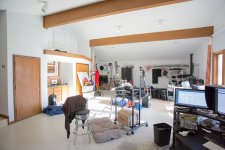
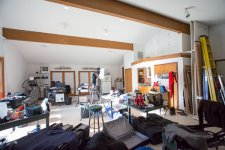
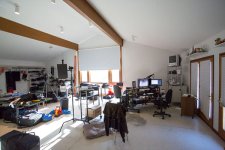
Thanks Alex, and since you brought it up, here's my challenge. I have to keep my workstation in this room, there might be an opportunity to convert a spare bedroom in the future.

Forgive the mess, I threw my back out right after completing a location shoot, so the gear sits where I unloaded it. The room is roughly 1000 sq/ft with concrete floors. I have plenty of c-stands for draping moving quilts, and can roll my workstation to any position.

I'm assuming this is not exactly a prime situation for audio. Is even worth it, or should I just wait for the possibility of the wee-wife giving up spare bedroom?

_65A0763.jpg_65A0764.jpg_65A0761.jpg

Mike
 
You can treat an area of that room and create some portable gobos to set up as temporary "walls" for when you need them.

THIS portable "vocal booth" is one handy tool.

THIS baffle is also useful.
 
$500-750 is actually the price range of just one good studio monitor

Hardly that, really - more like the price range for an average studio monitor. A really trustworthy monitor normally starts at about £1,000 / $1,600 and goes up from there. My own small portable studio monitors are almost £2,500 / $4,000 for the pair (excluding VAT)

However - at the $500-750 price range I would rate the Equator D5 the top of the bunch and I hear they are exceptional for the price. Also, being co-axial monitors they have an excellent stereo image and depth.


I should have clarified that as the starting range. There are Genelec monitors in that range that are accurate and reliable. Of course, they go as high as $2200/speaker.
 
Hardly that, really - more like the price range for an average studio monitor. A really trustworthy monitor normally starts at about £1,000 / $1,600 and goes up from there. My own small portable studio monitors are almost £2,500 / $4,000 for the pair (excluding VAT)

However - at the $500-750 price range I would rate the Equator D5 the top of the bunch and I hear they are exceptional for the price. Also, being co-axial monitors they have an excellent stereo image and depth.

Except that the OP is not looking for studio monitors. He's looking for decent sound post editorial near field monitors and that is a different thing all together.

Big budget studio editorial nearfield monitors are often in the $500 -$750 range. The KRK K-ROK speakers were all over the post edit rooms in the US and they were in that range (for a pair).

I never liked them particularly (found them muddy) but then I don't like Genelec either (they have always sounded overly bright).
The speakers I would own if I had a room big enough (they are not nearfields) and the cash are Meyer HD1's. But that is a sizable investment and totally not in the zone of what the OP was asking about. He's looking for a step up from computer speakers run off the headphone jack, not the Rolls Royce of studio monitors.

You have to take into account where the poster is coming from and what they are actually asking or the advice (no mater how accurate) is of no use to them.

The OP wants to know if moving from headphones to speakers is worth it and if so what they can get in the $500 range that will work. Giving them a list of speakers that are going for $2,000 each (not counting the interface and amp to power them) is so far from the mark that it's almost humorous.

What he is looking for is much closer to say a pair of M-Audio BX5 D2 powered monitors at $200 a pair. They are not high end studio monitors but they will be a BIG improvement over using headphones and he can get them and an interface on his budget.

I haven't used them but they should be relatively flat since Digidesign is actually the owner of the brand and they were designed for music and post sound work and are not goosed up speakers for your home stereo.

I'm not sure what the OP's video's are for/about, but he is doing dialog editing and dropping music in, and no FX (according to him) so we are not talking big budget work here.
 
Alex and Noiz2 are correct, I'm too much a novice to be spending much more for a basic set-up. Since yesterday morning, I've been on a You Tube marathon on room acoustics. Reflection points, diffusion, absorption and so on; I'm some what understanding it, but it makes my brain hurt. As you can see from my posted studio images, that in itself may present problems as big as the equipment I purchase.

With 15 years of Photoshop under my belt, video post didn't intimidate me. I knew what I wanted to do, just not how to do it; I'm confident with more time and experience it will become second nature. Audio, on the other hand, seriously scares me. I have absolutely no clue… heck, I just started recording room tone! That should tell you something.

I'm actually leaning towards the HS8's for a completely sentimental reason. "If you can make it sound good on HS10s, you can make anything sound good", or something to that effect. And I realize the HS8's aren't the 10s; but I shoot aircraft, and the Cessna 152, a little two seat trainer, had the same reputation. If you can fly and land the 152 will skill, you can fly anything. (But I'm still open to suggestions.)

Thanks fellas,

Mike
 
Actually I think that phrase referred to NS10's (the HS10 predecessor). The NS10's were used manly for music and some used them as "TV speaker simulators". The biggest problem with them were they were overly bright and tended to exhaust the ear quickly. That is less of a problem on a 3 min. pop song than it is with a 90 minute feature. But I only know them by reputation. Even with that in mind they are still going to be a big step up from headphones.

Your room is kind of huge and bouncy for sound editorial. But if you can pad the wall behind you and put a rug down it may not be too bad.
 
The better the monitors, the better you can hear small and subtle content masked by louder sounds. The stereo imaging will be more accurate and you can be sure that you are really hearing sound without the coloration that cheap monitors usually have. The price curve is logarithmic however, and once you get to john willetts idea of what constitutes 'good' you are spending lots of money. He's not wrong of course, because the things he can hear on these types of speakers are very evident once you've heard them. The trouble is that spending an extra 500 on things at this level generates very little extra 'quality'. The really crazy thing is that studios with this level of monitoring then MUST have a pair of consumer style speakers so they can hear what the typical home user will hear. Many of the expensive speakers have extended bass response so bass content might just sound farty on cheap speakers. Near field average sounding speakers are therefore a must have, but studios seemed to pick Yamaha NS10 speakers as a kind of standard of averageness. Everyone agreed they sounded petty awful but it was an awfulness that people understood, although the early ones did need a bit of tissue paper over the tweeter as it was quite painful!

my own take on mixing is that you need to hear properly to make considered judgements, but just need to check that on lesser systems it's still ok. Think about editing on an HD system, but only being able to monitor the picture on a down converted composite video output connected to a cheap domestic tv. People watching your bluray might see a few out of focus clips and maybe some odd colour casts that on the tv you didn't see. Studio loudspeakers now seem to be virtually all powered, so you are buying speakers and amps. There are some very good home studio speakers around at more modest prices. I got a pair of quite small and nice sounding Roland Edirol ones on eBay. In my edit suite I have a good set and a computer style set and can switch. The difference is amazing!
 
There is certainly some DYI absorbers/diffusers in my near future, I like Alex's hinged doors idea. I need something that I can fold up and store, I can paint them black on the face and white on back and use them for shoots in the studio.

I think the first order of business is to set up my station symmetrically in the studio, buy a measurement mic and use something like Room EQ Wizard. Beyond defining my room characteristics, with my substantial hearing loss, I need to discover what I can hear. I'm assuming it's no different than visual, I need to develop a sense of hearing.

Any hard-of-hearing engineers out there willing to share their experiences?

Mike
 
WOW, looking at the site (that Room EQ Wizard lives on) it's amazing they can get any posts at all. The "rules" go on for pages and ban "offensive words" like gosh or darn, they also won't allow email addresses from a huge list including Yahoo and AOL.

You have to register to download the software, which looks like it might be interesting, but after perusing the rules and such I'm a bit worried about what email lists I might get sold to (of course like everyone else they say they don't sell email lists but...) since they seem a little scary.

Anyway, IF your hearing aids don't get your hearing back to a "normal adult" range (some of the digital ones can if your hearing loss isn't too great) then if you know your curve you could put in an inverse curve on your output master for editing and remove it for rendering.

this might really drive your wife crazy though since you probably have high end loss and women generally keep more of their high end longer. Of course she won't be sneaking up on you if she has a pillow over her head in the back room ;~)
 
Back
Top