
Navigation
Install the app
How to install the app on iOS
Follow along with the video below to see how to install our site as a web app on your home screen.
Note: This feature may not be available in some browsers.
More options
You are using an out of date browser. It may not display this or other websites correctly.
You should upgrade or use an alternative browser.
You should upgrade or use an alternative browser.
Benefits of 14 stops dynamic range
- Thread starter ralfmouth
- Start date

macgregor
Veteran
Think about a DVD and shooting on film. Does the resolution and dynamic range of film make a difference once it's mastered as a DVD? After all a miniDV camera delivers the same quality ... ;D
A different subject is the fact that the DR of the videos recorded on the d800 are nowhere near 14stops.
A different subject is the fact that the DR of the videos recorded on the d800 are nowhere near 14stops.
Last edited:
Think about a DVD and shooting on film. Does the resolution and dynamic range of film make a difference once it's mastered as a DVD? After all a miniDV camera delivers the same quality ... ;D
I see what you're saying. Oversampling is always a good thing (nyquist and all that for instance)
I just think with dynamic range its really subdued.
Its really hard for me to tell between the D800 & mKII for instance.
thanks for answering.
macgregor
Veteran
I see what you're saying. Oversampling is always a good thing (nyquist and all that for instance)
I just think with dynamic range its really subdued.
Its really hard for me to tell between the D800 & mKII for instance.
thanks for answering.
Because they´re basically both really bad.
Didn't know that about the D800. This thread says the same thing regarding the D800 & video (about 1-stop difference between D800 & MkIII). Good to know.
http://www.dvxuser.com/V6/showthrea...s-area&p=1986119472&viewfull=1#post1986119472
Well, I don't think i'll be expecting miracles from the 13-stop BlackMagic Cinema camera either.
http://www.dvxuser.com/V6/showthrea...s-area&p=1986119472&viewfull=1#post1986119472
Well, I don't think i'll be expecting miracles from the 13-stop BlackMagic Cinema camera either.

Samuel H
Major Contributor
If everything ends up as 8-bit distributed media (8 stops dynamic range), what are the benefits of ~14 stops of dynamic range in the D800.
How is the extra dynamic range seen. I mean video in particular (H.264 Hi profile) but i think jpeg is usually 8-bit also.
There's a big mistake in that reasoning.
In a linear color space (e.g. in a RAW still, or in the ADC converters in the sensor), you can only get as many stops of DR as the number of bits that you have.
But as soon as you apply a log transformation, that limitation goes away. And both in JPG and in video mode you're doing that (and also applying a contrast curve, but that's irrelevant now).
Once you've moved to a log color space, there's nothing to prevent you from storing 20 stops of DR with only 8 bits. Or 50, if you can find a source with that much latitude. In this case the limiting factor is how bad you'll think the footage looks (and it will probably look quite bad), but that's subjective: there's no objective limit, like there is in linear color space.
In log color space and 8 bits, you have 256 values of brightness to distribute among the number of steps of DR that you have. If there are too few brightness values per stop, once you grade the image you'll see banding and posterization, noise and codec issues will be a lot more obvious, etc.
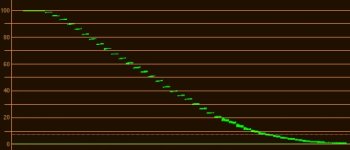
For example: in video mode, all the D800 can give you is 12.7 stops of DR (using Flaat_13). If this used a pure log transformation, you'd have 20 values of brightness for every stop of light. But it's not pure log: there are more brightness values per stop of light in the midtones and highlights (around 26), and less in the shadows (the darkest 2 stops are stored within only 7 values of brightness each). Macgregor thinks that's too little (i.e. it's unusable), so he will argue that the D800 doesn't have more than, say, 11 stops of DR. I also wouldn't use Flaat_13 unless I really have to, but I'd say Flaat_12 is highly usable, specially after a light noise reduction (Stu Maschwitz, my color guru, always recommends light noise reduction, then light add grain, if you're shooting with an 8-bit codec). But as you see, this is subjective, whereas in the case of the linear color space it's not: you just can't store more stops of light than bits you have.
To illustrate that example, here is Flaat_13's light response chart, in thirds of a stop:
for a good explanation of log vs linear workflows, go here: http://www.motionfx.gr/workflows-lut.html
Last edited:

Danielvilliers
Veteran
Above 12 stop you start to get some very good DR. That is about what I get in Raw from my Nikon d300. When you start to get into the 14 stop like the d800 (I mean RAW in photography) you start to get into the incredible level. You can look here http://www.fredmiranda.com/forum/topic/1112956/0, but there were already many example of people putting back images that were near point black to normal level from the pentax k5 and Nikon D7000 with the same 16 megapixel sony exmor apsc sensor. This sensor is the ground work of the full frame one in the D800 in terms of density DR etc.
From samuel H he is saying that we are getting conservatively 12 stop of DR from the D800 and that in extreme case 12.7 stops. That is already very good. Another thing is that bit depth is not directly related to dynamic range. You can fit much more than 8 stop in a 8 bit codec but 13/14 is a bit of a stretch and 12 perhaps is the limit as with the Canon C300.
From samuel H he is saying that we are getting conservatively 12 stop of DR from the D800 and that in extreme case 12.7 stops. That is already very good. Another thing is that bit depth is not directly related to dynamic range. You can fit much more than 8 stop in a 8 bit codec but 13/14 is a bit of a stretch and 12 perhaps is the limit as with the Canon C300.
In log color space and 8 bits, you have 256 values of brightness to distribute among the number of steps of DR that you have. If there are too few brightness values per stop, once you grade the image you'll see banding and posterization, noise and codec issues will be a lot more obvious, etc.
l
Thanks for putting it into numbers. So dynamic range is preserved, if there are enough "steps" to make it useable.
But what about contrast loss during compression...to get it back does one crush blacks and blow highlights...losing the dynamic range advantage?
(if not, wouldn't it look the same as a low dynamic range camera with low contrast grading)
You can fit much more than 8 stop in a 8 bit codec but 13/14 is a bit of a stretch and 12 perhaps is the limit as with the Canon C300.
So the BMC camera will have a few artifacts i suppose when stuffed into an 8-bit codec.
At least until they come up with better codecs (and display devices). Looking forward to OLED.
Samuel H
Major Contributor
well, dynamic range could be preserved
although in theory there's nothing to prevent it, Nikon's in-camera processing doesn't allow for those 14 stops of light to be preserved, it crushes a big part of it, and leaves very little info in another part; I'd say 12 stops is a fair measure, 12.7 if you're in dire need of DR and don't mind losing sharpness because of the noise reduction in post, 11 if, like macgregor, you like your footage nice and clean
check these tests:
https://vimeo.com/39899742
https://vimeo.com/39941831
https://vimeo.com/39937102
WhiteMonkey
Well-known member
Pictures are worth a thousand words BMC haters.

The 13 stops of dynamic range in an 8bit JPEG (picture on right). Imagine how good the RAW looks.
The 13 stops of dynamic range in an 8bit JPEG (picture on right). Imagine how good the RAW looks.
Its a tricky subject but after thinking about it, its much clearer now. Thanks
Those two end pics say it all...high dynamic range preserved to an 8-bit colorspace. It works.
But you know what, while fixating on the subject, i didn't notice the blown out background until after a couple minutes
Guess "its not the camera, its the photographer that matters most"
Btw I hope the BMC camera succeeds.