FS7: "Backwards" impressions

JPNola

Veteran
Have any of you started out on c300 type rigs with EF glass and then gone "backwards" to something like an HDX900 with a b4 zoom? I am curious as to what that was like, curious if it was liberating or not.

As someone who shot for many years on full-sized "broadcast tv" type cameras with b4 zooms, the new generation of cameras are a royal pain in the a**. But if 5D and C300 rigs are all you have ever shot on it probably doesn't seem like such a pain. I think many of the newer generation of shooters are unaware of how much the new generation of cameras limit you.

I joke that the new cameras make me a worse shooter. But that's only partly in jest as there is truth to it.

So, anyone regressed in their shooting experience from new gen to old gen cameras? From Canon 5D rig to Panasonic HDX900? Canon C300 to Sony PDW700?
 
I've gone to bigger cameras, some in rigs that tried to emulate the extra weight of a larger camera, some just annoyingly clunky on their own *cough*FS700*cough* and I really prefer a much smaller camera. The less weight the better.
 
Some of my colleagues have, and I've seen their reaction. They all loved it instantaneously. Its kinda awkward, since that's the way its supposed to be. Every "modular camera" I get my hands on, I try to modify to work like a shoulder mounted ENG camera. I still have a picture of my first ridiculously big camera rig, trying to make it shoulder style, when there weren't all these options from different manufacturers available :P
 
It depends on what you're shooting and the aesthetic you want/need. People love the large sensor look (and the jobs we are booking with them are the ones that would have required huge budgets and 35mm film decades ago) but of course it's more difficult to work with (focus, etc). There isn't anything wrong with going for a smaller sensor or more ENG styled camera, but they are different tools for different types of jobs.
 
I hate both.

I began in the 90s with shoulder cams. I scoffed at the Sony VX1000. "Your arms will start to hurt fast if you have to hold it out in front of you."

In the early 2000s I got used to that body style though, especially something as small as the TRV900. One hand on the grip, one on the LCD screen, you can more easily grab all sorts of high, low, tight shots. If you're willing to carry around something as big as a shoulder rig, just bring a monopod. Same volume of gear and even better stability, I think. Or just hold it against your chest. Another thing is that the handicam puts subjects more at ease. You walk around aiming a shoulder rig at people, and you look eerily like a sniper. When you hold a handicam and look down at its screen, you look almost like you're bowing. Much less intimidating! And one more thing: Ever since I read about a cameraman with a big shoulder rig walking in front of a car and getting killed, I thought, "Well, that's just something I would do: walk in front of a car or off a cliff. No more shoulder cams for me."

In the late 2000s, camera makers found out that we wanted big sensors, first because of all of the 35mm adapter contraptions selling, then the accidental DSLR video craze. But instead of cramming a large sensor into a sensible body style, like the DVX100, HMC150, etc., camera makers somehow lost their minds. They came out with such monstrosities as the FS700 and AF100. Or they thought that the reason we liked DSLRs was because of the DSLR body style (not!). So people like Blackmagic made their Cinema and Production cameras like that. The Blackmagic Pocket Camera actually is kind of nice, showing that if you make it small enough, it can overcome other drawbacks. Then Blackmagic rubber-banded from that to more monstrosities like the URSA and the War-of-the-Worlds Studio Camera. Canon probably came closest to better ergonomics with their C300 (and 100 and 500). But I wonder why they didn't go all the way, with a traditional side grip and an integrated, flip-out screen, like any number of handicams.

We'll see this NAB if Blackmagic and any of the rest regain their minds and start making sensible bodies again, like JVC is starting to with the GY-LS300. I think even that camera is a little too big. This body style is really sensitive to size and weight. It becomes annoying above 5 pounds. I believe the Panasonic HMC150 hit a sweet spot in weight and balance. You certainly don't want to rig out a handicam with pounds of stuff like monitors and recorders, unless you're willing to go back onto the shoulder.

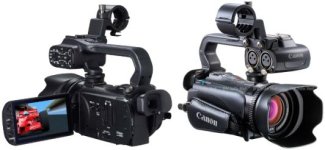
I think the ideal is something like the Canon XA-10. Imagine this baby if it had a good screen so that you don't need to attach another, a good codec so that you don't need to attach a recorder, an interchangeable lens mount, maybe a nice metal body, whatever you need, just this size:

canon_xa10.jpg
 
Last edited:
....But instead of cramming a large sensor into a sensible body style, like the DVX100, HMC150, etc., camera makers somehow lost their minds. They came out with such mostrosities as the FS700 and AF100.

Personal, highly biased opinion since I own one... but the AF100 comes closest of the large-sensor cams to that form. It is, in most all respects, an HMC150 with a larger sensor, the lens lopped off, and some buttons and things moved around. They just got the side handle mostly wrong... ideally it would have been shaped a bit differently and able to "trombone" to the proper balance point, but at least they made it removable. I added a rail block to the side of mine to allow the aforementioned functionality
 
Have any of you started out on c300 type rigs with EF glass and then gone "backwards" to something like an HDX900 with a b4 zoom? I am curious as to what that was like, curious if it was liberating or not.

As someone who shot for many years on full-sized "broadcast tv" type cameras with b4 zooms, the new generation of cameras are a royal pain in the a**. But if 5D and C300 rigs are all you have ever shot on it probably doesn't seem like such a pain. I think many of the newer generation of shooters are unaware of how much the new generation of cameras limit you.

I joke that the new cameras make me a worse shooter. But that's only partly in jest as there is truth to it.

So, anyone regressed in their shooting experience from new gen to old gen cameras? From Canon 5D rig to Panasonic HDX900? Canon C300 to Sony PDW700?

People wanted a cinematic appearance instead that old tired TV show appearance and are willing too sacrifice some ease of use too get it.
 
People wanted a cinematic appearance instead that old tired TV show appearance and are willing too sacrifice some ease of use too get it.

I think "ease of use" wasn't even an issue. For the people wanting that look, the only other option was 35mm. Expensive, timely, heavy, difficult... the DSLR crowd was basically getting the 35mm aesthetic without the weight and price tag.
 
Anybody who doesn't think an ENG camera is easier to use has never used one. Small sensor apart, shooting with an ENG camera is way easier. This is without mentioning the fact that will be hard for somebody to take you seriously if you show up for a professional job with a Canon XA-10. Unless you are charging that type of low rate and doing that type of low brow jobs.
 
In the late 2000s, camera makers found out that we wanted big sensors, first because of all of the 35mm adapter contraptions selling, then the accidental DSLR video craze. But instead of cramming a large sensor into a sensible body style, like the DVX100, HMC150, etc., camera makers somehow lost their minds. They came out with such monstrosities as the FS700 and AF100.


What do you mean? The AF100 is basically a HMC150 or HVX200 with a removable lens.
 
Anybody who doesn't think an ENG camera is easier to use has never used one. Small sensor apart, shooting with an ENG camera is way easier. This is without mentioning the fact that will be hard for somebody to take you seriously if you show up for a professional job with a Canon XA-10. Unless you are charging that type of low rate and doing that type of low brow jobs.


I clarify that it's not JUST that the shooting is more "easy" for the operator, as in less having to fiddle with different lenses and adjustments of camera accessories. It's that the form factor of the traditional ENG-style camera facilitates more variety of shots, more shots in general, faster shooting, and more technically proficient shots.

Stepped exposure change is never as good as infinitely variable exposure control. And most C300 /5D / FS700 / FS7 setups are going to be using glass with stepped exposure control.

Since most of the new generation camera rigs use still photo lenses, follow focusing is never as good as it was with B4 ENG lenses. ( made all the more difficult by the shallow DoF of the new generation cameras.). Its far more difficult to keep a moving subject in focus with still photo glass than it is with B4 ENG zooms. A zoom lens that is not a par focal is never as usable as a zoom lens that is par focal.

My point, or rather- my opinion, is that the cameras became "better" in that they gained a more cinematic look but at the same time they became much more sh*tty. Hurray, we gained a cinematic DoF and wider exposure latitude. But we lost much in the process.

Akin to souping-up a car so that it goes as fast as a Ferrari but as a result its far more difficult to steer, its brakes barely work, it takes 3 times as long as it used to take to get the engine started, its more difficult to drive in the rain than it used to be, parts fall off of it more easily, its less durable and rugged than before, the engine now sometimes just freezes up when it never did before, and as a result of all of this you take it out on the roads less.

...but you brag that it's now as fast as a Ferrari in a straight line.
 
Lord I miss the ENG shoulder cam device... So much less time spent "getting it ready" for the shot.
i agree that anyone who doesn't think it's easier probably never shot on one.
I don't know what the answer is, but a camera about the size of an HMC-150 is probably a bit of a sweet spot. Big enough to be functional and stable, yet small enough to get onto sliders and stabilizers easily. I admit I do like the form factor of that new JVC, just not its output.
 
Lord I miss the ENG shoulder cam device... So much less time spent "getting it ready" for the shot.
i agree that anyone who doesn't think it's easier probably never shot on one.
I don't know what the answer is, but a camera about the size of an HMC-150 is probably a bit of a sweet spot. Big enough to be functional and stable, yet small enough to get onto sliders and stabilizers easily. I admit I do like the form factor of that new JVC, just not its output.

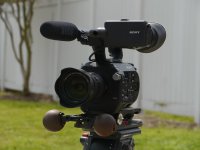
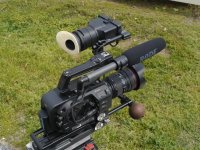
The way I have my Sony Fs7 set up it's darn close to the ease of a ENG shoulder cam. I don't use the control grip / arm accessory. I can just take the Fs7 out of it's run bag, power it up, and shoot.

P1000758.jpgP1000748.jpg
 
I believe you'll be able to use those 2/3" / 16mm lenses once 2k center scan is enabled. Of course you'll lose some of that DOF. The FS will be able to do what those old cameras ENG cameras did, but at higher def, plus do other things those ENG cameras never could. Simply, it's more versatile, higher definition, better codecs, and more functions. :thumbsup:
 
I believe you'll be able to use those 2/3" / 16mm lenses once 2k center scan is enabled. Of course you'll lose some of that DOF. The FS will be able to do what those old cameras ENG cameras did, but at higher def, plus do other things those ENG cameras never could. Simply, it's more versatile, higher definition, better codecs, and more functions. :thumbsup:


Far, far better than the old ENG cameras but can't command even half as much in rental rate as the ENG cameras could. How does THAT happen?!? :grin:
 
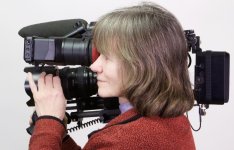
The way I set up our FS7, it comes right out of a Runbag from the 90's, right on the shoulder.

I don't keep the handle out all the way, I just keep it where the ENG lenses always had it. Even with the IDX battery and Odyssey attached it fits in my old Betacam run bag. And it sits down flat on the ground or a table. As far as I am concerned the new cameras totally blow the old Betacams etc out of the water in weight, pic quality and most of all price and versatility. I think Sony got a lot of things right in the FS7.

You can see all the options here:
http://www.westsideavstore.com/index.php?p=product&id=97


FS7sh.jpg
 
Just an observation...

If you spend $60K on an Amira, and $30K on a lens, which is somewhere around what an F900 or a 1st gen Varicam cost 13 years ago...

You basically get a camera that works as well as the F900 or Varicam did. Somewhat less range on the lens so you might need 2, but 13 years ago most ENG guys had 2 B4/HD lenses anyway. The standard and the wide angle. Unfortunately this is all of my thoughts on the original question.

Canon and Sony, and the newcomers, are throwing cheap cameras on the wall and seeing what sticks. That's why none of these cameras really work right. With greater frequency, because the market judges cameras on specs (the result of Moore's law) instead of what actually works. Resolution, etc. Chasing tails.

The market changed. What's "good enough" changed. Much more lower budget work to fill the internet channels, demand for content providers (I mean shooters, in this case) that can't support >$20K cost of entry. Quantity over quality.

I really do not want to come of sounding superior (I really don't), but that's why I scraped and scraped to buy an Amira. I wanted out. Arri, their customers, and the clients all want stability. People get mad and hate Arri because they don't think those prices are justified, Arri is just ripping you off. I'm here to tell you that if you can develop the clientele to even sort of afford an Arri rental, those jobs are easier, more professional, and you make more money. That's why the "high-end" works. It sifts out the crap. The lower end of the market is such a rat race to the bottom, it's a losing game for almost everybody involved. Fantasy football league with $7000 price of entry. The only way to win is to stick with your choice for 4 years, and hope it's still desirable at the end of that timeframe. This is just a HUGE generalization, there are great clients that only have $500/day for you and cam, and there are terrible, abusive prod cos that will pay you $1500/day + $2K for your camera. But these are the lessons 15+ years in the biz have taught me.

People who hire me do so based on the images I crank out. The Arri makes (arguably) the best. (by the way, if you are getting called because of the camera you own, you should do everything in your power to change that, it puts you in a crappy position). And by best, I don't mean resolution or sharpest. And by the way, who cares if most of us are making web content! If you believe that I am playing the same game everybody else is with the Arri except with larger price tags, then everything else is equal and I get more work (compounding) because my output looks better, more consistantly. As a bonus, the profit after the camera is amortized compounds faster as well, AND the camera lasts longer (4-5 years, maybe?). Once I get 58 rental days booked (1.5 years worth, maybe?), I make a solid $1K-$1.5K of profit everytime I shoot. Assuming the people that call me can afford the Amira. That's a different discussion. Even if they can't and have F5 money, that's $600-700.

Blackmagic Pocket cameras change owners probably every 3 months. GoPros even less. On the other end of the spectrum, Arri products change hands every 5-6 years, long after their owners have paid for them. The low end, you can rent that Blackmagic Pocket for $200 every time you shoot. Paid in 5 days of work. If you can keep it going for 2-3 years and do 30 days in a year, that's $5K. That's winning, but at 'young cost of living' economics. The middle range, that range sucks. $5-600 day for a ($40K cam) cam that lasts 2-3 years and takes 66 days of work to "pay off". Because of all the competition, bottom feeders screw up the rental rates and all the folks in the middle make very little or nothing on the $40K they invested. F55, I'm talking about you. Sony again, throwing crap at the wall. Feeling their way though the new media reality via message boards and self-proclaimed expert blogographers talking about specs. Enough.

Just random thoughts spilling out. Please don't shoot the piano player!
 
Last edited:
I just read my post. I sound like an elitist.

But if you accept the notion that the middle range camera race to the mediocre exists because its way easier to obsess about your work/career via specs on the internet, rather than experimenting with your hands and lights and developing your eye and taste (actual hard work), then you know where my heart is. In the end I just want to pass on my hard-won learnings.

(Btw, I am super guilty of obsessing over specs. But every time I learn a new lighting trick that gets my clients/directors attention, I realize the Internet spec race is for the birds)
 
Last edited:
Have any of you started out on c300 type rigs with EF glass and then gone "backwards" to something like an HDX900 with a b4 zoom? I am curious as to what that was like, curious if it was liberating or not.


I feel your pain. Having been only been in the full sensor arena for a few years via my Nikon D800 and now Super-35 with my FS7, I can attest the biggest curve ball is lensing. No simple or inexpensive way to enter that fray, and it is a fray.
I do have a nice compliment of Nikon zoom glass but the reach is short, even with the 70-200. That's my interview glass but I can run and gun with it.
My kingdom for an Angenieux Optima but at $40-$80k, that's just crazy for me. Or the Fujinon Cabrio at $30-$40k or even the Canon Cine Servo at about that same price range. All just out of the ballpark for mere mortals.
Using a B4 lens with adapter is cumbersome and no possible with the FS7. The cameras it is possible with doubles the focal length while losing 2 stops. Pretty senseless IMHO.
And the cine lenses I mentioned have to be powered via a Dtap interface I believe so you need full size camera batts to boot.
 
I have to agree with Nate about what we as cameraman, paid for our gear 20 or so years ago. My first Sony600 Betacam cost more than the Amira does today but the lensing was only like $10k. Now you can get an Amira for $30-$35k but a decent lens is in that same price range, which totals out to about $60, the price I paid for my first 600. However, those were also the days when I could depend on network news/docs/magazine shows to pay the freight so that camera was paid off pretty fast.
Now, we are kind of on our own. Network news for freelancers is essentially dead and their rental prices have dropped. Unless you have a long form project or a feature, I still maintain moving over to an Amira or even the new Varicam (which is sweet BTW), is all but unattainable to the likes of me.
 
Back
Top