ASchear's Camera Slider

ASchear

Well-known member
I'm currently working on a slider that was inspired by Cinevate, Cinezen, and a job I held about a year ago. My dad is a machinist and partial owner of a shop where I will do all the construction. Previously I'd worked on a 35mm adapter with him there that came out superb and was used on 3 or 4 shorts. We also attempted a doorway dolly that has been incredibly useful but rather unwieldy. This marks my 3rd attempt at a DIY project with emphasis on professional level design and construction.

The concept: I came up with the idea independently at first while working at my Dad's shop last winter for a few weeks stripping wires. The wires sat on a platform that slid in and out of wire brushes via linear ball bearings and 5/8" steel rods. I'd been thinking a while about how I can make a slider without using Drylin linear bearings like those used in the Zaza Slider, just because I wanted to shake the "DIY" feel of it, having used a friend's, and the linear ball bearings just felt a lot better sliding back and forth to me. Nothing against Zaza! It's alllll about how it felt to me.

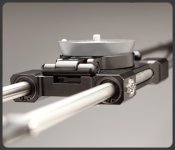
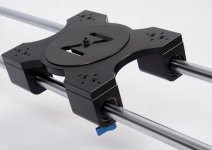
I later discovered that Cinevate and Cinezen (DVXU sponsor) make a similar slider system, but both are very expensive (I understand, people gotta make money). Here is a photo from each company's website:
atlas_30B.jpgcineGlidesmall.jpg

Both of these systems allow for free access to the bottom of the slider carriage, which I also felt was important. Other systems have the bottom covered either by something holding the rods together (in many cases with the Drylin) or work on a monorail concept.

I thought at length for how to mount the slider in the most efficient way with tools I would already have with me if I were shooting a wedding, event, etc. I also wanted it to be fully dis-assemble-able so I could easily upgrade it later by changing out any part I desire on the fly and so that it would be compact as possible, but without sacrificing strong construction and robustness.
 
The Design - With my concept in mind, I set out to build the slider. To keep my design simple, I wanted to use as few pieces as possible. I knew there were 5 essential pieces that I'd need - 2 rods, 2 ends, and 1 carriage. So I set to design the slider in 5 pieces.

The rods would simply be ordered from industrial supplier McMaster Carr along with the bearings, so there was not much work to do there. Links to and images of actual products purchased in the post below.

The carriage:

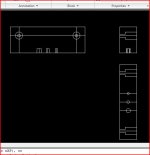
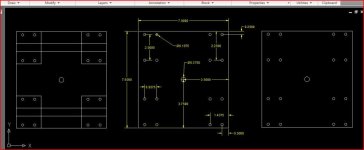
The design for the carriage was simple and very similar to Cinezen's design. I would have four bearings arranged in a square and screwed to an aluminum plate connecting the four. Using the CAD designs provided for the linear ball bearings by McMaster, I designed a square plate that all the bearings would be attached to. For ample space on the under-side, I made this plate 7" long and 7.5" wide. Here is the original design in AutoCAD 2010:

Carriage Design.jpg

On the left you can see the "underside" with spaces for each bearing and where the 5/8" rod will be, in the center a dimensioned drawing, and on the right, a view from the top. It will be made of 3/16" aluminum.

The ends:

I wanted the ends to be simple and sturdy. I also had to come up now with how to mount my slider. Center mounting on a tripod like the Zaza Slider was not an option due to my design. I've seen some sliders use a 2 tripod design, and while that may be very sturdy and ideal for stability, I don't always carry around two tripods, nor do I want to start doing that. I've also seen some sliders use a simple light stand for end support, but I've seen some where the light stand doesn't even lock into place, nor are they really versatile or robust. I realized that I'm often carrying a monopod around for small spaces and to steady some of my shots, and realized I could use that as a support on the other end. It's convenient, strong, and fits in places a second tripod or light stand wouldn't. Plus, it can go pretty low.

So, to keep my slider to 5 pieces I needed something I could screw a standard tripod plate / monopod to, and also something that would hold the rails firmly in place. I also wanted to be able to sit it on a table and get shots that way. What could be simpler and more capable than a block of aluminum? Well, there we have it, a simple block with slots for the rods, which can be screwed into place through the opposite side and screw holes put in the bottom for a tripod or monopod. I made it tall enough that there would be some clearance under the bearings so it can sit on a table and slide back and forth.

Here's the CAD design, I haven't put the dimensions on yet, but it's 6.5" long, 1.25" wide and 2.5" tall.

Slider End Design.JPG

The rods:

The rods will be purchased, as mentioned earlier, and then we will drill and tap holes in the end (to make the ends have a female screw). Then we can screw the ends to the rods.
 
Last edited:
The Materials - The precision ground rods and linear ball bearings were purchased from McMaster-Carr. It should be very easy to find the materials on their website, www.mcmaster.com.

The exact part numbers I used were 9338T2 for the bearings and 6061K124 for the 42" shafts. The shafts are relatively inexpensive, which is a plus because if I want to have a different length slider, I can for about $50 depending on the length. Went with 42" because it's long enough for many applications and there's less of a chance of them bending the shorter they are due to less torque. Went with 5/8" diameter based on strength recommendations from guys at the shop and because it's cheaper and lighter than the higher diameters. For the bearings, I went with the ones that come in a pillow block because it was easier and cost effective to buy theirs rather than design my own. For a future design, I might just buy the bearings plain and design my own pillow block that will be a little more compact like Cinevate's or Cinezen's.

For the ends and carriage top, I found a couple pieces of aluminum in the scrap room at the shop. There was a plethora of material that would've worked, and I changed a few dimensions to make what they had on hand work. The pieces I found will be machined to the dimensions that we want.

The total for the parts from McMaster was about $270. That mostly falls on the linear bearings, they were $56 each for four. The rest of the aluminum was free of course, since it probably wouldn't be used anyway. While that may be expensive, it's not way outside the range of the Zaza slider, and it's far less than the $750 price tag of Cinezen and the >$1000 price tag of Cinevate's comparable Atlas 30. I'd say it's a success on the spending!
 
Last edited:
The Construction -

Will commence tomorrow! Will bring my 20D and update with pictures of the making.

Update: Parts are in, and I'm working on it now.
 
Last edited:
The Results -

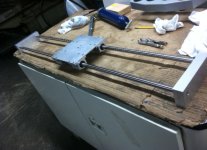
Update: Finished the slider yesterday. Will work today on getting some more info up about it's successes and failures. That's not to say there's too much bad news about it though, this thing came out awesome and slides just about perfectly.

photo right.jpg

Update 2: Will be re-posting all I have here and more on my website in the coming weeks. Figured it would be a better place for this.
 
Last edited:
Best of luck! I'll be watching. One thing I'd be sure to do if using roller bearings is to make sure you have a brake so you can adjust the resistance. People don't seem to understand that you really don't want a slider that rolls TOO easy, you can't get good starts & stops. I found this true with the hybrid bearing from igus too.

I'd still like the see you design a center mount for single tripod use.
 
Last edited:
This is awesome Andrew. I'll be keeping an eye on it. And for the record this is your fourth DIY project. I am still using the DIY steadicam that you made me.
 
This is awesome Andrew. I'll be keeping an eye on it. And for the record this is your fourth DIY project. I am still using the DIY steadicam that you made me.

Thanks Cory! The poor man's steadicam! I used it on a few films and weddings this past year before finally just buying a Glidecam, now they have me saving up for a vest since it might be out of my present DIY range. The poor man's version is still so great for the price!
 
Last edited:
Best of luck! I'll be watching. One thing I'd be sure to do if using roller bearings is to make sure you have a brake so you can adjust the resistance. People don't seem to understand that you really don't want a slider that rolls TOO easy, you can't get good starts & stops. I found this true with the hybrid bearing from igus too.

I'd still like the see you design a center mount for single tripod use.

I don't have any brakes built in, but I'll keep that in mind when I'm testing - to see how easy it'll be to get starts and stops. In fact, it's something I may have overlooked in the design. Thanks for the heads up. Already got the gears turning on a possible center mount that can extend underneath the entire thing!
 
Best of luck! I'll be watching. One thing I'd be sure to do if using roller bearings is to make sure you have a brake so you can adjust the resistance. People don't seem to understand that you really don't want a slider that rolls TOO easy, you can't get good starts & stops. I found this true with the hybrid bearing from igus too.
I'd still like the see you design a center mount for single tripod use.
1) I'll be too, I'm curious!
2) That's an excellent point! I thought about it too in the early test (before I put my HV40 and T2i on it). I ended up by adjusting the rails instead of the trolley. Easier: 3 points adjustment all over the rails. One at each end and another in the middle:
_MG_5945.JPG

3) One thing that I didn't actually managed to work perfectly, so instead I'm using what's on the hand. Another idea is to use foldable sawhorse, but it doesn't give the versatility of tripod to adjust the height.

If it can give you some ideas!
I don't have any brakes built in, but I'll keep that in mind when I'm testing
My hands are on it all the time when I do some slider shots, but always better to have a safety on it!
 
Bringing this back from the dead, but I will be building an updated version of my slider in about 2 months. It will be the same basic system with linear ball bearings, but weighing under 10 pounds, hopefully under 8 (instead of the 23 pounds / 120 lbs support it is now) and 24"-36" in length. I plan to give it a go on Kickstarter as a handmade, simple, professional tool. Some of the features I am incorporating will be:
  • Center mountable on a single tripod
  • Support for 30 to 80 pounds (depending on length)
  • Secure 5/8" light stand mounts at both ends
  • 1/4" 20 + 3/8" screws at both ends
  • Tool-less tripod head attach / detachment
The point about brakes previously raised is a non-issue. It slides easily when pushed but not at all when you let off the force (unless you're on an incline).

Wondering if anyone has any other suggestions I could figure out how to incorporate. After using mine for a year, I have a solid idea of where it excels and where it needs a bit of re-design.

Also wondering what's the most you'd pay for a system like this? I was thinking in the $450-$600 range for Kickstarter, maybe slightly higher thereafter. Since it's completely handmade and would be only available in limited quantities at a time, I'm really carefully examining my price range.
 
The point about brakes previously raised is a non-issue.
i disagree. having a little constant tension / drag is what often makes tapered and solid stops possible. and its the one thing lacking from most sliders.

I was thinking in the $450-$600 range for Kickstarter, maybe slightly higher thereafter.
im going to disagree with that as well. there are already a ton of slider options out there from practically free to a few grand. and the middle ground is very well covered by existing products. unless yours does something REMARKABLY better. im going to bet you'll be met with a great deal of indifference.

i say all this not to poo on your parade, but as a bit of info from my own experience... i built a slider that i attempted to launch on kickstarter recently. EVERYONE whos used it says it slides better (especially starts and stops) than ANY slider theyve used at any price. which it DOES. and it was targeted at $150. it obviously had a few things it didnt do at that price. but people still tried to compare it to devices that cost several times more.

its a tough market out there. be sure youre doing something that meets an un or under served need and does it in a way the buyers expect...
 
Last edited:
When I say that the brakes topic is a non-issue, it is because there is slight drag inherent with the linear bearings making starts and stops extremely smooth. No brakes are needed.

For reference, do you have the link to your Kickstarter campaign? Maybe I can learn something from it.
I'm not looking to make a fortune, but maybe 5 figures with this design. I don't know of many sliders that use linear bearings for the motion aside from Cinevate and Cinezen, so that could be the difference maker. Cinevate's comparable Atlas 30 is >$1000. And I don't believe it's center mountable.

But yeah, I do feel I'm trying to tap a very saturated market right now. Especially with the Rhino Slider's recent success.
 
Last edited:
yeah, the rhino is the one thats sits right at your market and its been bought to hell already.
go to kickstarter and search "drivingboard"

the thing i learned about the slider market is that at the low end, there are a lot of kids who build things for practically nothing that they THINK are good. so there's no talking to them.
then at the other end you have the folks who wont use anything unless its anodized, has an embossed logo and rides in a pelican case. and those guys already have a ton of choices.

so in the middle, you have rhino, cinetics, kessler, etc. who all have a fairly loyal following. so there just isnt a ton of unserved buyers out there.

but dont let me stop you. if you think you have an angle go for it. but i did too and basically had my ass handed to me.
my logic - which made total sense in my head, was that somebody who was used to showing up with a cobbled together pile of plumbing parts on saw horses would appreciate something simple, effective and easy to setup and use SOLIDLY. but what i found out was even at a very low price, youre still compared feature by feature to units costing several times more...
 
Last edited:
Annnnnnd it's done! As long as there are no unforeseen circumstances, I'll be filing a provisional patent application in the next week or two, and then I'll show you guys some pictures! It really is a beautiful piece of equipment and came out better than expected due to the advice of the two machinists (my dad and his friend) that I was working with. Here are some specs:

  • 30 inches in length, but modular and interchangeable to any length from 12 inches all the way to 48 inches with kits of different lengths we will offer (in 6 inch increments)
  • ~7.5 lbs total unit weight
  • Aluminum and steel all metal construction
  • Linear ball bearing sliding mechanism
  • Center mount for single tripod use
  • Held 20 lbs in barbell weights without trouble, I didn't take it any further since it's my only one right now :) It is at its quietest after being loaded with at least 10 lbs.
Should be on Kickstarter in about a month! Not sure about the price point yet. It will be a bit higher than originally expected in my previous posts, but still I expect sub-$1000. I'll feel accomplished even to sell a few and pay my school bills for a couple months.
 
HI, the brakes not only act as a safety, sometimes you want to record without moving. Then you want adjustable friction so you can be comfortable with the amount of effort required to move from static friction to sliding friction.

Do you figure what you are building will be good for a 10 pound camera?

You seem to have two versions going here. One with threaded rails (for a future motor drive?), the other that seems to need to work horizontally only.

The ideal design for me is horizontal or vertical, motor drive (with fine speed control), manual friction control/solid lock, tripod mountable but with two adjustable mono pods at each end.

And do you plan to provide a base so that the slider can be used vertically?
 
Last edited:
I filed a provisional patent just mainly to cover my bases, figured it wouldn't hurt and only cost $65 with the USPTO. I didn't know of any other linear bearing sliders out there that use an aluminum frame like ours for rigidity and mounting. To my knowledge they all require support at both ends and real thick, heavy rods to remain straight. But maybe I'm incorrect.
 
Back
Top