Arri AMIRA

Because I need total control. I said above: So I would suggest both "underexpose so you have more headroom in the highlights" and "ETTR, that is, overexpose", depending on the scene (former if you have highlights to preserve in your image, latter if not).

And also, because all of this is valid only if you're shooting RAW or log. As soon as there's an s-curve in the recorded footage, you have to go where it wants you to go, or face horrible nightmares when you grade the footage. My current camera doesn't record RAW or log.

In any case. I never said it doesn't matter how you expose or where to place middle gray. I said you can choose where to put it. There are tradeoffs, of course: if you leave a lot of headroom for the highlights, your midtones are closer to the bottom noise. All I'm saying is that if there's enough distance between that bottom noise and the highlight clipping point, you can decide where you set your midpoint and the noise tradeoff is not a big problem. 5-under-and-7-above or 7-under-and-5-above, your choice.
 
Last edited:
I would do the opposite. Underexpose and pull up.

Careful not to mis-quote what I said. I never said to purposely over-expose. I was giving a clear explanation why its more possible to get a filmic look from RAW linear gamma, same as you can shoot a RAW still over-exposed on any DSLR and still pull detail out of the highlights and ending up with a high quality still.

As for under-exposing RAW it is the worst thing you can do which will result in noise and grain in your final print. Look at the diagram I posted, way less than half your data bits get allocated to the dark tones. This would be the worst region to move up in post.

Don't believe anything I'm saying however. Grab any DSLR and shoot -4 under and +4 over then process to proper exposure and see the results for yourself.
 
At any rate, best practise for shooting raw is kind of irrelevant to the discussion of THIS camera (for obvious reasons).
 
* To me, "expose to the right" means "move your histogram to the right as much as you can, but without having any clipping on the right side". It is what you should always do with a log or RAW system

No you really wouldn't want to expose the same if shooting RAW vs log... look at the differences in how data is quantized for each gamma type using a perfectly even black to white gradient:

Linear gamma
gamma_gradient.jpg


Given RAW linear gamma has infinite data allocated towards the highlights you can safely expose to the right without clipping and rest assured you will have a beautiful image in post after using any myriad of tools to pull down your highlights. You can also shoot somewhere in the middle and be pretty safe.

Ryan Walters did some over-exposure tests earlier this year using BMC, RED and Alexa over-exposing as much as 7 stops in some case and still producing acceptable images after adjusting in post. Worth taking a look at: http://nofilmschool.com/2013/03/bla...epic-arri-alexa-raw-test-part-3-overexposure/

Log gamma
gradient_5bit.jpg


With a log based gamma curve the values are mapped with such a drastic hyper-curve in-camera that once they are stored digitally you end up with a better allocation of data bits per stop for the entire tonal range rather then being extremely heavy with data on one end and completely lacking on the other.

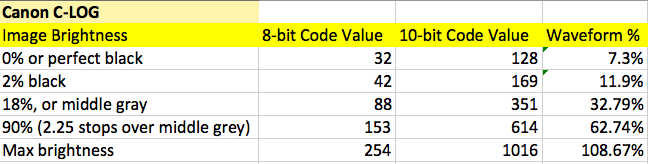
So with log based gammas you really wouldn't want to "shoot to the right". Instead the best results are obtained by placing your middle grey where the manufacturers specification tells you it is according to their mapping. For example on the F3 in slog middle grey is 38%. On the F5/F55 in slog2 middle grey is 32%. Canon clog maps middle grey at 32% as well. Probably more important is paying attention to where "white with 90% white reflectance" has been mapped; on the F3 slog 90% is 65%IRE, and on Canon log 90% is 62%. Shoot "white" over those values and you'd be throwing a lot of the highlight handling capabilities of log right out the window and get back to a "video look" in a hurry.

Look at the mapping values for slog and clog in more detail; you can see that around 40% of the data bits are going to JUST the highlights alone, 40% to the values below middle grey, and the rest to values between middle grey and 90% white.

sony_s-log_zps1b1891f9.png


canon_c-log.png


At any rate, best practise for shooting raw is kind of irrelevant to the discussion of THIS camera (for obvious reasons).

This is a good point too.
 
Last edited:
I don't know what your graphs represent. This is how linear values are assigned, with each color patch representing a stop of light, from darkest to brightest:
linear.JPG
So, it's a lot worse than your graphs would say. You definitely don't want to live in the left side of that scale, I get it.
But the scale is really huge, it's not 8-bit, so it's not that much of a problem.
Plus, the big thing is: EVERY CAMERA starts with this information, no matter if it shoots RAW or LOG or with a baked-in curve or whatever: the information comes to the processor in high-bit-depth linear, because that's what an ADC generates.
So, the proof is in the pudding: do you get lots of noise if you underexpose two stops? Then don't do it. But if the camera has "lots of DR but assigned to the shadows", it means it doesn't have a lot of noise if you underexpose two stops, so you can do it, and it suddenly becomes a camera that has "lots of DR but assigned to the highlights".
Sorry if I derailed the thread, I thought this was part of the "ARRI has more DR on the highlights" issue, and therefore relevant.
 
reality.

does anyone know the pixel size/depth/capacity of the alexa versus the rivals.

Being '2k' versus many '4k' cameras I would guess the pixels are much bigger (and better at catching photons) and the noise floor much lower thus enabling the mid point to be set lower and the highlights to be 'better'

Simply this is why I think the Alexa has a rep for being a bit special - failure to engage in the MP war wins the DR war!

S
 
The black/white images represent how much of data is being allocated to the specific tones of the image. So when you look at my linear gamma black/white image it shows that a lot more data allocated towards the highlights not the shadows. Conversely the image for log shows you how the data is more equalized over the entire tonal range.

There is no doubt on my part that all sensors are linear (of course they are) and that cameras start off with linear data first before anything - but my point about value remaping in post is that it will never be the same as having the camera processor get to it first and running through the vast array or algorithms engineers probably spent months or years tweaking on a bench to optimize and perfectly balance between signal, noise, color, quality, etc..


As for ARRI, or the AMIRA in this case, I think ARRI still stands as one of the best digital based cameras for highlight rendition no matter which end of the scale you shoot it with. Its somewhat magical in that sense.
 
I tend to think that I can process the original data in the PC much better than what any camera can do onboard, that's why RAW is so much better than regular video in all cameras offering both, at least the ones I've used... which are all well below $5K. The Alexa may be an exception, given it is on a completely different price bracket. I doubt it, though. Adobe Camera RAW really does its job very well.

Pixel size:
Arri Alexa: 2880x1620 on a sensor that is 23.760x13.365 mm --> pixel pitch 8.25 um, pixel area 68.1 um2
Canon C300: 3840x2160 on a sensor that is 24.6x13.8 mm --> pixel pitch 6.40 um, pixel area 41.0 um2

Doesn't the FS100 have a 1920x1080 sensor? if so, the pixels are even bigger than those of the Alexa. I think the magic mojo of the Alexa is the dual gain readout, which gives it such huge DR (the same clever trick that the scmos sensor in the BMC uses).
 
I don't know guys, if your looking purely at specs vs price you might be disappointed with the Amira- but keep in mind this is pretty much a better version of the same camera that has shot some of the best looking and most awarded digitally acquired films of our time. The alexa look has the mojo.

Its arguably a better version of the alexa for 1/2 the price. Im not going to rush to buy one because of that, but its pretty exciting to think about from a rental standpoint.
 
Back
Top