Arri AMIRA... your hands-on experience wanted

alphaville

Active member
After a long and careful thinking cap training I have decided to make the jump from C300 to Amira.
I feel it was probably one of the best decisions I have made in 15 years of production. I have just received it (picked it up at Türkenstraße 89 in Munich myself) and am putting it into production straight away. Needles to say I am in LOVE with the camera. Arri observed what the C300 users liked about their cameras, added the Alexa ergonomics and sensor and made the price (relatively) accessible. The UHD option, the EF mount, the one-man operation and quick workflow make the Amira an amazing tool.

While waiting for the SUP 1.1. update and my EF mount to come I am asking everyone to share your personal experience with the Amira:
Is it as cool as the 16mm ST in the seventies? What would you change? Update? How do you find the workflow?

Let us know!
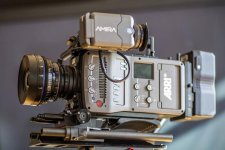
aa.jpg

(On the photo is my Amira from www.amirarent.com)
 
I'm on the move myself from a F55 to Amira. Mine is waiting for me at dealer, hopefully can pick up in next week or so.

First good pic I've seen with the BPA-3, so thanks for that!

With the stock top handle, are there any attachments for a noga arm besides the handle itself? It looks like I'd have to get the UAP-2 top plate if I really want to go attaching much up there?

On that subject, have you ever seen a quick release noga arm for the Arri star 3/8 attachment system?

And one last, did they give you a tour? I have to say visiting there would be quite a treat for me.
 
Funny you say you are selling the F55 to get the Amira, the F55 was my firm candidate to replace the C300 before I "discovered" all the Amira's advantages.

I have the BPA-3, the BP-8 with 19mm carbon rods and the BPA-1 in case someone rents the latter for Alexa.

Not many threads besides the handle, but I do not use the Noga for my TVLogic 074, instead I got the ULCS kit and it has been great! It is kinda quick release if you unscrew any of the joints...

Regarding the tour - we came to Arri Munich HQ looking for a showroom and were sent from Ari Rental to Arri Cinema to Arri offices and later found out there is NO SHOWROOM WHATSOEVER, i.e. there is ABSOLUTELY NOTHING to see at Arri HQ but some Arriflex cameras, a burnt Alexa and a couple of Academy Awards behind the hallway glass display. We made a joke about it later with Mr. Frees, the head of regional sales at Arri. It is a little disappointing though that a company of that magnitude and influence has no showroom/museum/exhibition.

Also, Amira's update package from Basic to Advanced (200fps, Log C, ProRes 422 HQ and LUTs) costs 3.300 euros and comes (wait for it) in a 9 kilobyte (!) file. The price is 366.66 euros per kilobyte, which was by far the most expensive download I have ever made in my life. The next upgrade to Premium will set you back 4.400 euros more.

Eagerly awaiting SUP 1.1 with waveform, support for EF iris control, camera remote control from tablets and smartphones and several other bonbons...
 
After a long and careful thinking cap training I have decided to make the jump from C300 to Amira.
I feel it was probably one of the best decisions I have made in 15 years of production. I have just received it (picked it up at Türkenstraße 89 in Munich myself) and am putting it into production straight away. Needles to say I am in LOVE with the camera. Arri observed what the C300 users liked about their cameras, added the Alexa ergonomics and sensor and made the price (relatively) accessible. The UHD option, the EF mount, the one-man operation and quick workflow make the Amira an amazing tool.

While waiting for the SUP 1.1. update and my EF mount to come I am asking everyone to share your personal experience with the Amira:
Is it as cool as the 16mm ST in the seventies? What would you change? Update? How do you find the workflow?

Let us know!

View attachment 93869

(On the photo is my Amira from www.amirarent.com)


Hey!

I have used the Amira as a 1st AC on multiple commercials and music videos, in fact it's now the most common camera I am working with. I'm currently on a multi-city commercial shoot right now and I had them order my unit an Amira, while the other unit is going Alexa.


First and foremost, the Arri Amira is an amazing camera. It has it's faults, but overall I have never been so immediately impressed with a camera as I was on my first prep day with the Amira. The following write up is going to be about Amira's with top license package, ProRes 4444, Log-C, 2k ... as that is the only format I have ever used on the Amira. Default for all my productions when using it.

Recently I've been consulting with multiple production companies who are thinking of purchasing a new camera package. The Amira is winning everytime, so long as they aren't deciding on Red Epic for different reasons. For those people reading this who aren't the OP, these were my thoughts to those companies when deciding on Alexa or Amira:

If deciding on an Arri product, in my opinion, the only reason you would ever go Alexa over an Amira would be for the following five reasons:


1) You want to shoot true Anamorphic on a 4:3 sensor (not all Alexa's have 4:3 sensors)
2) You want to shoot Arri RAW (not all Alexa's shoot RAW internally (most don't))
3) You are old-school-cool and want an optical viewfinder on your camera (only the Alexa Studio w/ OVF has this)
4) You are interested in ProResXQ format, Open-gate, or other Alexa centric features.
5) You are willing to give up the Amira advantages (if 1-4 are not of interest to you) to save a little money buying a used Alexa 16:9 camera. (not worth it in my opinion)


The advantages of the Amira vs Alexa:


1) Lighter weight
  • The Arri Alexa with SxS module is about 14-15lbs while the Amira feels more like 10lbs. (rounding numbers here)

2) Higher Frame Rates.
  • The Arri Alexa only shoots up to 120fps, while the Amira shoots up to 200fps

3) Internal ND's
  • Not so much to be used on narrative work, as a matching set of IRND's should be used for complete color consistency, but for run-and-gun style productions/documentaries, etc, having these have made life much easier

4) Multiple Mount Options.
  • The Amira will have PL, LDS-PL, B4 and Canon mount.

5) UHD.
  • Eventually, UHD will be offered. I have not tested but I typically give Arri the benefit of the doubt until proven otherwise. Alexa will have ProRes 3.2k soon and already has RAW open-gate ability, too, but UHD is still an advantage to the Amira in my opinion.

6) Operator usability.
  • I absolutely love the toggle switches on the side of the camera which allow for preprogrammed settings. It allows changing ISO, Color Temp, and Frame Rate to be instantaneous if going to the predetermined values. The User buttons are plentiful, although the Alexa user buttons were probably just as nice and I have no idea why they didn't keep the same layout on the body.

Overall, if shooting ProRess 4444, 2k and Log-C.... Unless you want anamorphic or an optical viewfinder, the Amira seems to just be better, especially in docu-style situations, which many commercials and music videos I'm currently on tend to embrace.


Things that bugged me about the Amira:


1) No user record button on the 'dumb' side of camera.
  • This can easily be fixed with either a wireless FF with Run-stop or get a three pin lemo runstop trigger and mount it to the dumb side of camera.

2) No information through HD-SDI port.
  • As of this commercial, the newer SUP 1.1 has not trickled into the field cameras. As of now, the monitor feed out is CLEAN only. No red dot for recording, no camera data, no timecode. This WILL be fixed in SUP 1.1, but thus far, not seen it in the wild.

3) The Eye Piece
  • Wonderfully built with a flip out LCD/Menu screen.... however, the EVF is only crisp and clear when looking VERY perpendicular to with your head/eye. If your viewing angle isn't perfectly centered, it gets soft. I think it's a diopter issue and I would press ANYONE buying a new Amira, to press the Arri representative hard about if a new diopter or viewfinder is forthcoming and wait for that! I don't know if anything is coming but they ought to!

4) Power up time.
  • Again, I've heard the boot up time is 25% faster with SUP 1.1, but so far on my run and gun productions with the older software, the boot up time has been a bit of a drag when the Director see's something he wants to shoot during say, travel between locations, and the camera takes time to start-up missing the moment. However, compared to typical Alexa's in the past, it's not bad. The 25% is a welcome update though!

5) No waveform.
  • Again, this is coming in SUP 1.1, but so far only false color and zebras are available for monitoring exposure. However, put an onboard monitor with waveform on the camera and problem is fixed until SUP 1.1 is uploaded to field cameras. I also prefer false color over waveform, when I shoot, so I don't mind it. Some of the DP's I AC for do.

6) The Arri Amira WPA-1 AMIRA Wedge Plate Adapter
  • If you are using only lightweight 15mm rods, and LW15mm rod accessories, than the wedge plate adapter is great! If you ever need to use 15mm studio rods or 19mm studio rods, DO NOT PURCHASE the WPA-1/QRP-1... I have yet to figure out a way that this baseplate can be used in conjunction with a 15/19 studio baseplate with proper alignment.
  • Arri offers two interchangeable baseplate adapters and if you ever need studio 15/19 rods, get the BPA-3 plate. It doesn't pop on and off as fast as the WPA-1, but you can put 15/19 studio baseplate on it and should hold proper spacing/alignment.
  • Even if you have a FF and MB that is all LW15 friendly, special equipment like professional teleprompters, century tilt shift brackets, large lens supports, low angle prisms, and other equipment is commonly studio 15mm. Just a warning. Explore both baseplate adapter systems the Amira offers and choose which is best for your style of shooting.

7) The EVF cable...
  • I don't know if I love or hate it. It is actually an HDMI cable. HDMI has the best quality-image : poor-quality-connection than any other cable to have ever been invented. That said, Arri did the horrible and wonderful deed of securing the cable.
  • The wonderful? They made the Amira so that the cable is actually embedded into the camera body and EVF. You can't pull the cable out by accident and this protects the HDMI cable from getting bent or broken. They basically fixed the terrible HDMI curse that plagues all HDMI cameras.
  • The Horrible? Well in order to change an EVF cable that is giving you trouble, you have to literally unscrew plates from the body and EVF. This makes the typical LEMO based or BNC EVF cable switch go from 10 seconds to a camera going down for 2 min, at best. Hopefully you do not need to change the cable often and this will be more of a positive than a negative.
  • I personally would have much rather them just make LEMO EVF cables. They'd make more money on them too. I don't know...


That's about it I can think of.

- C-Fast 2.0 cards and card reader are so far great. None of our DIT's have had any issues with the data process. It's ProRes afterall so there really is nothing new on the software side of things.

I have no experience with sound though. All commercials and music videos have been blissfully MOS. :)
 
I thought of one more thing that is strange about the camera!

The battery plate. For some dumb reason the p-tap / d-tap port on the camera plate does not trickle power through when a battery is on but the camera is off. Sort of annoying depending on what accessories are feeding off of the plate. If you want to use/adjust any electronic accessories feeding off P-tap or D-tap you have to turn the camera on first. We got around this by putting a sandwich plate with p/d-tap ports between the native battery mount and the battery. This allowed power to trickle through the ports when the camera was off.

Also, if you are using a teradek bolt system, be prepared for everytime you change framerates to have signal drop out and reconnect. The side toggle switch allowed us to change framerates so quickly in the field we often found ourselves waiting for the wireless video signal to catch up! Many different camera systems do this... but it just came to mind for what it's worth.
 
Mr. O'Hara, what you wrote above is a great post! I too have never been so immediately impressed with a camera as I was on my first work day with Amira. Arri entrusted me (a former C300 user) the task of shooting a promo video with Amira for Slovenian and Croatian market. It was a natural crossover with no frills whatsoever. The result you can check here. We had 12 hours to set up, shoot, edit, grade and present the ProRes 4444 Log C recorded video filmed with Fujinon Cabrio at Viba Film theatre in Ljubljana.

Btw, some additional comments on your post: The internal NDs are IR according to ARRI, the HDMI viewfinder cable is a drag and purchasing a used Alexa will STILL set you back more than a brand new Amira. At least here in Europe.

A funny thing happened to Amira rental prices as well... in the UK the rental companies offer Amira for 250-300 British pounds, in central Europe it goes for 500-600 euros and in the USA I noted the prices vary from $900 to $1200... The US price seems to be twice as high as the UK price and I can't figure out why...
 
Hey Ryan,

I'm in LA too and I'm hoping I get a good response with the camera. Er, who am I kidding, I know I will. I managed to make the F55 work against the tide, but I'm tired of pushing. Here's to 3 years of happy directors, clients and my bank account!


2) No information through HD-SDI port.
  • As of this commercial, the newer SUP 1.1 has not trickled into the field cameras. As of now, the monitor feed out is CLEAN only. No red dot for recording, no camera data, no timecode. This WILL be fixed in SUP 1.1, but thus far, not seen it in the wild.

Yikes. I didn't know this. Glad they had the good sense to fast track that.

3) The Eye Piece
  • Wonderfully built with a flip out LCD/Menu screen.... however, the EVF is only crisp and clear when looking VERY perpendicular to with your head/eye. If your viewing angle isn't perfectly centered, it gets soft. I think it's a diopter issue and I would press ANYONE buying a new Amira, to press the Arri representative hard about if a new diopter or viewfinder is forthcoming and wait for that! I don't know if anything is coming but they ought to!

I have heard this also, and also heard that they stopped production for a second to do a diopter revision. I hope this is the case, your comment is probably the 3rd time I've read something about it.

5) No waveform.
  • Again, this is coming in SUP 1.1, but so far only false color and zebras are available for monitoring exposure. However, put an onboard monitor with waveform on the camera and problem is fixed until SUP 1.1 is uploaded to field cameras. I also prefer false color over waveform, when I shoot, so I don't mind it. Some of the DP's I AC for do.

In same bag as overlays for output. But I haven't really had an operational one with the F55 so I don't miss it as much. It will be nice to have when it comes.

6) The Arri Amira WPA-1 AMIRA Wedge Plate Adapter
  • If you are using only lightweight 15mm rods, and LW15mm rod accessories, than the wedge plate adapter is great! If you ever need to use 15mm studio rods or 19mm studio rods, DO NOT PURCHASE the WPA-1/QRP-1... I have yet to figure out a way that this baseplate can be used in conjunction with a 15/19 studio baseplate with proper alignment.
  • Arri offers two interchangeable baseplate adapters and if you ever need studio 15/19 rods, get the BPA-3 plate. It doesn't pop on and off as fast as the WPA-1, but you can put 15/19 studio baseplate on it and should hold proper spacing/alignment.
  • Even if you have a FF and MB that is all LW15 friendly, special equipment like professional teleprompters, century tilt shift brackets, large lens supports, low angle prisms, and other equipment is commonly studio 15mm. Just a warning. Explore both baseplate adapter systems the Amira offers and choose which is best for your style of shooting.

I'm not into the ENG build they keep showing so I went with BPA-3 and did not order the WPA-1. Plus I hate VCT, but mainly because of all the sloppy 10 year old VCT plates I've been forced to use over the years (and I don't even hardly ever shoot with Varicams/etc)

Did you ever happen to try to prep the Alexa Digicine VCT plate with the WPA-1? My instinct tells me the spacing for the studio rods would be off (lower than usable), but I wonder if the rods have some vertical adjustment on it? (The Digicine plate, I mean)


7) The EVF cable...
  • I don't know if I love or hate it. It is actually an HDMI cable. HDMI has the best quality-image : poor-quality-connection than any other cable to have ever been invented. That said, Arri did the horrible and wonderful deed of securing the cable.
  • The wonderful? They made the Amira so that the cable is actually embedded into the camera body and EVF. You can't pull the cable out by accident and this protects the HDMI cable from getting bent or broken. They basically fixed the terrible HDMI curse that plagues all HDMI cameras.
  • The Horrible? Well in order to change an EVF cable that is giving you trouble, you have to literally unscrew plates from the body and EVF. This makes the typical LEMO based or BNC EVF cable switch go from 10 seconds to a camera going down for 2 min, at best. Hopefully you do not need to change the cable often and this will be more of a positive than a negative.
  • I personally would have much rather them just make LEMO EVF cables. They'd make more money on them too. I don't know...

This and the fact that you HAVE to have the EVF onboard to control the camera is my biggest beef with the camera, I think.

HDMI is a little scary, but if it's completely captured I'm sure durability wise it will be fine. But as you, I don't love the idea of screwdrivers and a total work stoppage just to extend the EVF or whatever.

I can't believe I'm going to say this, but if they are going to make the viewing device the controller ala Red, then I hope they come out with a bigger LCD-only unit that can also control.

I could see them saying "well, you *are* using the camera outside it's use case, but I think they're smart enough to "get it" and provide another option later down the line.

Thanks for the write up. By far the most useful commentary I've heard on the thing.

Now I just need *mine*!
 
Last edited:
Mr. O'Hara, what you wrote above is a great post! I too have never been so immediately impressed with a camera as I was on my first work day with Amira. Arri entrusted me (a former C300 user) the task of shooting a promo video with Amira for Slovenian and Croatian market. It was a natural crossover with no frills whatsoever. The result you can check here. We had 12 hours to set up, shoot, edit, grade and present the ProRes 4444 Log C recorded video filmed with Fujinon Cabrio at Viba Film theatre in Ljubljana.

So that is an Arri promo video in the Balkan states?! Talk about a difference in culture! :) I'm not commenting on the quality of the piece, but rather simply on the subject matter. I mean, who eats that much vegetables in the USA? hahaha

Btw, some additional comments on your post: The internal NDs are IR according to ARRI, the HDMI viewfinder cable is a drag and purchasing a used Alexa will STILL set you back more than a brand new Amira. At least here in Europe.

Oh yes, I definately assumed the internal ND's were IRND. My point was that IRND's of different manufacturing origins tend to not match each other in terms of color rendition. On a narrative feature, as a DP or an AC, I would suggest NOT using the internal ND's mixed with external IRND's without testing first. I would be afraid the precise image continuity would not hold as much as I'd like. I'd instead get a matching set of IRND's, say Firecrest or Tiffen and use those exclusively. It would likely help ensure shots match better versus a scene that uses a mix of internals and externals ND's in different combinations. In a narrative setting, I would assume there would be time to do typical IRND filter switches as normal.

On run and gun or docu style, the internals are amazing. I also love the way they did 2, 4 and 7 stops.

A used Alexa (say a basic 16:9 alexa) might cost less when it comes in a bundle. See here for example: http://www.visualproducts.com/storeProductDetail.asp?productID=1756&Cat=141

But yes, if you want 4:3 RAW Alexa, especially with OVF, than yes, it will still cost more.

A funny thing happened to Amira rental prices as well... in the UK the rental companies offer Amira for 250-300 British pounds, in central Europe it goes for 500-600 euros and in the USA I noted the prices vary from $900 to $1200... The US price seems to be twice as high as the UK price and I can't figure out why...

In Los Angeles, list price for Amira is typically the same as Alexa at most rental houses, because it's new and in demand. Typical list price before discounts (there are always discounts) is $1,500. Most Alexa's in LA that are standard issue go for the same. Of course there are owner operators who are attracting business by going $1,000/day.
 
Last edited:
This and the fact that you HAVE to have the EVF onboard to control the camera is my biggest beef with the camera, I think.

HDMI is a little scary, but if it's completely captured I'm sure durability wise it will be fine. But as you, I don't love the idea of screwdrivers and a total work stoppage just to extend the EVF or whatever.

I can't believe I'm going to say this, but if they are going to make the viewing device the controller ala Red, then I hope they come out with a bigger LCD-only unit that can also control.

I could see them saying "well, you *are* using the camera outside it's use case, but I think they're smart enough to "get it" and provide another option later down the line.

Thanks for the write up. By far the most useful commentary I've heard on the thing.

Now I just need *mine*!

Not that it is an acceptable form of controlling a camera but you can do the following with the much anticipated SUP 1.1:

1) The LCD menu system can be displayed and controlled via a wireless device, such as Android and Apple devices. It looks and operates just like the flip out LCD.

2) LAN-capable laptops can be connected via ethernet cable and controlled that way... although this is far less useful. IMO
 
Did you ever happen to try to prep the Alexa Digicine VCT plate with the WPA-1? My instinct tells me the spacing for the studio rods would be off (lower than usable), but I wonder if the rods have some vertical adjustment on it? (The Digicine plate, I mean)

Never thought of using the Digicine plate hmmmm. perhaps there is a way. I've not found a solution yet with the peices at rental houses. We were lucky enough to get everything happy on lw15

Maybe... I do know that using the typical WPA-1 and QRP-1 is not going to align if you add a 15mm studio plate under it. I'm not sure about the spacing but so far I've been really pessimistic.
 
3) The Eye Piece
  • Wonderfully built with a flip out LCD/Menu screen.... however, the EVF is only crisp and clear when looking VERY perpendicular to with your head/eye. If your viewing angle isn't perfectly centered, it gets soft. I think it's a diopter issue and I would press ANYONE buying a new Amira, to press the Arri representative hard about if a new diopter or viewfinder is forthcoming and wait for that! I don't know if anything is coming but they ought to!

7) The EVF cable...
  • I don't know if I love or hate it. It is actually an HDMI cable. HDMI has the best quality-image : poor-quality-connection than any other cable to have ever been invented. That said, Arri did the horrible and wonderful deed of securing the cable.
  • The wonderful? They made the Amira so that the cable is actually embedded into the camera body and EVF. You can't pull the cable out by accident and this protects the HDMI cable from getting bent or broken. They basically fixed the terrible HDMI curse that plagues all HDMI cameras.
  • The Horrible? Well in order to change an EVF cable that is giving you trouble, you have to literally unscrew plates from the body and EVF. This makes the typical LEMO based or BNC EVF cable switch go from 10 seconds to a camera going down for 2 min, at best. Hopefully you do not need to change the cable often and this will be more of a positive than a negative.
  • I personally would have much rather them just make LEMO EVF cables. They'd make more money on them too. I don't know...

When I played with the Amira at NAB, I noticed the same thing about the EVF, too.

And Arri is the LAST company on the planet that I thought I would see put an HDMI connection on a camera. I don't really trust HDMI on my receiver and TV that don't move(I've had cables "just die" that were never touched), much less on something that is constantly being moved around and is 'mission critical' like the VF on a camera. It irks me enough that Canon wasted space on the C300 with HDMI instead of another SDI connection, but I would really be scratching my head if I had an Amira and found out that my VF working depended on one of the most questionable ideas to come out of the consumer electronics world in the last decade or so.
 
And Arri is the LAST company on the planet that I thought I would see put an HDMI connection on a camera. I don't really trust HDMI on my receiver and TV that don't move(I've had cables "just die" that were never touched),

I hear what you're saying and if this was a Zacuto with connectors hanging out in the open I'd agree. But the connector needs to be separated from the cable in this discussion. I'm going to assume Arri is using very high quality cabling that will not break down until X amount of flexes, and we know the connectors are captured and not going anywhere.

I think it's somewhat brilliant actually, with the downside that it needs extra time to actually connect and disconnect them. That part sucks.

But the costs of the cables themselves are low, the "Long" cable from Arri is $56, and the "Extra Long" is $91. That's a far cry from $250-300 you usually need to buy longer/spare EVF cables. If the camera is almost useless without the EVF/control, maybe I do want that on a cable I can buy at 7-11. Kinda. You know what I mean.

BTW, as I understand it, almost all the EVFs these days are driven off DVI/HDMI derived signal drivers. Alexa included.

So yeah, I'd rather have lemo too, but there is an upside to this.
 
Last edited:
Hey, if anyone wants to provide a link to a log-c clip, that would be much appreciated.

ftp-footage.arri.de
User: AMIRA
Pass: samplefootage

Following PDF details what's at that FTP:

http://www.arri.com/?eID=registration&file_uid=12835

One cool thing I learned from the Amira clips as opposed to Alexa (I have quite a bit Alexa footage of my own to play with)...

The Looks that the Amira embeds in the Quicktimes as metadata, whether 3D LUT based or not, are rendered in FCPX by default, but can be turned off to view the unaltered Log C if you please.

Shooting Amira for a job editing on FCPX would be a slick operation.
 
Regarding HDMI, the cable is secured to the port on the camera with a cover and screws and an extra spare cable came with the package. There is however no other HDMI port on the camera. Which is good.

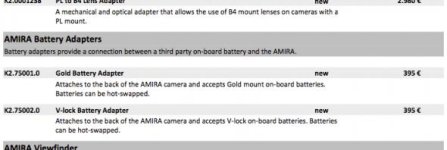
I have another issue with Amira - Arri claims "batteries can be hot-swapped" with their V-Lock battery plates (a claim made in the official price list) and sells them for almost 400 euros, but it is just an ordinary IDX plate with D-Tap that costs 100 euros everywhere. I thought their plates would offer UPS power supply and opted out of a similarly priced Bebop Rouge Hot Swap one, only to find out that I received a regular plate with down time... Needless to say I was pretty upset.
 
I have another issue with Amira - Arri claims "batteries can be hot-swapped" with their V-Lock battery plates (a claim made in the official price list) and sells them for almost 400 euros,

Just my experience, I haven't seen that claim anywhere in my own shopping or research.

I wonder if it's something that got goofed up just in your part of the world.
 
Here is a screenshot, official ARRI Price List 03/2014... the claim appears on several online stores' product description (such as CVP in London) as well...
Screen Shot 2014-11-24 at 17.46.24.jpg
 
Back
Top