Apple dumps Intel and shows Final Cut Pro on new Mac with Apple CPU !

The M1 is an ideal chip for use in servers, many posts ago I guessed the market would move in this direction. Its a server the code can be written to serve (see what I did there ).
Many moons ago at an SAP research lab PR event, Intel turned up giving there sales pitch on how they could coax their hardware to run a few degrees hotter, the promise was that this small increment could reduce power and cooling costs for large server farms.
Now along comes the M1, very powerful and frugal on power with minimal heat output.
If Apple doesn't reenter the server market perhaps Dell etc and hammering on their door to buy.

There were other CPU's that were more powerful than the x86 that did not need cooling. BTW there are a lot of server farms in Greenland. The air there is consistently very much cooler than other parts of the world and the heated air is used to heat all the buildings the towns beside the server farm(s) It makes a very energy efficient and less expensive system to run.
 
There were other CPU's that were more powerful than the x86 that did not need cooling. BTW there are a lot of server farms in Greenland. The air there is consistently very much cooler than other parts of the world and the heated air is used to heat all the buildings the towns beside the server farm(s) It makes a very energy efficient and less expensive system to run.

Which processors are these and how much more efficient or cooler did they run?
Heat dissipation is a major issue with Amazon etc building their farms near rivers using the river water to assist in cooling. Greenland sounds great yet not every server farm is located there.
The M1 is a magnitude more efficient in reducing power consumption (electricity bill) and waste heat management.
 
Which processors are these and how much more efficient or cooler did they run?

We used PPC, 603 cores a lot for servers and SDH (Sonet in the US). This is going back a while.


Heat dissipation is a major issue with Amazon etc building their farms near rivers using the river water to assist in cooling. Greenland sounds great yet not every server farm is located there.
Server Farms are the growing industry in Greenland. Other "cold" countries are seeing similar increases in server farms. Due to history of where companies started and their first computer sites there are a lot of server farms in warmer countries and now they are there it wil be difficult to move them.

The M1 is a magnitude more efficient in reducing power consumption (electricity bill) and waste heat management.
That is true. BTW it is not an ARM-Cortex cpu. Apple licensed the instruction set and designed the CPU themselves.
 
PPC 603 core, that's a RISC processor from the good old joint project from Motorola, IBM and was it Sony also? Not the x86 instruction set.

I used to programme 6502 and Z80 (and a few others)in machine code later moving on to low-level assembly language for control systems.
 
PPC 603 core, that's a RISC processor from the good old joint project from Motorola, IBM and was it Sony also? Not the x86 instruction set.

The Apple M1 isn't an x86 instruction set and has more in common with the 68K than the x86.
 
The M1 is an ideal chip for use in servers, many posts ago I guessed the market would move in this direction. Its a server the code can be written to serve (see what I did there ).
Many moons ago at an SAP research lab PR event, Intel turned up giving there sales pitch on how they could coax their hardware to run a few degrees hotter, the promise was that this small increment could reduce power and cooling costs for large server farms.
Now along comes the M1, very powerful and frugal on power with minimal heat output.
If Apple doesn't reenter the server market perhaps Dell etc and hammering on their door to buy.

Actually, it's not. It's built as a custom SOC that's optimized for client devices rather than servers. There's a reason that the server oriented ARM processors don't have the same feature set, like embedded system memory.

I doubt that Apple would have any interest in that market. Breaking into that market is a long road, and it's not like Apple is lacking customers.

Maybe not on the face of it but ARM's new owners might be looking at servers. Especially with the M2 CPU
 
Maybe not on the face of it but ARM's new owners might be looking at servers. Especially with the M2 CPU

To my knowledge, ARM does not have new owners. There is a proposed future acquisition by nVidia which would take at least 18 months, assuming it is not blocked. There is significant opinion that it will be blocked by regulators: https://www.cnbc.com/2020/10/01/tech-investors-predict-nvidias-arm-acquisition-will-be-blocked.html

Even if it went forward, I don't think ARM (no matter who owns it) has any rights to Apple's microarchitectural design -- and that's where the real magic is. Apple has an architectural license which means the chip is totally designed by Apple and the only commonality is a subset of the ARM64 instruction set. From an internal microarchitectural standpoint, the Apple M1 is no more similar to a mass-manufactured ARM Cortex CPU than a 10th-generation Intel Sunny Cove CPU is to an AMD Athlon CPU, even though Intel licensed the instruction set from AMD.
 
Maybe not on the face of it but ARM's new owners might be looking at servers. Especially with the M2 CPU

What makes you think that anyone outside of Apple would have access to Apple's IP?

Apple has an ARM license, that doesn't mean that anyone else with an ARM license has access to Apple's architecture or implementation.

In any case, nVidia is already a large and growing presence in datacenters, and ARM has several licensees that have been building servers for a long time. They've been working on breaking their ARM designs into the server market for several years. Apple's had no involvement in any of that, since Apple is primarily a consumer electronics vendor that sells computers also.

* joema is correct, the nVidia acquisition isn't a done deal.
 
Last edited:
The Silicon Valley has a lot more sway in the incoming administration than in the outgoing one. IOW, this will be approved by the DOJ. $40B is peanuts by the global standards anyway and the chip market is very competitive as it is.
 
The Silicon Valley has a lot more sway in the incoming administration than in the outgoing one. IOW, this will be approved by the DOJ. $40B is peanuts by the global standards anyway and the chip market is very competitive as it is.

Even that isn't guaranteed, because ARM isn't a US company, so the EU could still block the acquisition. My guess is that nVidia's choice of using stock to make the purchase, making ARM a major shareholder, is to grease the EU wheels. But that's just a guess, since it's not my area of expertise.
 
The Apple M1 isn't an x86 instruction set and has more in common with the 68K than the x86.

I never said Apple M1 used a x86 instruction set, I was pointing out it is a Power PC chip not manufactured by Intel.

The question is what is a server? It's a data forklift truck reading information off a hard drive and firing it out a port.
But the M1 is not a server chip.... so what? Write the code and build a suitable interface for a server crate.
Important issues being speed and reliability of operation but the biggest is that of power consumption (the electricity bill for power and cooling).
Greenland for the current intel based server makes sense but Greenland is expensive, in fact very expensive for salaries, property rates, power etc.

Now introduce a chip that can offer similar or better performance that takes a fraction of the power and requires minimal or no additional cooling, you could relocate your data centre to Eastern Europe and enjoy the savings.
When Intel was citing a chip that could run a few degrees hotter as being a big selling point the Apple M1 processor is a very attractive proposition.
 
You are right that cloud companies should seek speed per watt, not just speed. Google was talking about the importance of that over 10 years ago. In their custom-built servers, they preferred some of Intel's slower processors because of that. (They could just use more of them to get the needed speed.)

Low power is attractive not just to servers but for laptops. It is the reason cited for Apple moving from PowerPC to Intel in 2005.

But cloud providers can save electricity by using processors based on ARM without using Apple's M1 specifically. As Tamerlin points out, the M1 is customized for laptops. It would be more efficient to use a processor customized for servers. And that is exactly what Amazon did. Its ARM processors are called Graviton and use about half the power. I would think we would see more cloud companies (like Google and Microsoft) offer their own ARM servers in the next few years.

Or I'm still thinking that RISC-V stands a chance.
 
Last edited:
I never said Apple M1 used a x86 instruction set, I was pointing out it is a Power PC chip not manufactured by Intel.

It's not a PowerPC, either.

The question is what is a server? It's a data forklift truck reading information off a hard drive and firing it out a port.

Also wrong. Servers do a lot more than that. At least the ones that I typically code for do.

But the M1 is not a server chip.... so what? Write the code and build a suitable interface for a server crate.
Important issues being speed and reliability of operation but the biggest is that of power consumption (the electricity bill for power and cooling).

Not entirely. A datacenter built around efficient but slow processors can actually end up consuming MORE power than one built on high performance processors that burn more power. The nVidia A100 is actually a great example of how -- replacing an ENTIRE datacenter with a single rack that's 2-3x faster than the entire datacenter saves a lot of compute time. The A100 isn't a power miser, but it's so powerful that the overall hardware requirements decrease drastically.


Now introduce a chip that can offer similar or better performance that takes a fraction of the power and requires minimal or no additional cooling, you could relocate your data centre to Eastern Europe and enjoy the savings.

You're acting like that's news. In reality, you're just not aware of all of the low power datacenter designs that are already out there. Zen3 looks like a power monster on paper when you look only at the wattage per socket, but when you look at its power consumption per core, it ends up not being that much higher than for the M1. Part of that is due to the fact that a lot of the power consumption isn't in the cores themselves, but rather in the interconnects and external I/Os.

When Intel was citing a chip that could run a few degrees hotter as being a big selling point the Apple M1 processor is a very attractive proposition.

That's why several companies have been building ARM based servers for years. Mostly, because they've been nowhere near as powerful as x86 processors, they've been going into web servers because web servers are latency constrained more than compute constrained, because they spend more time waiting for database queries to complete than they do to complete their own business logic and HTTP request/response processing.

Even if Apple did decide to start selling M1 CPUs to to 3rd parties, it would be the newcomer trying to break into a market that several companies are already in, with products that are more suitable for that niche, and much higher end. There are already some 100+ core ARM server processors in the works. They'd be pretty unappealing for most of our needs though, due to not having GPUs and not having as much FPU throughput -- again by design. If your primary use case doesn't need it, it's wasted silicon and not a feature.
 
...Even if Apple did decide to start selling M1 CPUs to to 3rd parties, it would be the newcomer trying to break into a market that several companies are already in, with products that are more suitable for that niche, and much higher end....

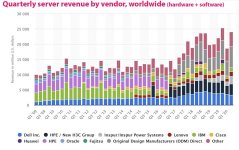
Also, things have changed a lot since Apple was a computer company. Back then one might envision Apple expanding into IT or the server market. Today Apple is so large there is insufficient revenue to warrant even considering that. Apple's revenue in one quarter is greater than the total *annual* hardware + software revenue of all server vendors combined -- worldwide. That is total systems, hardware, software, upgrades, etc. The revenue from supplying just CPU chips for servers would be tiny on Apple's current scale. Apple's revenue for wrist watches is greater than Dell's and IBM's total server revenue combined: https://9to5mac.com/2019/04/30/apple-watch-q2-2019/ See attached.
 

Attachments

  • ServerRevenueWorldwide.jpg
    ServerRevenueWorldwide.jpg
    105.3 KB · Views: 0
Yeah... I just don't see how Apple would justify the investment based on the return. Since x86 is the dominant server platform and it's a commodity, I'd guess that most of the profits are in services rather than in the hardware itself.
 
The global server market is about $90B in hardware sales, which is much smaller than the global smartphone sales of ~ $500B.

But the smartphone industry is very competitive with an increasingly longer upgrade period and a rapidly improving performance, where a middle of the market product is becoming more than sufficient for most users. Apple is smart enough to recognize that. Which is why they keep diversifying their offerings and will continue to do so.
 
Apple seems to working on diversifying into a wider array of consumer electronics and content.

You have heard of Apple TV, haven't you? Apple's investing nearly as much in content as Netflix...
 
Apple seems to working on diversifying into a wider array of consumer electronics and content.

You have heard of Apple TV, haven't you? Apple's investing nearly as much in content as Netflix...

Not quite on par - $6B for Apple vs $15B for Netflix - but close to Amazon Prime.
 
Back
Top