Anything wrong with using halogen work lights...

I have a short that we are going to be shooting and we are trying to stay on a "no-budget" type of deal for the sake of saying we did it DIY. I'm planning on using a few of those halogen works lights to light the interior (it's all night interior shots). To soften them a bit, I am going to direct them away from the talent and use large white boards to bounce it back. Other than the fact that they get real hot, is there any real disadvantage to using them for this project if all the lights match in color spectrum? The initial video tests look pretty good. but I just wanted to see what you all had to say about it. Thanks for any insight you can lend.
 
Image is everything (not to discount sound, but you are asking about picture). How you get a good one doesn't matter. Proper technique is more important than "proper" gear. I'm a work light fan myself.
 
Thanks. I've never done it that way before and just wanted to make sure that I'm not missing something that I'll have a problem with when we start shooting.
 
I wouldn't put too much money towards a set. If you already have them, great. If you do a lot of work, they will quickly become your nemesis. Mostly because they're hard to control for anything other than a big soft bounce like you describe, and hot is an understatement. I used one once and burned up some gels and that was the end of it for me.

Also, if you're doing paying gigs, they don't exactly look pro. But, whatever it takes to get the job done, and what you get on screen is what matters.
 
Thanks. This is not a paying gig, just for our own production. I agree that taking work lights to a paying gig would look pretty shotsy. I have not had a paying gig yet that required lighting. I've kinda steered clear until I could purchase a quality light kit. We are shooting this short as a test into a making a no-budget film. I have a few different wattage lights that I'm using so background and fills are a little less cutting. The white board bounce really softens them alot, although it creates a need for creative stands or personnel to hold them.
 
I wouldn't put too much money towards a set. If you already have them, great. If you do a lot of work, they will quickly become your nemesis. Mostly because they're hard to control for anything other than a big soft bounce like you describe, and hot is an understatement. I used one once and burned up some gels and that was the end of it for me.

Also, if you're doing paying gigs, they don't exactly look pro. But, whatever it takes to get the job done, and what you get on screen is what matters.

This sir is right.

Okay if really heavily bounced, but not pro at all, can get heavily hot and burn anything close to it, and not controllable.
 
I would diffuse the lights and not bounce them off boards. You can use translucent umbrellas (just far enough so not to scorch them) mounted on stands or go buy some "rip torn nylon" fabric at a fabric store. It is also translucent and durable. I used it to make replacement front covers for some my 1000w Photoflex soft box dome lights. Its a about $3 a yard.

Having the lights enclosed in some sort of dome or some other enclousre would be best. That will prevent light spill from the sides. You can light big areas softly and very evenly with this technique... If you do it right. You can also put the lights on a dimmer to really control the amount of light.

Yes they get hot.. but if you are on a no budget, they will do the trick very well. Just turn them off when not filming.
 
Work lights are bright. Work lights are cheap. Right there is where the good things about them end.

Light is light and you can make them work, but it's not worth it to have to do it every single time you ever want to shoot something, whether for a client or for yourself. Not to mention the 2nd or 3rd degree burns if one tips over on someone . . .
 
Worklights are great for just getting started, but they are far from ideal in most situations. Like others have said, you need to bounce them, so you need enough room to do that. Plus they are very hot so they need a good amount of room around them. And they will heat up your set pretty fast and make it uncomfortable for your actors.

They are fine for learning on, but once you switch to real video lights, you'll never want to go back. The important thing is learning proper technique. If you know how to light, you can pretty much use any light. It's just that video lights have three factors: build quality, consistancy (rated color balance), and are controllable (barn doors, softboxes, etc.).
 
The biggest issue with work lights is mounting. If you can bolt a tvmp to the things, I see no reason not to use these fixtures. A bonus would be some form of at least rudimentary barn doors if even on 2 sides of the head.

.
 
If the OP is serious about using work lights as his primary lighting for awhile, then I would suggest that he pick up a roll of gaff tape, a roll of black wrap, and lots of foam board both white for bouncing and black for flagging.
 
Well, probably not directly on the light...but there are spots around the edges or on support braces and handles, etc. that should remain cool enough.
 
I'm currently working on a film-noir contest over another forum and I'll be using mainly work lights as my main lighting setup/kit. I know there's a reason why there's pro lights kit, but being a pro-hobbyist and mainly doing these for fun, I don't want to spend more money on them, as I only use them once in a while. That being said, I hope I'll be able to prove other people in this contest that it's perfectly doable to do such with these lights. I plan to put some barn doors on them just like Mark Apsolon did in a tutorial on youtube.
It's not the ideal or the best way to achieve it, but isn't the results that matters in this case?
I'll make sure to keep this thread update with the results, whether the results are great or not.
 
I'm currently working on a film-noir contest over another forum and I'll be using mainly work lights as my main lighting setup/kit. I know there's a reason why there's pro lights kit, but being a pro-hobbyist and mainly doing these for fun, I don't want to spend more money on them, as I only use them once in a while. That being said, I hope I'll be able to prove other people in this contest that it's perfectly doable to do such with these lights. I plan to put some barn doors on them just like Mark Apsolon did in a tutorial on youtube.
It's not the ideal or the best way to achieve it, but isn't the results that matters in this case?
I'll make sure to keep this thread update with the results, whether the results are great or not.
Of course. Worklights are not as convenient as professional lights but light is light. If you can shape, color correct and diffuse it with worklights to get the result you want, great.
 
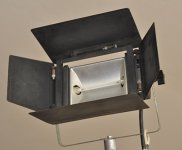
One thing I've noticed - I have three or four theatrical rectangular open-faced lights - with barn doors and yokes and TVMPs. Several of them use the exact same bulbs as work lights, which can be purchased from 100 to 1000 watts with plenty of in-bewteen... and the bulbs are cheap. I've found color temp to be consistent, and - since they have appropriate mounting hardware and barn doors - they are just crazy-good workhorse lights, for bounce, scrims, even when you need a narrow shaft of soft fill. Think of shop lights as the neanderthal cousins of these guys - not very advanced but if you know how to flag, bounce, and scrim... it's a lot of light for a few bucks.

DSC_0018.jpg
 
One thing I've noticed - I have three or four theatrical rectangular open-faced lights - with barn doors and yokes and TVMPs. Several of them use the exact same bulbs as work lights, which can be purchased from 100 to 1000 watts with plenty of in-bewteen... and the bulbs are cheap. I've found color temp to be consistent, and - since they have appropriate mounting hardware and barn doors - they are just crazy-good workhorse lights, for bounce, scrims, even when you need a narrow shaft of soft fill. Think of shop lights as the neanderthal cousins of these guys - not very advanced but if you know how to flag, bounce, and scrim... it's a lot of light for a few bucks.

View attachment 36709
I've got some nooks too and they are useful as you describe. But the globes supplied for worklights are much lower in color temperature in order to extend their life, ~2700K. You have to go out of your way to get 3200K ones. They burn much hotter and don't last nearly as long.
 
Back
Top