Anyone here familiar with multi-camera sitcom shooting on film?

I read about a system from the 1960's where they would shoot film (obviously) but all the film cameras had video-outs that would go to monitors at a switcher booth (as done today), and they would do a 'live-switcher-edit' as the show shot. This saved on film and time. To do this the film cameras were remote triggered and would only roll film when they were selected.

So the director of the show would see all 5 cameras on multiple monitors, and he would do a live directing job... but only the camera being used at that moment would be rolling. So let's say the director was on camera 1... camera one would be rolling film. He'd look at his other shots via the video monitors and call for camera 3, when they switched to camera 3, camera 3 would start rolling it's film magazine, and camera one would stop. This allowed for very very long scenes without having to stop, as they would have lots of leftover film, had all five cameras just ran the entire time. They can, and often did, roll at least two camera angles at once, but would turn off any that were definately not going to be used.

I found this incredibly cool and smart... then I wondered if this was a modern day practice or not, since I have never worked on a staged sitcom that shot on film, like FRIENDS. They used film cameras from Panavision.

The only issue I can tell from this practice is the moment it requires for film to get to 'speed'. I'm wondering what was done to mitigate those losses.

In the article, the DP said that doing this method made the weekly consumption of film to go from 22,000 feet to 16,000 feet, which is quite a bit!
 
I don't know about starting and stopping, but I think this sort of dual film/video system was used on early "I Love Lucy" which was still filmed live to air, but had pristine film masters for re-runs, as opposed to the "Honeymooners" which used kinescopes to film a monitor feed.

Perhaps this where calling a preview for a camera, before a go came from, they would need that few seconds of preview to get the film rolling before calling the actual take. I have to wonder what they used as a sync reference if not all the cameras started on the slate, this would be way before time code. Secondary audio recorder for 'bloops'?

As shows are no longer live to air. I would think the studios would want full coverage to allow for the best post edit.
 
^ Good points. Really good questions regarding the sync sound. That would be quite difficult. They didn't mention that at all. I know nothing about sound, how was it recorded back then? Magnetic tape stock?

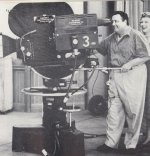
I think you are right about the live to air thing too, except the show The Honeymooners was the first major show to use the live on film system in 1955-1956 area. It would shoot video while shooting film (as normal) at the same time. Silly looking camera. I have a picture of Jackie Gleason looking at the camera for a sense of scale.

The other productions, that didn't do this, did what I described above, namely the studio show (not a sitcom) "People Are Funny" in 1956.

Here is the picture of Gleason... who isn't a small fellow, as you know. Look how big that camera is. At least it wasn't an original technicolor camera. That would likely be the only way it could get bigger!


jackie.jpg


This photo is from a Mitchell Camera Ad / DuMont Ad in 1956, and within the advertisement said that the Honeymooners was the first major show to use the system of 'live to film'. Maybe I Love Lucy was another company's system and they Mitchell and DuMont are slanting facts for the sake of advertising. Who knows. According to them, this was the 1st. :-/
 

Attachments

  • jackie.jpg
    jackie.jpg
    60.8 KB · Views: 0
Last edited:
I read about a system from the 1960's where they would shoot film (obviously) but all the film cameras had video-outs that would go to monitors at a switcher booth (as done today), and they would do a 'live-switcher-edit' as the show shot. This saved on film and time. To do this the film cameras were remote triggered and would only roll film when they were selected.

So the director of the show would see all 5 cameras on multiple monitors, and he would do a live directing job... but only the camera being used at that moment would be rolling. So let's say the director was on camera 1... camera one would be rolling film. He'd look at his other shots via the video monitors and call for camera 3, when they switched to camera 3, camera 3 would start rolling it's film magazine, and camera one would stop. This allowed for very very long scenes without having to stop, as they would have lots of leftover film, had all five cameras just ran the entire time. They can, and often did, roll at least two camera angles at once, but would turn off any that were definately not going to be used.

I found this incredibly cool and smart... then I wondered if this was a modern day practice or not, since I have never worked on a staged sitcom that shot on film, like FRIENDS. They used film cameras from Panavision.

The only issue I can tell from this practice is the moment it requires for film to get to 'speed'. I'm wondering what was done to mitigate those losses.

In the article, the DP said that doing this method made the weekly consumption of film to go from 22,000 feet to 16,000 feet, which is quite a bit!

This kind of thing is still done for "live" TV shows -- talk shows, etc. I worked on a topical talk show in Seattle in the late '90s and it was all done that way, edited and recorded in real-time.

You might actually check with some local public access channels -- if they have their own studio, they probably have that kind of a setup and training classes for it.
 
I read about a system from the 1960's where they would shoot film (obviously) but all the film cameras had video-outs that would go to monitors at a switcher booth (as done today), and they would do a 'live-switcher-edit' as the show shot. This saved on film and time. To do this the film cameras were remote triggered and would only roll film when they were selected.

I don't know the details but I recall hearing on a DVD of "The Bellboy"(1960), Jerry Lewis' first film as director, where he had a 'video assist' feed available so that he could 'see' what the camera was seeing.

This may have then been developed into the system you found where several cameras with such feeds, were fed into the 'standard studio' type control room.

One of the issues back in the olden days, was delayed broadcasts across time zones, which 'film', whether originally shot on film, or 'kinescoped', was the only reasonable media until video tape was sufficiently developed. And even wyrder... Here in San Diego the ABC affiliate had their transmitter in Mexico. Due to FCC regulations about content origin, transmitting a TV broadcast signal outside the US was illegal, at the time, so programing had to be transferred to 'film' then physically transported and played in the studio in Mexico... according to the Wiki article this was called 'bicycling'... which may have worked moving media around New York... but required cars here...
 
This kind of thing is still done for "live" TV shows -- talk shows, etc. I worked on a topical talk show in Seattle in the late '90s and it was all done that way, edited and recorded in real-time.

You might actually check with some local public access channels -- if they have their own studio, they probably have that kind of a setup and training classes for it.

Yes, but those shows are digital, yes? Did the one you worked on shoot film? I've been on plenty of multi-cam video shows where the show is edited on the spot via a director switching between the streaming feeds. I am asking about film production, when all the cameras are shooting film, and specifically if the use of the system that was developed in the 50's, where as the director cuts between video feeds, the cameras would start and stop their actual filmming as directed. I found that a really fascinating way of working with film cameras. Then there is shows that went live and did have a video edit transmission live AND recorded to film, such as discussed above.

I don't know the details but I recall hearing on a DVD of "The Bellboy"(1960), Jerry Lewis' first film as director, where he had a 'video assist' feed available so that he could 'see' what the camera was seeing.


Yes, he is given credit for video assist quite often. I'm not sure what the definition is that makes his invention much different from the video-film hybrids made by DuMont. I found an article on the camera system from 1955, that I am reading right now. I will post it because it seems that the video camera was capturing the light reflected from the mirror shutter of the film camera... which is just a big fat version of a modern video assist. I will investigate further.
 
Last edited:
From May 1955,
"Electronicam" is the tradename of the newest dual purpose video-film camera unit for the simultaneous motion picture and electronic recording of a scene or image. Developed by Allen B Du Mont Laboratories, Inc., "Electronicam" was given initial public demonstration April 14th in New York. The 'Electronicam' system operates in the following manner: An image-orthican television camera head and a film camera are mounted side-by-side on the same base and operate with a common lens system. The base is mounted conventionally on a tripod or dolly. Except for the common optical system, both units are independent and have their individual power supplies which function simultaneously.

The optics of the 'Electronicam' system are designed so that a portion of the light passing through the common lens is split up into two parts-- one going to the film and one to the television camera. The system operates with either of two basic pickup units. One of these is designed primarily for the making of motion picture films, utilizing the television system as the control and editing means. This unit operates on the principle of a time-shared light path. While the film pull-down is moving a new frame of film into position in the film camera, a shutter interrupts the light path. During this interruption, the image is reflected from the front surface of the shutter into the optical path of the image-orthicon tube in the television camera.

If the studio lighting and film sensitivity requirements are satisfied, the 50% light duty cycle to the television camera provides automatically an adequate signal for monitoring and studio direction purposes. There is no problem in changing from monochrome to color film operation, according to DuMont engineers. The excellent sensitivity of the image-orthicon camera, they point out, permits the use of all conventional photographic emulsions in black-and-white and in color with practical amounts of studio lighting.

The other version of the 'Electronicam' system pickup unit is suited to the requirements of the TV broadcaster, providing a direct film recording while a high quality studio television signal is simultaneously broadcast. This unit operates on the principle of a shared optical system where a major percentage of the light passing through the common optics is transmitted to the film camera and a minor portion is reflected to the image-orthicon tube in the television camera. The sharing ratio of the light between the two optical paths is determined by the film sensitivity, the image orthicon sensitivity, and the studio lighting. These principles are common to both black-and-white and color operations.

DuMont employs image-orthicon cameras in its 'electronicam' system because, as they point out, "the superior performance and versatility of the I-0 tube permits a much wider variety of shots and effects that the less sensitive camera such as the vidicon."

Another advantage in the use of the high definition signal delivered by the image-orthicon camera is the fact that the I-O matches the existing control units, standard television switching control equipment and matting amplifiers. This, according to DuMont engineers makes it possible to record an 'editing master' film guide (the equivalent of a work print) at the same time that the high-definition film is being shot. This editing master is recorded (actually kinescoped) complete with all wipes, lap-dissolves, fades, super impositions and other special effects normally processed optically in the motion picture industry-- the effects being produced electronically at the mixing panel. This guide is later used as an aid in putting together the final high-definition film version produced by the film camera component of the system.

The entire 'Electronicam' unit is operated in exactly the same manner as a standard television camera. The focusing control handle, located on the back of the TV camera in the panhandle, has been modified so that it controls the focus of the common lens system. It permits continuous control of focusing throughout the shooting sequence. Thus the advantages of TV 'ad lib' focusing and camera direction are made available to the motion picture cameraman or director. Since both TV and film cameras receive light through the same lens system, the image sent to both cameras is in focus. The camera operator determines the focus by looking at the image in the 'Electronican's' electronic viewfinder inset in the back of the camera.

DuMont engineers emphasize that tremendous savings in motion picture production as well as increased quality of product are a possibility becuase of the instantaneous monitoring of the motion picture cameras afforded by the TV monitors and the electronic viewfinders of the 'Electronicam' system. Set-up time can be cut way down, and much of the editing of productions can be done as shooting takes place, just as live TV shows are now edited during the process of being picked up and put on the air. Perhaps the important time and money saving feature of the system for the TV film producer is the 'editing master' film, mentioned earlier. This film represents a print of all the 'takes' chosen by the director during shooting, and it is complete with all the wipes, dissolves, fades, scene shifts, and other effects which were ordered by the director, executed by the engineers, and which appeared on the monitor as the show was recorded. With this 'editing master' it is claimed, final editing fo the complete film production can be accomplished in a matter of hours, instead of days or weeks.

'Electronicams' are to be made available in two models-- one for 35mm and one for 16mm films. The 16mm model, which was demonstrated, is capable of loading up to 1200 feet of monochrome or color film-- sufficient for recording a 30 minute program.

The motion picture segment of the pick-up units contain built-in synchronizing bloop lights and are operated from a control panel located at the switching position, which also contains the individual motor controls for each unit and the gang control that makes possible the simultaneous start of all cameras.

During early stages of testing the new 'electronicam' system, a series of motion picture films were successfully shot under stark and unrehearsed conditions of production. Cameramen who were totally unfamiliar with the equipment were assigned to the cameras for the test runs. They were given ad-lib direction by intercom for camera movement, turret changes, and focus adjustment. The results were screened during the New York demonstration of the system. The continuous follow focus feature of the system, its complete mobility, and it's ease of lens change -- plus the electronic editing and monitoring facets of the system all indicate that it has a definite future in the production of motion picture films.

Months later an article about this system being used on The Honeymooners showed up... October 1955

It's called Gleason Goes 'Live on Film'

Of the three video-film systems developed and introduced to date, the DuMont Electronicam is the first and only one to go into practical television film production. "The Honeymooners", most popular feature of Jackie Gleason's weekly 60min television show, is the first major TV program to go before the electronicam systems. The Du Mont electronicam system is a new and completely engineered method of recording programs on film through use of 'live' television techniques. It differs from 'live' television only in that the permanent recording, for 'delayed' markets and subsequent re-runs, is a camera-photographed motion picture-- either 16mm or 35mm-- instead of a kinescope with its poor quality and extremely limited use.

Electronicam differs from the conventional motion picture filming in that (a) it permits cameramen and directors, by means of normal television viewfinders on the camera, and by monitors in the control room, to see what they are recording on film as each scene is being shot. No longer do they have to shoot 'blind' and wait till 'rushes' are developed before they know whether they got what they wanted, or whether retakes will be needed. (b) it enables production units-- once they are set up and rehearsed-- to record a complete program in no more time than it would take to put that same program on the air live, using as it does, the same TV personnel and the same TV techniques with which all hands-- performers and technicians alike are familiar. Putting a program on film so fast, so smoothly is unheard of in modern film production. But it is this very identity of method which guarantees that the filmed program will have the naturalness, spontaneity and 'look' of a live telecast, DuMont engineers point out. (c) it cuts cost..... (article goes on)

So I guess I've split this conversation into two fields...

First of all, the video assist.

This video system from 1955 is basically a video-tube that gets the light reflected off of the mirror shutter of the film camera... Exactly like how a video assist works in a modern day reflex camera but much larger. I still fail to understand the timeline of Mr. Lewis and his 'invention' that is credited to him.

The other thing is this article doesn't seem to mention the practice that happened on the show (in 1956) called 'People are Funny' where they would only roll the film side of the video-film cameras when they were selected in the control room. It saved film by not rolling all cameras at once, but that seems strange for audio and roll-speed issues. The HoneyMooners article did not mention them ever selectively running cameras during only certain times, while others ran at other times.

AND it is clear now that the video signal here, for the Honeymooners, was kinescoped and then used as a guide for the actual camera negative edit. So it seems they might have used the kinescoped 'master' for a fast turnaround version, while the film was then cut to the kinescoped master as a higher quality master and used for other markets and re-runs... less time sensitive stuff.

Can anyone tell me what the importance of being in such a rush was? I see how the kinescoped master is a good way to get a fast edit and template ready for the actual film, but did they do news segments in Gleason's show? I thought it was a comedy sketch... like what ricky gervais parody's in Extras. Why couldn't they have shoot it days before air (weekly show) and then take the extra time release the good quality film for all broadcasts?

They weren't very clear, but it seemed that they might have actually used the Kinescoped version for first broadcast. I don't get the hurry.
 
Last edited:
So I guess I've split this conversation into two fields...

First of all, the video assist.

This video system from 1955 is basically a video-tube that gets the light reflected off of the mirror shutter of the film camera... Exactly like how a video assist works in a modern day reflex camera but much larger. I still fail to understand the timeline of Mr. Lewis and his 'invention' that is credited to him.

Here's an article on that subject. It seems that Lewis may have 'overstated' things... What probably is not over stated, is the extent, and use of 'video' displays on set, while filming...

However, the actual 'video assist', the article indicates that patents existed from the mid 40's... and further, that Lewis' use was perhaps more on the order of a separate video camera next to the film camera, with the video displayed on a number of screens around the set, so that Lewis could 'see' his performance.

http://filmcastentertainment.blogspot.com/2009/08/video-assist-predates-jerry-lewis.html
 
Can anyone tell me what the importance of being in such a rush was? I see how the kinescoped master is a good way to get a fast edit and template ready for the actual film, but did they do news segments in Gleason's show? I thought it was a comedy sketch... like what ricky gervais parody's in Extras. Why couldn't they have shoot it days before air (weekly show) and then take the extra time release the good quality film for all broadcasts?

The "rush" on The Honeymooners was that it was a live show -- the TV cameras were used to broadcast the action on the set instantaneously at the time of production. The film version would have been used later for overseas distribution, reruns and archiving the program. The audience expected all television to be live in those days and I suspect pre-filming the Honeymooners
segments would have been perceived as "cheating" by a lot of viewers at that time -- not to mention (tongue only partially in cheek) that Gleason pretty famously only wanted to work one day a week.

This is a pretty massive, R&D and capital-intensive solution to what, in the era of videotape and cheap video cameras, doesn't seem like such a big or expensive problem anymore! It's really interesting to look at some of the weird mechanical-electrical contraptions that developed in that era. (The aviation industry was rife with them at the time also.)

I knew about these hybrids but had never heard before about linking the rolling of the film cameras to the video switcher to save film. It seems like the rev-up time of the camera would be a problem, but maybe not; certainly I've used a lot of 8mm and 16mm cameras that could come up to speed within a frame or so. If you could delay the shutdown of the first camera by a few frames while starting up the second one, I suppose there would be enough footage to cover. And they did it all without even time code! :)

- Greg
 
Last edited:
In the 1940s & 50s, most TV shows were either shot multi-camera "live" to broadcast (eg. "The Honeymooners") or film style single camera with film style post (eg. "Wagon Train" or "The Twilight Zone") for later broadcast. "I Love Lucy" was the pioneer of shooting multi-camera for post.

Live shows, like "The Jackie Gleason Show" (which included the Honeymooners) or "Playhouse 90" (Rod Serling was a frequent writher and Syndey Lumet was an occasional director) were broadcast live as they were shot east of the Mississippi river, but were recorded onto Kinescope (often shot directly off of a TV monitor) to be rebroadcast an hour or two later west of the Mississippi. There was no other way for these shows to be recorded, cut and rebroadcast in that timeframe before the invention of video tape. I suspect that the shot of Jackie Gleason with the dual-camera system is just a PR shot. I don't think I've ever seen a "Honeymooners" rerun that wasn't from a Kinescope. Kinescopes have a signature flicker and scan roll.

"I Love Lucy" pioneered the method of shooting on three film cameras and cutting all three negatives together into a single show to be broadcast later. Desi Arnez, Lucille Ball's husband and co-star, was the architect of this method. He hired a top DP (for scale), a seasoned editor, and rented three new crabbing dollies and a newly kluged "four-headed-monster" made up from several upright Moviola editing machines to turn the three camera (and one soundtrack) show into a single cut. The immediate success led to Desilu (Lucile Ball's and Desi Arnez' joint production company) being the go-to shop for multi-camera sit-coms. Along the way they also pioneered syndication and were the home of shows like "Mission Impossible" and "Star Trek".
 
Back
Top