FS7: Angenieux EZ 30-90 T2 vs Zeiss 21-100 T2.9-3.9

TMHiggins

Member
Which one is everyone leaning towards and why? It sounds like they will be around the same price (with the Angenieux calling for another $3000 if you want the FF capabilities).

I'm definitely more interested in picking up the Angenieux (no ramping, FF capabilities, faster) but on the other hand the Zeiss one would come in a little bit cheaper and you can cover more straight out of the box.

Just curious which one is peaking more interest if any!
 
I really like the 30-90mm T2 zoom. All my favourite focal lengths at the fastest I normally shoot. Can't wait to see this lens in person and see some samples from it.
 
I am sure both lenses are very capable but with the Zeiss, I save $10k by not needing to buy another lens to cover the full range I need. I like the idea of having one lens mounted for 95% of my shoots. I usually use something in the 18-24 range for my wide angle shots, the 21mm on the Zeiss is a nice sweet spot for that. The only thing I like more on the Angenieux is the constant T2. I can see myself shooting a lot at T/2-T/2.8 spilt range.

Both lenses seem to have the same weight and size. I considered purchasing the Angenieux and then grabbing a Canon 16-35 or something similar for those random wide angles I need. Lots of choices to consider!

I am more interested in seeing how both lenses compare on the character - sharpness, color, flare, and bokeh. I really need to do a side by side comparison when they become available.
 
I am more interested in seeing how both lenses compare on the character - sharpness, color, flare, and bokeh. I really need to do a side by side comparison when they become available.

Definitely - basing this off specs and the very little I've seen from each lens. Both very reputable companies so I'm sure they will be great! Lots of awesome announcements in regards to affordable cinema zooms this past week.
 
Which one is everyone leaning towards and why? It sounds like they will be around the same price (with the Angenieux calling for another $3000 if you want the FF capabilities).

I'm definitely more interested in picking up the Angenieux (no ramping, FF capabilities, faster) but on the other hand the Zeiss one would come in a little bit cheaper and you can cover more straight out of the box.

Just curious which one is peaking more interest if any!

The new lenses are all interesting, but none of the newly announced zooms is THE zoom many of us are wanting and needing. Close, but still not there. I am aware of the engineering obstacles that exist, but I do think that it will eventually come. Something along the lines of a 16-100mm T3.

That both Zeiss and Angenieux are offering sub $15k zooms is very good news indeed. As is the fact that both Canon and Sony are offering manual iris zooms that are par focal.
 
Last edited:
I'm appealed by both choices as well.

Lots of pros and cons from both side.

What I want to know about the Angenieux is the look. I was told at Angenieux's booth NOT to expect the same LOOK as other Angenieux zoom lenses. These new lenses are very sharp but they have more contrast and I was told to expect more of the same look as Fujinon zoom lenses. The new lenses are made in Japan, that was told publicly, but I guess they are made by none other than Fujinon after what I heard.

With the Zeiss, will still have the Zeiss LOOK, but with all the compromises that comes with this lens design.

So, all in all, we can't know before testing both !
 
I don't think that Angie video showed the lens off too well. If you'd told me it was shot on Canon L glass I'd have believed you.

A 16-100mm T3 is going to be huge and cost a shedload.

Just for the sake of reference and assuming everyone here is a clever little sausage who knows all this, a lovely explanation from wiki as it goes...

The f-number N or f# is given by:

N=f/D


where f is the focal length, and D is the diameter of the entrance pupil (effective aperture). It is customary to write f-numbers preceded by f/, which forms a mathematical expression of the entrance pupil diameter in terms of f and N.[2] For example, if a lens's focal length is 10 mm and its entrance pupil diameter is 5 mm, the f-number is 2, expressed by writing "f/2"...

Ignoring differences in light transmission efficiency, a lens with a greater f-number projects darker images. The brightness of the projected image (illuminance) relative to the brightness of the scene in the lens's field of view (luminance) decreases with the square of the f-number. Doubling the f-number decreases the relative brightness by a factor of four. To maintain the same photographic exposure when doubling the f-number, the exposure time would need to be four times as long.

A 100 mm focal length f/4 lens has an entrance pupil diameter of 25 mm. A 200 mm focal length f/4 lens has an entrance pupil diameter of 50 mm. The 200 mm lens's entrance pupil has four times the area of the 100 mm lens's entrance pupil, and thus collects four times as much light from each object in the lens's field of view. But compared to the 100 mm lens, the 200 mm lens projects an image of each object twice as high and twice as wide, covering four times the area, and so both lenses produce the same illuminance at the focal plane when imaging a scene of a given luminance.

I think that enables people to do the maths about that when you take into consideration requiring an image circle of over S35 or even FF35mm/VV coverage.
 
The two new Angies have so much appeal. A 15-40mm T/2 (and only 2kg!) would barely ever leave my camera.

They'll make a pretty terrific and futureproof combo.

I'd almost consider selling up my CZ.2s to get that focal range and T-stop for S35mm shooting (though I'll have to wait and see if more full-frame cameras come on the market - because I think the Zeisses offer a better range for the larger format).

But I'm so in love with the look of the Zeisses, I think I'll probably just add one of these new sets of affordable(!) superspeeds (Sigma, Celere or Tokina), and then I have ze Germans for all my standard shooting, but a set of superspeeds for when I need those extra two stops, or better close-focus abilities.
 
what is the focus travel of these lenses I wonder.. alot over 200 degrees is going to be a bit crap for anyone without a focus puller.. which would seem to be alot of the market for these "cheaper" zooms.. in the news shooter clip they have a ASC DP talking about the Zeiss zoom saying it would be a C camera lens.. so apart from low budget drama where it might be an A camera lens.. whats the market except for doc/corp/sports dp,s.. ?.. they want 180 degree focus travel.. ?
 
Just because you don't have an AC, you still have a follow focus, right? You're not adjusting focus with your hand on the lens are you?
 

Comparing both videos is rough due to the nature of the material but I would say I prefer the Zeiss 21-100. The Angenieux's didn't really shine in that test and didn't make me go "I want to drop 20k on two zooms" mostly because it looked like natural light shooting with a RED which is always hungry for light.

Here are some of my favorite frames from "The Circle" where I think the lens really shines. Nice bokeh, skin tones, and neutral colors. This doesn't feel like the typical clinical Zeiss look I see in the CP.2's.

Screen Shot 2016-09-13 at 1.00.55 PM.jpgScreen Shot 2016-09-13 at 12.58.33 PM.jpgScreen Shot 2016-09-13 at 12.59.41 PM copy.jpg
 
Follow Focus is something I rarely find a need for.
It doesn't lend itself well to balls to the wall type of shooting.
I'm not sure I agree with that. I shoot mostly obs doc and value my follow focus whenever I have time to use it.
Follow focus slows down lens swaps.
Agreed, and when I don't have time to add it after a lens swap, I'm sad ... :embarasse
Follow focus also adds weight to the front of camera ( albeit minimal weight ) and it alters the balance of the camera ( also minimally).
These two factors are, IMO, effectively negligible. Do you use the lightest possible lens, regardless of it's optical properties? Do you also disregard an ND or Poly because it would unbalance your rig? Just move the camera back a centimeter or two!:Drogar-Shock(DBG):
It introduces possible malfunction with very little gain in exchange and it can physically impede certain shots.
A FF is an incredibly simple device. The only malfunction I've ever experienced is the FF/rail rotating away from the lens, which is always due to operator error (not tightening the rig enough).
It places your left hand further off the line of sight.
What's wrong with having your left hand off the line of sight? Especially on an FS-7, where your right hand is well wide of the lens, isn't it BETTER balanced with your left hand also offset?:shocked:
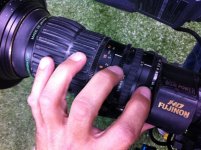
When using ff you lose the tactile, hand / muscle against lens relationship. It introduces gearing and mechanics between your hand and the lens. Gearing and mechanics that can malfunction. Stuff that further removes you, the operator, from the camera. You are less "one with the camera" when using ff.
I can't argue with that, but it sounds very subjective. Obviously we all have our preferences, but IMO they should be based on empirical fact.
Rarely do I see any shooters using follow focus.
That says more about the shooters that you see than anything about a follow focus' value.
Follow Focus is sort of a pretentious thing often incorporated mostly just to make the camera look more "Hollywood" and hopefully impress clients. More for the sets where you have the luxury of sipping latte while you collaborate on the shot over a 17" monitor with a gaggle of ad agency people none of whom have the slightest clue yet you have no choice but to respect and consider their input.
That's a subjective value judgement, and I think a poorly chosen one. People only imagine they 'look more "Hollywood"' because they are used by at least 99.99% of those people who's careers depends on smooth, accurate, repeatable focus pulls. Whilst I did smile at your depiction of a typical ad-shoot scene, I'm afraid I don't see how it relates to the use of FF!!!
Real men hand focus on the lens. As God and Nature intended. :tongue:
"Real" men aren't cameramen, they're gun-totin, baccy-smokin, girl-grabbin A-holes. AND, God doesn't seem to have any intention, otherwise we wouldn't live in a such a messed up unfair world! :Drogar-KnockedOut(D

To state my own experience, (and thus I hope justify the frankly ridiculous post-autopsy I seem to have just made - sorry!), I find that a follow focus is very helpful in allowing smoother pulls than a hand-on-the-lens, as well as allowing longer-throw pulls without having to pause to creep the hand round the barrel. A FF handle is smaller than a lens barrel, and doesn't mind if you're hand covers the live-end! :Drogar-Happy(DBG):

*Pauses, clicks 'Submit reply', and awaits the downpour of outraged counter-arguments!*

-jason
 
Jason covered most of my thoughts on this - especially that the shooters you know who never use FF are squares.

A good follow focus makes your camerawork better. End of. Same way a good tripod does. Not sexy but hugely important.

A good follow focus with a swing away arm adds about 5-10 secs to resetting a cameras after a lens swap.

A good follow focus is far less likely to introduce any disruption to the shot as compared to having your hand on the lens.


A bad follow focus is worse than Hitler.

But a good follow focus doesn't have to break the bank any more.

I'm now suspicious... Are you like this about matteboxes as well?


aUmEIIi.png
 
Real men hand focus on the lens. As God and Nature intended. :tongue:
JP - This one made me laugh out loud. Like me, you must have gotten your start or at least at one time had your feet planted in the ENG type world. Back when I was shooting 3/4" and then Beta for tv news... I would have agreed with you whole-heartedly. I do sometimes miss those Beta Sp days... but all the toys we have now... surely your tongue was inserted in cheek (or all your lenses are still lenses.) :happy:
 
This is all in good fun, boys. And do know that Ben and I often indulge in a friendly back and forth that is done with both winks and intentional tongue-in-cheek pokes. I welcome you all to join in that pastime.
 

Attachments

  • IMG_7548.jpg
    IMG_7548.jpg
    105.6 KB · Views: 0
  • 5760350.jpg
    5760350.jpg
    91.5 KB · Views: 0
  • nflfilms.jpg
    nflfilms.jpg
    75.3 KB · Views: 0
Last edited:
This is all in good fun, boys. And do know that Ben and I often indulge in a friendly back and forth that is done with both winks and intentional tongue-in-cheek pokes. I welcome you all to join in that pastime.

"A good follow focus with a swing away arm adds about 5-10 secs to resetting a cameras after a lens swap. "

5-10 seconds doesn't seem like much but there are times where I am swapping lenses every 30 seconds. 10 times in 5 minutes of shooting. Add 5-10 seconds for each swap and...well, you get the point. That means more missed shots.

Some of the shooting I do is seriously gonzo. Down and dirty shooting. Madcap shooting. No lens caps or back caps in use because they slow things down...having to temporarily hand a lens off to a Field Producer or even to a total stranger while I perform a lens swap "here, take this! Don't drop it!", performing lens swaps while the camera is still rolling in order not to miss recording audio content. ( 'But, JP, part 3.52 of Doug Jensen's instructional series says that you are supposed to power down when...' yeah, yeah, whatever. Ain't nobody got time for that.
:kali: )


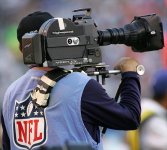
Shooting where smooth, accurate, repeatable focus pulls are possible is a minority of shooting that takes place. In most shooting such luxuries are not afforded. There are no marks, no rehearsals, no measuring of focus in advance, and the subject moves spontaneously, without warning, without any care as to attainment of smooth and accurate focus by some camera. You are going to have to hunt for focus and hunt for focus often. And there are people whose careers depend on their talent at quickly and effectively finding focus after losing focus. I argue that it requires more talent to find focus under pressure and with no witness marks than is required to effectively pull focus from mark to mark on a lens in a controlled and comparatively relaxed environment. ( ask any focus puller about the guys who shoot NFL Films on those long lenses and pull focus on the fly, with no marks, by muscle memory and instinct. The focus puller will express amazement at what those guys do. )


1) Remind me never to lend you gear :)
2) The minority of shooting that takes place 'in your world'. Smooth accurate focus pulls are a huge part of my work and that of the people I work with. Even with unblocked, unmeasured 'reactive' pulling in docs. If I do a job needing my zooms I won't use a FF but whenever control is the order of the day it is of paramount importance. I think you'd be surprised what a good focus puller is capable of. Sadly, I'm not one of them :(
 
Back
Top