
Navigation
Install the app
How to install the app on iOS
Follow along with the video below to see how to install our site as a web app on your home screen.
Note: This feature may not be available in some browsers.
More options
You are using an out of date browser. It may not display this or other websites correctly.
You should upgrade or use an alternative browser.
You should upgrade or use an alternative browser.
AMC Says ‘Almost All’ U.S. Theaters Will Reopen in July
- Thread starter groveChuck
- Start date

G
Guest
Guest
Five years...why so long?
...look at what Canon has been doing the last 12years since the 5Dmkii accidental success.
Tech could go faster, but they have to make money.
I don't see the comparison. At all. And I'm not saying they will thrive. But they will survive. Cinemas didn't kill the theater. TV didn't kill cinema. Vinyl didn't kill radio. Streaming won't kill cinema. Seeing a movie at home and seeing one in a theater are different experiences. One people will still want. And by the way, tube amps are making a small comeback because of vinyl enthusiasts wanting the purest analog experience.
Tube amps work too. In fact, true audiophiles, prefer the tube sound but there's a very small market for them these days.
The fact that TV didn't kill the theater market is due to a variety of causes - technical inferiority and affordable cinema prices being some of the variables (I saw ET in a matinee in 1983 for $3). But, as has been discussed here ad nauseam, the technical superiority is with the home entertainment. As is the price of the said entertainment. Most importantly, streaming is giving the studios a full control over their product, something they weren't allowed to do for 70 years.
Of course, it's possible to work out a different type of a release schedule because, should an opening month result in a gross in hundreds of millions, the studios would be well served to consider it. Especially, if they get a 90% cut of the gross. The negative here is the marketing and the advertising expense, which eats a lot of their profits.
The problem for theater chains - and this is why the Irishman couldn't get inside them - is that they make their money at the back of the run when their share goes up to 50%-70%. If that's gone, all theater chains will be broke. They work on thin margins - and in many instances, at a loss -as it is.
The only solution is for the chains to get into production themselves - either with studios or solo - because otherwise chains are done. Small coffee house type "cinemas" with a projector or a large flat screen, with a a sound bar and a subwoofer for audio, may pop up here and there and they could show classics that some fans may want to see but it won't be the multiplexes that rule the world.
And small 10-15 seat coffee house theaters will be much like tube amps. Very hot. Even more so with a hot cup of coffee.

Batutta
Major Contributor
Five years...why so long?
Five years for a consumer device like the Quest. Most of the tech exists right now, but it's expensive and bulky. For about 2k you can get the PIMAX 8Kx and controllers and get pretty close, but it has to be wired to a PC with an expensive graphics card. VR is still a relatively small market compared to traditional gaming, and VR is primarily a gaming platform so until there's enough money in it the tech will proceed slowly.

ahalpert
Major Contributor
There's enough flexibility though in how a cinema operates that it can be made into a more affordable entertainment outing again. Digital projection has already lowered costs a lot. The giant cineplexes as we know them are probably going to be downsized, but I grew up in a time when there were way fewer screens per city, with my hometown having only one theater with one screen, and rolling things back to that would still be a viable industry. There's just going to have to be a lot of belt tightening from the industry and lowered expectations.
Sounds like a death spiral to me. Being larger than life is part of the power of Hollywood and the allure of the stars.
Reminds me of the famous line...
- You used to be big.
- I am big. It's the pictures that got small.
Batutta
Major Contributor
Sounds like a death spiral to me. Being larger than life is part of the power of Hollywood and the allure of the stars.
Reminds me of the famous line...
- You used to be big.
- I am big. It's the pictures that got small.
The theaters can still be big, just fewer. That one theater and screen in my hometown was HUGE. I actually miss the days of the big single screen movie palaces. If we returned to that I would be happy. Those old theaters had personality.
Big screen movie palaces were pre-studio system breakup. The top ones were pure class. Multiplexes need to be paved over (or, more likely, have the stadium seating paved over).
Seriously, as Abe said, the death spiral isn't just a 2020 event. Netflix revenues in 2019 were (let me look it up) over $20B. The North American box office was $11.3B over the same time frame. Granted, Netflix takes in money from across the globe but North America is half of its income, making the Netflix gross almost as much as the entire film industry over the same territory. And their programming is not going to show up in theaters. They say they'll spend ~ $20B on new content in 2021. The other heavyweights are also spendnng huge money and very little of it is going to the theater chains.
https://variety.com/2020/biz/news/2019-original-content-spend-121-billion-1203457940/
I actually disagree strongly and I'm pretty optimistic that there won't be lasting psychological damage, at least not for most people. ...
Psychological damage; no, I don't think so either. I'm saying there will be a lifelong effect of some sort; perhaps minor, but it will be there. The people I knew that went through 1929 didn't have what I would call damage, but they had, from my youthful view, peculiar views and behaviors that were a direct response to their recession experience.
There is no way to know what is being imprinted in our minds and how it will affect us. I may have a lifelong need to keep 100 rolls of toilet paper in the garage that I never use. That reminds me, I've got to get to the grocery store.

Run&Gun
Veteran
Lifelong. Many of us that live through it, whether we get ill or not, will never be the same. The 1929 crash had lifelong effects on people. People I knew from that era (my parents and others) all had peculiar and rigid 'things' that stayed with them all their lives.
I think people and society today have a very short memory for the "bad things" in life. Well, really anything and everything, in my opinion. It's one of the few ways I can explain "Mom Jeans"... AGAIN.
ahalpert
Major Contributor
Big screen movie palaces were pre-studio system breakup. The top ones were pure class. Multiplexes need to be paved over (or, more likely, have the stadium seating paved over).
Seriously, as Abe said, the death spiral isn't just a 2020 event. Netflix revenues in 2019 were (let me look it up) over $20B. The North American box office was $11.3B over the same time frame.
The other thing about the death spiral is that you can reach a tipping point of declining cultural relevance. Which may have already passed when you consider declining Oscar's viewership or the preference of Gen Z and younger for YouTubers instead of scripted stuff.
The numbers we're batting around may implode if people stop caring about big releases and movie stars.
Sort of like how Elon Musk could build Tesla up in such a short time - by making it cool. If theatrical cinema stops being cool, it's screwed.
No but an 85 year old man has 6 years of life expectancy left, a woman has 7. (If you reach old age, your life expectancy is higher). The 85 year old had 13 years left just to reach the age of the 98 year old.
6yrs is still really small, compared to the years ahead for a 30yo who commits suicide because he lost his job due to lockdowns.
ahalpert
Major Contributor
6yrs is still really small, compared to the years ahead for a 30yo who commits suicide because he lost his job due to lockdowns.
I'm not sure that actually happened.
"a reasonably consistent picture is beginning to emerge from high income countries. Reports suggest either no rise in suicide rates (Massachusetts, USA11; Victoria, Australia13; England14) or a fall (Japan,9 Norway15) in the early months of the pandemic" https://www.bmj.com/content/371/bmj.m4352
Plus, business restrictions are not the sole factor in unemployment. They may not even be the largest factor. Dining, tourism and entertainment took a hit due to voluntary precautions before lockdown and they are taking a hit where restrictions have been lifted. For example, I wouldn't fly or go to the movies now even though I can.
The CARES act also expanded unemployment coverage and benefits and held back the poverty rate. Unemployment is a problem you can solve with money. dying from covid isn't.
Lots of younger people (especially men) are dying from covid in the US, which will balloon if and when hospitals are totally overrun:
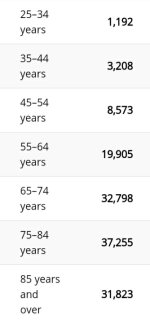
Younger guys like this 33-year old sailor who died earlier this week:


JAMedia
Well-known member
6yrs is still really small, compared to the years ahead for a 30yo who commits suicide because he lost his job due to lockdowns.
There is no point in keeping businesses open if all that happens is that is spreads the virus.
A LOT of people are asymptomatic so if they are not wearing masks the spread of the virus will be rapid.
There is an increase in younger people having serious affects from COVID. The Long COVID will affect them for the rest of their lives.
The USA has an linear increasing death toll to COVID. All the developed nations don't, they had marked decreases in deaths and transmission during lockdowns.
The US is in the top 4 worst performing nations for controlling the outbreak.
Keeping the economy open might look good on Wall street for a few months but in the long run it will be at the cost of many more tens of thousands of people.
These people are both workers and consumers. Many companies will loose essential staff and many companies will loose their customers or both.
In the long run "keeping the economy going" short term will not help the economy long term.
Though I suppose it depends if you are looking after the individual or the society at large.
... Keeping the economy open might look good on Wall street for a few months ...
In America, there's also such a thing as Main Street. Maybe not in the UK.
JAMedia
Well-known member
In America, there's also such a thing as Main Street. Maybe not in the UK.
Yes the UK has had Main Street (High Street) for about a millennium and a half longer than the USA.
However... If you kill the population it also kills the businesses.
The reality is without a lockdown the virus will kill or seriously harm so many people that it will kill businesses.
The Lockdown would be short term. Death is somewhat longer term.
For my sins the last video job I had was at a conference in March 2019 and I spent 2 evenings with people from a leading biological experts.
A Lock down is the only sensible option. This is why the whole of Europe did that.
It is also why some well informed US states did similar.
I believe DLD saying he saw ET for three dollars when it came out. Best deal until 2018 was my local cinema center in North East Indiana. You paid 30$ to join, ( you don’t need to join you just pay a little more) and the matinee were 3$ and after 6 5$ and you got a free popcorn every time. They could only do this because the cinema has never had a mortgage. All the regular art fare from the boutique divisions and others. Probably won’t see anything there until I get the vaccine. Afs in Austin for decades was the best deal around. Before I could walk to most of the screenings now when in town which isn’t often it’s a bit of a drive. Still a good deal but has lost some of the comaraderie and charm with the wild growth and crazy cost increases. Some many artists have been priced out , very sad.
Run&Gun
Veteran
The other thing about the death spiral is that you can reach a tipping point of declining cultural relevance. Which may have already passed when you consider declining Oscar's viewership or the preference of Gen Z and younger for YouTubers instead of scripted stuff.
The numbers we're batting around may implode if people stop caring about big releases and movie stars.
Sort of like how Elon Musk could build Tesla up in such a short time - by making it cool. If theatrical cinema stops being cool, it's screwed.
This brings up something interesting. Is it kind of a “counter culture” thing, with younger people gravitating towards YouTube and the like and the “anti-establishment” type content? Because as we’ve progressed, the content is becoming more and more polished (a lot surpassing traditionally produced/distributed content. I mean now networks are shooting on cell phones and YouTube vloggers on 8K RED’s) and corporate, because all of these “stars” are sponsored and/or given stuff. Maybe no one cares. Maybe it’s just the natural cycle. One day you’re the rebel, the next you’re working for ‘the man’.
Batutta
Major Contributor
I believe DLD saying he saw ET for three dollars when it came out.
Ticket prices at my local theater were $1.50 through most of the 80's. Then they chopped the theater up into three and charged $1.75, which was sad, but the main theater was still about the size of most multiplex theaters. As cheap as it was, I got in for free beacuse my sister worked there. They demolished it a couple years ago. The chain multiplexes that started to pop up in the late 80's charged around 5 bucks for an adult ticket. Kids and matinees was about 3 bucks.
I believe DLD saying he saw ET for three dollars when it came out...

Mind you, this was a Saturday matinee with a long line and a nearly full house.
PS. This is not Photoshop. It's the actual marquee from this past spring.
ahalpert
Major Contributor
This brings up something interesting. Is it kind of a “counter culture” thing, with younger people gravitating towards YouTube and the like and the “anti-establishment” type content? Because as we’ve progressed, the content is becoming more and more polished (a lot surpassing traditionally produced/distributed content. I mean now networks are shooting on cell phones and YouTube vloggers on 8K RED’s) and corporate, because all of these “stars” are sponsored and/or given stuff. Maybe no one cares. Maybe it’s just the natural cycle. One day you’re the rebel, the next you’re working for ‘the man’.
I think it goes deeper than that. A year or two back, I was pushing my toddler on a swing and an 8- or 10-year old comes over swinging beside us and starts talking to me.
So I decide to do some consumer research and ask him if hes seen any good movies lately. He doesn't watch movies, he says. "What do you watch, Hulu?" "No. Youtube."
And it turned out he mostly watches videos of other people playing video games. I guess they're sort of reviews, but mainly just a group experience of the play that you're not participating in.
I'm sure he doesn't have any notion of counterculture. I think it's about accessibility, relevance, and attention span. He can get to YouTube as much as he wants, he and his friends like video games and can talk about these videos, and his attention span probably isn't trained for longform narrative. Lord knows, he may never develop the taste for it.
So, maybe he sees this material as age-appropriate and in line with his interests. Maybe he would see all the shows I consider hot and new to be for fuddy-duddies like me. Maybe in that way it's counterculture.
But more deeply, I think Hollywood needs to cultivate every new generation of fans and they have done so effectively until now. Probably multiple reasons for it not happening anymore