Alzo 300 LED light

That's pretty much all I have experienced too - either small productions with ideally a single luggage to carry all significant gear or productions with trucks full of lighting/grip and enough crew.
The desires in portable lighting you mentioned sound right on to me too (personally rather higher (daylight) output than variable color though).
 
Here is what was averaged out as far as the light(s) specs. desired.

1- Battery operation from 14.4 V mounts or similar
2- 90 minutes MINIMUM run time at full brightness, and the ability to swap battery without power interruption.
3- 400W minimum bulb equivalent ( or 7K lumens)
4- LED color control from 2700K to 6000K

That pretty much meets my list if you add the ability to diffuse the light source and use egg-crates to control light spill.

Alzo has some low-cost soft-boxes with egg-crate options.
 
Daylight output for leds always have a higher brightness than warmer tinted ones as the yellow phosphor material used is more transparent so more blue gets through. Variable color is a "mix" of both. In the remote phosphor designs, that yellow phosphor is placed away from the blue leds as a polycarbonate sheet that also acts as a diffusion panel. That phosphor material magically transforms the ultrabule led color to a high CRI almost pure white. Changing the color temperature on RP units is only possible by changing the RP panel to a different color temp. one. The only drawback is that the light is broad wide angled. There are, however a few designs that use the RP material placed within a reflector just above the blue led(s) but below the outer area so that the beam angle is narrower. To change the color temperature on this type will require to swap out the entire "light engine" assembly for another. Possible, but perhaps in the works. Maybe NAB will have more on the RP offerings. I am sure there will be a few LEP's around, but LEP technology will require a ballast of some sort and doubtful battery powered.
 
David, incase you or others are curious to know, an Alzo 4 bank at full blast (with included grid) @ 10 feet puts out 30 footcandles.

I also tested a 575w Source 4 and at 25 feet with 19 degree beam angle its around 120 fc. The documentation shows 392 fc with 750w bulb but I have not been able to confirm that.

dennis-

are you referring to the alzo pan-l quad : http://www.alzovideo.com/alzo_pan-l-lite_quad_dimmable.htm

and what about this alzo photometric link: http://www.alzovideo.com/alzo_photo_metrics.htm

thanks for any info you care to share.

be well.

rob
smalltalk productions/nyc
 
Picked up the Alzo 3000 today; first impression is positiv, seems to be well built. The barndoors are very heavy though. Someone asked for the mount, feels ok too.

The output is nice, I am too inexperienced to compare it with a 1K without having them side by side. I can tell that it has enough output for anything I'd want to use it for.
Color looks good to the eye too.

Two strange things:
Color looks to have a (very slight) magenta touch when on full output. All settings below full don't seem to have that.

There are supposed to be five steps of brightness but it really feels like only three.
1 and 2 are virtually identical, 3 and 4 are almost the same too. The difference between full output and one below is quite big too, so the very slight magenta touch might just be my eye seeing much more of it bouncing back from the - in this case - white wall.


Dusty, have you seen these or similar things with your unit?


Bouncing it into a PLM soft silver umbrella gave really really nice light imo.

I will be on sets during next two weeks where I probably can borrow a light meter and set it up somewhere to get 10ft lux numbers.


First impression summary: I like it!


UPDATE 1

Turned it on today and immidiately felt that the fan is much too loud to use with sound recording in the same room.

UPDATE 2

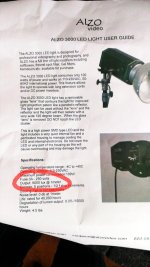
This is funny - or maybe not. Here's the sheet that came with the light. It states "6000 lux @ 1 meter" instead of the 9000 lux @ 1 meter that the website and promo video state.

alzoManual_2.jpg

Also, it states 0 db at 1 meter which my unit definately proves to be wrong.
 
Last edited:
dennis-

are you referring to the alzo pan-l quad : http://www.alzovideo.com/alzo_pan-l-lite_quad_dimmable.htm

and what about this alzo photometric link: http://www.alzovideo.com/alzo_photo_metrics.htm

thanks for any info you care to share.

be well.

rob
smalltalk productions/nyc


Hi Rob, yep those are the ones. The Alzo pan L lights. Basically 4 tubes of 55w each, so 220w total, and about 1000w equivalent of softlight output.

30 footcandles is not a lot, but at ISO's like 800 or higher this should give you at least f4 on your lens, which gives you some room to work with if you shoot at f2.8 for example. I own two of the four bank ones, and one of the 2-bank ones and love the price and versatility.

As for that photometric link, it seems about right. They are giving numbers at 1 meter (3.3 feet) and 2 meters (6.6) feet, and by the time you get to 10 feet you can pretty well see how low the "real" numbers get.

By the waylook at Kino Flo photometrics, http://kinoflo.com/Products Button/Fixtures Built-In/Diva-Lite/Photometrics.html You can see that even a D-401 at 10 feet only gives around 28 foot candles so I'd say my numbers are pretty accurate.

Cheers,
 
At a distance of 10 feet from a wall, what would you estimate the beam spread would be like with the supplied reflector attached ? a rough estimate. Like 12, 8, 5 ft wide ??
As the specs did not seem to mention that.
Thanks
 
Just keep in mind when determining beam angle or beam spread you really should use a light meter to actually measure the fall off starting from dead center going outwards towards the edge of the beam. I'd say as soon as you hit 1/2 a stop to make note of that beam diameter, and then make another measurement at 1 full stop loss.
 
At a distance of 10 feet from a wall, what would you estimate the beam spread would be like with the supplied reflector attached ? a rough estimate. Like 12, 8, 5 ft wide ??
As the specs did not seem to mention that.
Thanks

EDIT

I measured 4,60 meter / 15 feet (front of reflector being 10 feet from wall).

That's were the edges of the reflector beam can be seen when panning the light, the spill itself goes further out. There's a hot spot I can't measure but I guess it's 1/2 stop brighter than where the edges of the reflector can be recognized when panning.
I only have white walls to throw it on and measure atm though.

BTW the spec sheet says without the removable internal diffuser glass and reflector it has a 120° beam angle (See the foto above).


output is good, really.
What I'm starting to get pissed about is that the light is so loud that it's not usable for any sound recording, when they advertise it as 0 db at 1m.
I mean I can easily hear it 30 feet away, probably more if the room was bigger??!

I don't know if it's just my unit, I hope Dusty can chime in on this.
 
Last edited:
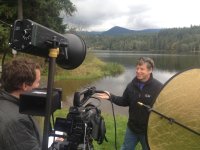
photo.jpgBoy there's much being said in many directions about this light but I must tell you it saved my ass on a location job on a lake in Seattle, got very cloudy and the sky was blowing out my image, I put some ND on the lens so of course I needed to have more intensity on my key light. We took this Alzo 300, ran power via a Radio Shack DC converter, ran it about 2 hours with no problem, lots of punch from such an inexpensive light. Had it about 10 feet from the talents face, no diffusion on the light. Looked great.
 
That's great info about the NOISE. Never even thought of that, and most of the videos I watched on that light show it being used for single or three point lighting for photography stills.

Just remember too that the further away you pull away any soft light source from your scene or subject the more it starts to turn it into a pointy hard light.

To me, the real power of this light might be using it with a more controlled modifier like a softbox with grid and getting it closer to the subject not further away. But if it's noisy... DOA.
 
Yes, I shot it into a parabolic soft silver umbrella and really really really liked what I saw, but I'd rate it pretty much useless if sound is supposed to be recorded. For anything without sound, this thing is great for the money.

Of course only if my unitisn't a bad lemon being that loud. Dusty? :)
 
+1.

I'd settle for a DSLR, set at 1/48 sec, ISO 800, TTL spotmeter reading off a grey card at 10 feet... 'til someone can get light meter readings.

I only have a GH1 here, set to
ISO 800 - 1/50 - daylight - 10 feet from Alzo

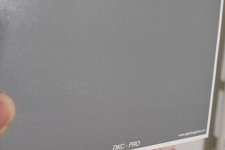
Grey Card, EV = 0 @ F 8.0 :

alzo_EV_0002_Background.jpg

F7.1 is just before the white sheet starts clipping:

alzo_EV_0000_Reflector_F7.1.jpg

F5.0 is just before white sheet starts clipping when reflector and inner diffusor glas is removed (120° beam angle according to spec sheet)

alzo_EV_0001_noReflector_F5.jpg


A smartphone app that gives VERY basic lux numbers gave these numbers:

- about 320 lux @ 10 feet without reflector and inner diffusor glas (120° beam angle according to spec sheet)
- about 450 lux @ 10 feet with reflector and inner diffusor glas


I would like this light if it roared less like a miniature hairdryer :Drogar-Mad(DBG):
 
Even if it is a 9000 lumen unit , then that equates to 9000lm/1600lm = 5.62 = 562 watt filament light bulb equivalent.
That led module then has to be 90 lumen per watt rated at full power.(assuming all 100 watts go to the led)
Fot it to be a 1000 watter (16000 lumens) then that led module has to be 160 lumen per watt rated at full power. Either alien technology or that led module is on steroids.
 
It's still very bright for what it is, I'd love to use it but it's useless for me with the fan being too loud (imagine a loud desktop computer at full work).

Anyone in EU, who does not need to record sound, interested in this light then PM me, I can't keep it anyway.
 
I've owned this unit for a few months now, and use it for hair or rim lights. In conjunction with Alzo's Pan-L two-bulb flo lights for key and fill, the combo makes for a nice interview setup.

It seems like you all have the photometrics naied-down on this light. But I'll chime-in about the noise floor of my unit: from 6' away, it's barely perceptible... way below the noise floor of my lav mic, if I were to try to record it. When right up next to it, I would liken the sound and pitch of a 120mm quiet case fan on a computer, and this falls off pretty rapidly with distance. My own PC is about 4x louder than my unit.

If I shot on a sound stage, I might possibly hear it without any other noise in the room. I'm at my house this week and would try to record it, but the boiler noise of water running through the pipes would drown out the noise of the light. With talent speaking at normal levels, I doubt if I could hear if the light were on or off.

FWIW, I'm in the States and on 120v/60Hz power and have no idea if this could/would change the sound or pitch of the fan noise compared to 240v mains. Or if stip simply got a bad unit.

I Hope this helps.
 
BrownCowVideo,

thank you very much for the precise description!!

What you describe is definately miles away from the noise level of my unit, so there seems to be something wrong with the one I received or the fan really has an issue with 230V/50Hz, I have no idea about that too.
 
Typical case or box fans used in heat/thermal management that are used in lighting and computers use a brushless DC motor typically in the 80-100 mm size with a CFM rating of around 30-50 and a RPM range of 2.5-4K which should only present the noise of the air being displaced. Being brushless in design does away with as much mechanical friction to reduce noise and improve bearing/sleeve longevity. If that noise is like a hair dryer then that is not normal as hair dryers fan must operate at a much higher RPM as the nozzle diameter is much smaller and thus has to push as much hot air out as possible regardless of noise. The fan in led units have to keep the led cool below the max allowable heat level and may only need to dissipate like 60 watts of heat at the led's full power and may only require minimal RPM speed as well as air flow noise to accomplish. If your unit is as loud as you say, then I think it is the bearing/sleeve that is dried out or a defective fan.
 
Alzo told me that the '6000lux@1m' in the spec sheet is a misprint and that it's indeed 9000lux@1m. Deleted my above post with speculation about it.
 
Back
Top