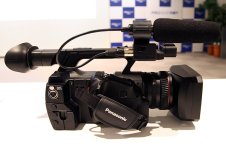
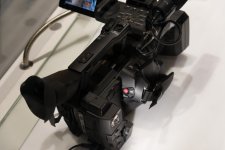
HPX250: AJ-PX270 new youtube video

12-position color matrix control on a $6K cam will pretty much remove the need to buy their $30K 2/3" AJ broadcast series cam. How about Film Rec Gamma and 120 fps and called it a mini Varicam? If they can pull that off, the next challenge would be not overheat the 1/3" PX170 w/ the extra circuits. But very unlikely for a corporation where profit matters.

Well, Canon and Sony offer very extensive color controls in their 1/3" & 1/2" camera models. Does not seem too much to ask from my point of view. I never mentioned anything about a mini Varicam :) Just don't want baked in color.
 
Panasonic sure knows how to check boxes off my wish list. Looks like about everything I've been needing in a small-sensor cam - easy flexibility to big and small jobs and (hopefully) a high-quality EVF so I can finally get critical focus IN CAMERA! (of all astounding things)...

...now if only they could mate the back end of this camera with a large-sensor, interchangeable-lens front end...
 
Large sensor cameras have one very big problem: long power zooms with a decent aperture are so large and expensive as to put them out of reach for most people. This means that for a lot of people, a small sensor makes more sense. Although I'd be much happier with 1/2". Diffraction comes in too soon on 1/3".
 
Last edited:
What a weird place to put an XLR oudio input...

Front start/stop and rear XLR input are borrowed fr 2/3" cam design. In this case they couldn't put it rear, so it's rear right.

The advantage I see here is that if you do lots of 270-degree pan left/right, the XLR cables will not get in the way as much
when it's in the rear vs the current front right. When the connectors are high up, I typically have to get a shorter 2-3
ft piggy cable w/ right angle connectors to minimize XLR cable strain. And yes, over time those XLR connectors and cable
contacts will get loose. You'll hear grounding noise.

Another issue here is for wireless mic receiver. The most commonly used is the Sennheiser G3 series. I now may have to get a short 3-5 in. XLR extension cable to run from the top of the handle to the rear back.
 
What a weird place to put an XLR oudio input...

I like it... CH1 gets the shotgun anyway, and now that plug won't be sticking out the side making an obstruction to fitting it into a bag. Leave the short shotgun attached and go. CH2 gets a breakaway cable (good position) or a wireless (unless the guy has HUGE hands in that video, looks like the cold shoe is close enough for the standard 18" G-series cable, or use the 1/4" mount hole on the rear of the handle to fit a simple bracket)

The front record button might be pointless for me but certainly it'll be welcomed by the growing ranks of self-shooting platypus reporters in the local broadcast ENG world.
 
Anyone know why they keep using 1/3" chips in these types if cams vs 1/2 like the sonys? I realize canon did the same thing with their last round of higher end eng prosumer cams, but then again the xf305 was quite a while ago.
 
Looking at this pic, it looks like the supplied shotgun mike has an XLR long enough to attach to the rear. This should allow a wireless receiver mounted on the front cold shoe to reach the front XLR port, if it has a short cable:

px-270.jpg

But then again, this camera has a shorter mike cable. Which comes with the camera?

px-270 a.jpg

Or no mike at all!
 
Last edited:
With the transition to HD Panasonic issued an edict saying they would never make 1/2" chips cameras again. They thought 1/3" and 2/3" covered the market well enough. I owned some DVC-200's which where 1/2" DV cameras and I think were the last 1/2" chip models made by Panasonic. Too bad as the EX-1 has proven to be a great success. I really like my XF300 but if it had 1/2" chips it would not be the little light challenged that it is. (probably would not have an 18x lens either...)

The 1/3", 1/2" 2/3" thing seems kind of trivial now that larger sensor cameras are all over the place. 2/3" chip cameras used to be so revered, now they are just a choice (and a very expensive choice by comparison.)
 
Aw. That's too bad they declared NEVER to make anything with that size chip. Although I guess if it makes purty pictures it does
 
With the large sensor Super 35mm size gaining popularity and it appears that many people are jumping into the bandwagon, it's interesting to see why the 2/3" cam and lens market haven't lost a big chunk of the market share or at least drop the price. Prices have been pretty much the same since 2003. I'd hoping the entry single chip 2/3" would be within $10-12K (HPX600) and the higher end 2/3" AJ 3-ccd dropped down to $16-18K. It's still $30K now. What interesting is that the HDX900 used to be about $26K in 2007-2008 and now it's a whopping $36K new. The Sony DVW900 Digital Beta is a shocking $45K at B&H. They're still making them! Are these soon to be collectible cams that appreciates over time or what?
 
I would think because those big cams still far outclass the smaller cams in picture quality (lenses etc) and are therefore used in broadcast situations where that high quality is a necessity? Also the bigger cams may stand up to rough conditions better. A local news cameraman told me something like an ex1 wouldnt stand up to what they put those cameras through over time (e.g. Shooting reporter standing in a hurricane) and thats why they still use the monsters.
 
It definately is a strange market. In my opinion, the 2/3" segement has left the supply and demand curve a bit. The demand is lower but prices are not following but seemingly going up. Pana & Sony do not want to let this part of their business go as it was always the engine of company profit. Everything in this sapce was expensive and major broadcasters just paid the money. I think that gravy train has come off of the tracks so to speak.

Back in the day, the "monster" cameras had the best image processing and chipsets. They still do have nice innerds but I think you can make a point that cameras like the C300/500 and the Sony F5/55 are in a different image quality league. I was watching the NFL draft show this year and the cameraman who was in front of the announced athlete walking to the stage was using a C300 with a shoulder mount thingy. Just seemed telling to me that the industry was moving on in a way. The big cameras are never going away but I think any wave of buying on a large scale has already happened.

1/3" vs the rest... I think 1/3" cameras given enough processing controls can look very good if the makers deem it. At some point you have to wonder if a souped up 1/3" model will make more money than another 2/3" model in the long run. I would like the emphasis to be on 1/2" because of diffraction but 1/2" does need more glass which drives up the cost of the camera. I am still interested in trying out something like a C300 with an adapter to fit 2/3" broadcast lenses just too see how the image, noise & sensitivity are compared to that same lens on a Varicam.
 
I don't know about others, but the color EVF is so hard to focus with (HPX-250 or other higher end AJ 2/3" cam). I actually have to shut off the colors on the HPX-250 and stick w/ B&W. Much easier to focus. Maybe I'm old school, but I find hi-res b&w EVF (LCD or CRT) is much easier to control the focus than colors, especially fast moving subject that requires constant focus tracking. Colors just make it too distracting in some ways. The PX270 will very likely to benefit from added pixel counts in its EVF.

This is the first time I see that Panasonic is putting their 1/3" PX270 in the AJ series broadcast cam class ($25K+). Previously all 1/3" cams have been AG. Even the 2/3" AG-PX600 is still AG. So the price may be a bit higher and consequently the overall quality, performance and features should be much better than AG series. Nevertheless, this will augment but not replace any of their 2/3" AJ line. Something got to be sacrificed over 2/3" body for certain. Or perhaps it's just a renaming to remove the "H" in the previous models and the fact AVC-Ultra is considered higher end. However, the fixed lens is questionable.
 
Last edited:
That AJ designation is what has me interested in this camera, among its other attributes. Panasonic does indeed reserve this classification for its higher end cameras.
Hopefully Panasonic will one day put these innards into a more shoulder-friendly body like the HPX600. 1/3" chips aren't the best sensor size, but they're more than capable of doing acceptable work.
 
I'm pretty excited about this cam. Would be great if there was more info on it. Some better test footage would be nice. I always found it funny that tech companies who make video products, don't know how to make a good videos themselves. It was great when they let some AF-100s loose with some pro videographers. Hopefully they do the same here.
 
The design seems like they're going upmarket some -- it has 3G SDI, it has an OLED viewfinder (if there's one constant complaint about Panasonics, it's about the viewfinder), it has a new screen, it has 1080/60p, it can probably record AVC-LongG on regular SDXC cards, and it has wireless connectivity so you can be uploading files while they're being recorded, for the fastest shoot-to-editing workflow we've seen yet. Seems like some fairly substantial improvements in usability and workflow.

The wireless connectivity is by using the AG-WM30 wireless option, About $180 US. It will be able to record 50Mbs and lower on standard SDXC or SDHC UHS1 cards, all need to be class 10)

it has AVCI-200, it has Micro-P2,

This is an option in June, and you don't have to buy it, but if you were trying to work it with the PX5000 that had been upgraded then this may be great! Haven't see it do this yet, so I may sound more enthusiastic in June. ;-)


If it does turn out to have new sensors and/or a new lens, it could be a nice step up in quality too.

It is new sensors and a new zoom lens. This camera is distinctly smaller than the HPX250. It really is very sweet. A little bigger than the HPX170 but not by much. And it has a lot of features that start showing up when you start exploring it. I think even some of the most hardened of you will appreciate the work in this camera.
 
That AJ designation is what has me interested in this camera, among its other attributes. Panasonic does indeed reserve this classification for its higher end cameras.
Hopefully Panasonic will one day put these innards into a more shoulder-friendly body like the HPX600. 1/3" chips aren't the best sensor size, but they're more than capable of doing acceptable work.

The camera that you are talking about is the AJ-PX5000 which is the big brother to the AJ-PX270. The PX270 has the menu structure of the Shoulder Mount Cameras.
 
Back
Top