Advice for newbie run and gun filming

seanadl

Active member
Hi all,
I'm a relative newbie when it comes to camera operating. My background is TV producing so I've had to do some limited self shooting on red carpets and interviews for some of the "rougher round the edges" broadcasters such as MTV in the past. However, my comfort zone is with writing and producing.

Currently I'm running a YouTube project. I'm a one man band - writing, filming and editing everything. I'm enjoying it a lot - but feel I need to really improve my camera work.

Specifically, I want to improve my technique when it comes to run and gun reality style TV work. I'm currently writing an online series that follows a person around and will be filmed almost entirely in the style of a reality tv show. I want to mount the camera on my shoulder and follow this person out and about.

Are there any online courses or videos you recommend for learning the craft? Due to lockdown, one-on-one teaching isn't an option just yet. But I'm interested in anything that's super practical and goes into depth.

I'm using a C500ii as my main camera for everything. I've got the ZACUTO Z-RDTG ROSETTE DUAL TRIGGER GRIPS (https://cvp.com/product/zacuto-z-rdtg-rosette-dual-trigger-grips) along with a SHAPE BP10 (BP-10) Revolt VCT Universal Baseplate with Shoulder Mount (https://cvp.com/product/shape_bp10_revolt_vct_baseplate) - these were recommended to me for gun and gun work with this camera. I'm not finding the set-up comfortable, it's quite awkward actually, and am wondering if I've configured things the wrong way? For instance, where should I be placing the LCD monitor so I can comfortably view while this is all sitting on my shoulders? Where should the body of the camera be on the rails while the shoulder pad is on my shoulders? Are two trigger grips better than one? I've seen lots of run and gun people use one trigger grip and the other hand seems to grip the lens for support.
 
I'm working from memory, but I recall Michael Rabiger's textbook Directing The Documentary as including exercises on filming someone while you and they are walking, and so on.
The book is now in its 7th edition and is available everywhere. https://www.routledge.com/Directing-the-Documentary/Rabiger-Hermann/p/book/9780367235574
Available online for about $55, but older editions are like $15-20 and probably have the info you need. Might even be available at a local library.

Geez, there are so many other resources, but that's one that springs to mind.
 
I think you should practice the style of shooting you want to do (even just following your wife or whomever around the house) and retool the rig as you go until you like it.

And definitely review your test footage to make sure you're happy with the results.

The rigging should minimize strain on your back or your neck because you should be able to support the camera in a natural position. The camera and lens should be balanced on your shoulder. You'll probably need a hand on the lens for pulling focus (although when I was an AC, I dont recall a single camera operator going shoulder-mounted without 2 handgrips since they didnt have to pull focus themselves).

Different people like different rig configurations and different configurations can accomplish different styles, movements, angles. The key is to find the way you want to shoot. But certainly, if you're going to shoot shoulder-mounted for long durations, it will pay to balance the camera well, and get the controls and monitor where you can comfortably use them.

But another issue is that handheld shooting is inherently straining IMO. Basically every type of camera operation puts some strain on the body, even tripod shooting where you often have to brace yourself and hold a position for long durations
 
My philosophy of the camera rig is that you should be able to shoot in most positions with the same rig as-is. I've been building my own rigs with components from 4 or 5 different companies which allow for shoulder, waist level, and ground level shooting. Having a balanced rig is absolutely crucial, as mentioned. Also, a top handle, 2 front hand grips, shoulder pad, and preferably a rear counterweight are all crucial imo. Adding weight helps dampen out the jittery movement inherent in handling very light cameras.
 
The most optimal handheld camera was perfected long ago, its the big eng shoulder camera. The size and weight make it stable, the center of mass is directly over your shoulder, the viewfinder is positioned in front of your eye and adds an additional point of contact. This is what they use for news, sports, and reality tv. All of these smaller non eng cameras need a complicated constructed rig that isn't quick to setup and break. The weight is in front of you not over your shoulder.
 
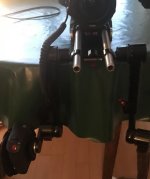
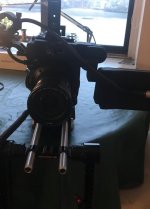
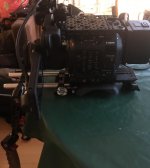
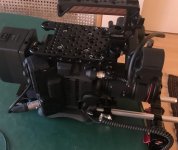
Thanks for the feedback guys - it's very helpful. I've taken a few quick snaps of the camera with the current rig. A couple from each side and a couple from the front. I find the shoulder pad doesn't sit comfortably, it's probably something to do with the ergonomics of my set-up.

At the moment I don't have a viewfinder. Is shoulder mounting out of the question without one, or is it feasible I can mount my LCD screen on a Noga cine arm and comfortably film on the shoulder while monitoring that?

How do you get the balance of the camera correct? When I try running around with this rig, I find the camera often tilts either to the left or right. Again this is probably something to do with the shoulder pad not sitting neatly on my shoulder.

Also, I'm left handed and my left eye has the strongest vision - so perhaps I should be sitting on my left shoulder.


Sorry for all the questions. I just want to get the basics of this sorted out so I can practise.

Cam-bottom.jpg
Cam-front.jpg
cam-side1.jpg
cam-side2.jpg
 
At the moment I don't have a viewfinder. Is shoulder mounting out of the question without one, or is it feasible I can mount my LCD screen on a Noga cine arm and comfortably film on the shoulder while monitoring that?

How do you get the balance of the camera correct? When I try running around with this rig, I find the camera often tilts either to the left or right. Again this is probably something to do with the shoulder pad not sitting neatly on my shoulder.

Also, I'm left handed and my left eye has the strongest vision - so perhaps I should be sitting on my left shoulder.

You might not need a viewfinder and can use the camera screen if you decide that's doing the job for you. The issue is you need to get it far enough forward e.g. 01:38 in this video - https://www.youtube.com/watch?v=a47hUI4BAHc.

You should be able to get pretty close with the cable that comes with the camera but Canon also make a comically expensive 39" cable - https://www.bhphotovideo.com/c/product/1184818-REG/canon_0887c001_un_10_unit_cable_for.html

There are left-eyed shooters out there who usually keep the camera on the right hand side but will position the viewfinder across their face to make it to the left eye. If you end up happy with the monitor position then you won't need a viewfinder as far as being in a viewable position.

Brightness is another thing to think about - the canon LCD screens are pretty bright and can be seen in a lot of situations outside but in some filming conditions it'll still be pretty difficult to see what's happening. Also, a viewfinder makes a huge difference for extended shooting outside vs. roughly judging the image gets old quickly. An in between option is to experiment with shades for the monitor, which could work fine for your needs.

Good luck and keep us updated.
 
Last edited:
Thing about the Wooden Camera rig promos is they don't show the rig with a camera mounted and I suspect (only suspect, haven't tried to use one) the reason may be that you can't use either the EVF or screen when using this rig or others like it, you basically have to guess where you're shooting. That, and all the weight is forward. I don't think anyone makes a decent off-the shelf rig. But standard parts are available and you can easily adapt one to suit you. With longer rails and a counterweight you can get the same balance as an ENG camera, and have the camera far enough forward to use the screen. The rest is practice.
 
Thing about the Wooden Camera rig promos is they don't show the rig with a camera mounted and I suspect (only suspect, haven't tried to use one) the reason may be that you can't use either the EVF or screen when using this rig or others like it, you basically have to guess where you're shooting. That, and all the weight is forward. I don't think anyone makes a decent off-the shelf rig. But standard parts are available and you can easily adapt one to suit you. With longer rails and a counterweight you can get the same balance as an ENG camera, and have the camera far enough forward to use the screen. The rest is practice.

There's a (front heavy) camera mounted in the video.
 
Shoulder pad looks way too close to the screen. I would suggest a baseplate that allows for iris rods to run forward and back in the same position so you can put the shoulder pad where it actually needs to go AND so you can mount the battery and possibly a counterweight far enough back to not be front heavy.
 
Another issue with OMB shooting is audio. AFAIK most reality shows use audio ops running a serious number of wireless mics. A typical OMB setup would be a wireless on the lead and a short shotgun on the camera. Would that be able to capture the content you want? How will you get good audio when your lead interacts with other people? You could add the expansion module and gain 2 inputs, but the module plus wireless receivers would add to the complexity and weight you'd have to lug around. Plus you'd have to spend some time dealing with getting people wired up, not shooting.

I guess this is an argument for audio ops. When producers ask me if I require audio help I say if it's a simple one on one interview, or basic non-dialogue B-roll, then I can handle it. If it's spontaneous action then a dedicated audio person would be a good idea.

As I often say, only partly in jest - "Audio, nothing but trouble."
 
Back
Top