About PAR 64 lights

Sorry to sound ignorant, but what do you mean by that statement? Do you mean Par64s are very efficient in putting out light per watt? Otherwise, I'm not understanding you.

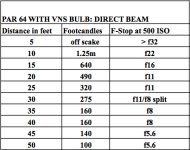
I don't want to speak for NextWaveG but what he is talking about is guerrilla filmmaking lighting electrics reality 101. Most standard household circuits are 15 amps, with maybe a couple of 20 amp circuits for the kitchen, a utility room, shop or what not. You can safely run a 1000 Watt light off of 15 amp circuit with room to spare. You need a 20 amp circuit to safely run a 2K light. (Amps = Watts divided by Volts.) To me the PAR 4 cans are the biggest bang for the buck for pure light out put. Here are the photometric readings I got with my PAR 64s, taken with my trusty Sekonic analog light meter.
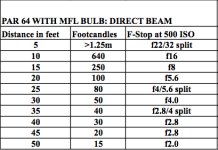
Par 64 MFL photometrics.jpg

Par 64 VNS Photometrics.jpg

When you want to set up a bounce source, like Paul Hudson said, having very bright lights that you can run stingers to regular house hold electrical circuits to spread the load with is very, very handy.

paulears is right, PAR cans are not as versatile as Fresnel lights and are not a substitute, but they are available for a lot less money. Like he said, they are what they are, but I think they are is very handy.
 
Last edited:
Thanks, David. I think what you mean is tungsten light output per $, not light output per watt... am I right? After all, you can always get Source 4 750 watt 5 degrees 15 amp giving you 124 foot candles from 105' (as an example), but you will pay some $600-$700 when all is said and done.
 
Thanks, David. I think what you mean is tungsten light output per $, not light output per watt... am I right? After all, you can always get Source 4 750 watt 5 degrees 15 amp giving you 124 foot candles from 105' (as an example), but you will pay some $600-$700 when all is said and done.

That is correct. The PAR 64 are plain ol', rather inefficient, incandescent bulbs, but the fixtures are just so inexpensive that I couldn't see a reason not to pick up a set. I would love to have a set of Source 4 PARs but I just can't swing that kind of money.
 
How are those for film work? Do they need to be bench focused often from getting banged around like source four ellipsoidals or do the lamps stay put well? ETC claims around the output of a 1k PAR64 but I'd imagine that once the bulb gets slightly knocked out of the focus of the paraboloid that bad things would happen.
There is no lamp adjustment on the par caps like there is on the ellipsoidal caps. The bulb just goes into the socket and is secured in place when the cap is tightened to the housing. The beam spread is controlled by your choice of lens like an HMI par. For high lumen output combined with low wattage you might want to look into some of the LED options out there provided you have deep pockets.
 
These days I don't know if indie filmmakers care what we do in "Hollywood" any more, but for what it's worth: Par 64's (as well as 40's and 20's) are pretty standard order f electric package, as well as lekos. Their uses overlap depending on preference. I myself will specify a par can for a "sloppy" bounce (if I'm not concerned about spill around the hot section), for a background accent on a large set, or for specialty purposes ( just shot a faux rap video where I needed a lot of sources in shot to play flares via blue streak filter; all three sizes of pars did the trick nicely). One of my gaffers loves them for creating sunshine hits across a set, using the Firestarter globes. I love the Source 4 lekos for tidy bounces (where you can exactly fit the beam into a piece of card), for quickly punching up a face or a detail without splattering light around the set, to duplicate a follow-spot, or of course to throw a pattern via gobo. I probably call for the lekos three times more often than the pars, but they are both staples of my package.
 
Most standard household circuits are 15 amps, with maybe a couple of 20 amp circuits for the kitchen, a utility room, shop or what not. You can safely run a 1000 Watt light off of 15 amp circuit with room to spare. You need a 20 amp circuit to safely run a 2K light. (Amps = Watts divided by Volts.) .
Since you brought it up and just to be a bit more technical and contribute here, on the 20 amp household circuits newer homes should have at least 5 usable 20 amp circuits. My home has 10. 1). washing machine, 2). bathroom(s), 3&4). 2 for kitchen counter, 5). microwave/hood, 6). fridge, 7). disposal & dishwasher, 8). Security panel, 9). TV & 10). Christmas lights. 9 and 10 were added custom, but most of those will be standard in homes built in the past 15 years in the US. I know it can vary but I thought it might be worth mentioning.
 
Newly built homes (if properly built!) should have true 20 amp circuits, and the circuit breakers in the box may be rated thus, but in older homes the wiring and/or outlets themselves may be only rated for 15 amps.
 
How are those for film work? Do they need to be bench focused often from getting banged around like source four ellipsoidals or do the lamps stay put well? ETC claims around the output of a 1k PAR64 but I'd imagine that once the bulb gets slightly knocked out of the focus of the paraboloid that bad things would happen.

No need to focus. You just change lenses, like HMI pars, for varies spread patterns. We have also rigged 9 to twelve of these lights on rectangular rigs to make make-shift maxi-brute rigs, at 575 watts per light you only need three circuits per rig to power a nine light rig. Source4 claims the 575 output is about the same as a tradition 1000 watt standard par light.
 
If I can piggyback on some questions here, I was looking at Source 4 Par-nels that I want to use in my apartment, so I assumed that I should look for Edison plugs (am I right?), but they don't show what amperage is required:

ETC Source 4 750W PAR-nel Edison Plug (115-240V AC)

whereas they show the same exact lights, except with a twist lock listed as requiring 20 amps:

ETC Source 4 750W PAR-nel 20 amp Twist Lock (115-240V AC)

I looked over the specs and the twist lock doesn't show it as being dimmable, so my questions:

1)Can I use the Edison plug in common household outlets (grounded)
2)Can I assume the Edison plug version as 15 amp?
3)Why is the twist lock version 20 amp?
 
Since you brought it up and just to be a bit more technical and contribute here, on the 20 amp household circuits newer homes should have at least 5 usable 20 amp circuits. My home has 10. 1). washing machine, 2). bathroom(s), 3&4). 2 for kitchen counter, 5). microwave/hood, 6). fridge, 7). disposal & dishwasher, 8). Security panel, 9). TV & 10). Christmas lights. 9 and 10 were added custom, but most of those will be standard in homes built in the past 15 years in the US. I know it can vary but I thought it might be worth mentioning.

Newly built homes (if properly built!) should have true 20 amp circuits, and the circuit breakers in the box may be rated thus, but in older homes the wiring and/or outlets themselves may be only rated for 15 amps.

New construction probably does have more 20 amp circuits. I just have not had that many opportunities to shoot in newer homes. Most of the houses I have shot in most had 15 amp circuits with just a few 20 amp circuits thrown in. Commercial buildings, schools, churches and the like are a different story and have been, for the most part, pleasures to shoot in; available electricity wise.


BTW, I was reading the April 2013 edition of American Cinematographer today and noted that in the articles about the making of "The Place Beyond The Pines" and "Oz The Great And Powerful" they both mention using 1K PARs. Here is a pic from "The Place Beyond The Pines":

Place beyond the pines Par light.jpg

It is a small picture but that sure looks like a 1K PAR in use to me. "Oz The Great And Powerful" made extensive use of 1K PARs. They used up to a total of 1200, through overhead diffusion, as their general ambiance. They also said that they used 168 PAR lights grouped together into an eleven foot "Big Sun" source. On that gizmo they mention using different lenses on the lights in the rig so I would venture that they used Source 4 lights.
 
If I can piggyback on some questions here, I was looking at Source 4 Par-nels that I want to use in my apartment, so I assumed that I should look for Edison plugs (am I right?), but they don't show what amperage is required:

ETC Source 4 750W PAR-nel Edison Plug (115-240V AC)

whereas they show the same exact lights, except with a twist lock listed as requiring 20 amps:

ETC Source 4 750W PAR-nel 20 amp Twist Lock (115-240V AC)

I looked over the specs and the twist lock doesn't show it as being dimmable, so my questions:

1)Can I use the Edison plug in common household outlets (grounded)
2)Can I assume the Edison plug version as 15 amp?
3)Why is the twist lock version 20 amp?


Yes, the 750 will work fine on a 15 amp edison plug. It is listed as 20 amp because the twist lock is rated at 20 amp not because the instrument requires 20 amps. The Parnel is dimmable and you can down lamp it.
 
No need to focus. You just change lenses, like HMI pars, for varies spread patterns. We have also rigged 9 to twelve of these lights on rectangular rigs to make make-shift maxi-brute rigs, at 575 watts per light you only need three circuits per rig to power a nine light rig. Source4 claims the 575 output is about the same as a tradition 1000 watt standard par light.
I knew that the lenses were changed out to change the beam spread, interesting that there's no adjustment to make sure the filament of the lamp is perfectly centered in the reflector though. I don't know about really big HMI PARs but the smaller ones that I've worked with have that adjustment.

Also, B&M makes an actual light like what you're talking about, a maxi using HPL lamps with swappable lenses.
If I can piggyback on some questions here, I was looking at Source 4 Par-nels that I want to use in my apartment, so I assumed that I should look for Edison plugs (am I right?), but they don't show what amperage is required:

ETC Source 4 750W PAR-nel Edison Plug (115-240V AC)

whereas they show the same exact lights, except with a twist lock listed as requiring 20 amps:

ETC Source 4 750W PAR-nel 20 amp Twist Lock (115-240V AC)

I looked over the specs and the twist lock doesn't show it as being dimmable, so my questions:

1)Can I use the Edison plug in common household outlets (grounded)
2)Can I assume the Edison plug version as 15 amp?
3)Why is the twist lock version 20 amp?
Yes, yes, and I'm not really sure what you mean. NEMA L5-20 plugs are rated for 20 amps, B&H just happens to sell that fixture with one of those plugs installed. A 15 amp twist lock plug would work just fine though, seeing as how 750w is only 6.25 amps.
Both are dimmable, it's the same light. I wouldn't really look to B&H for accurate descriptions and specifications. They sell hundreds of thousands of products, many of which they don't even keep in stock. It's not like they're checking to make sure everything is accurate.

Spiderman is making extensive use of LED PAR cans to replicate the illuminated signage of Times Square. They also used two PAR64 cans on a technocrane to make a rather interesting gag - a fast approaching car headlight effect. Don't want to say too much more in an open forum and potentially get someone in trouble...
 
Last edited:
Thank you Paul and Moseph! I'm generally exploring Source 4 lights, and just figuring out what's what, so sorry to ask newbie questions... but anyhow, I see these PAR-nels, and I'm trying to figure out what the pros and cons are compared to equivalent wattage tungsten fresnels - it seems the PAR-nels would be somewhat brighter for the same watts, but as you guys say they are dimmable, so they still should have quite a bit of control (plus the 25%-45%). I guess they're somewhat heavier and if they're using the HPL bulbs, maybe it's like 300 hours which sucks. I don't see the PAR-nels discussed on these boards as much, so I wonder what the deal is why the fresnels are so much more popular (and price-wise about equal). Thank you again, guys, I'm learning so much!
 
Thank you Paul and Moseph! I'm generally exploring Source 4 lights, and just figuring out what's what, so sorry to ask newbie questions... but anyhow, I see these PAR-nels, and I'm trying to figure out what the pros and cons are compared to equivalent wattage tungsten fresnels - it seems the PAR-nels would be somewhat brighter for the same watts, but as you guys say they are dimmable, so they still should have quite a bit of control (plus the 25%-45%). I guess they're somewhat heavier and if they're using the HPL bulbs, maybe it's like 300 hours which sucks. I don't see the PAR-nels discussed on these boards as much, so I wonder what the deal is why the fresnels are so much more popular (and price-wise about equal). Thank you again, guys, I'm learning so much!

A regular fresnel is more popular for many reasons. It is simpler to focus (no need to change lenses), it usually comes with a switch, a long cord and a bale block. If you plan on using the Source 4 for general production work you will need to add a lot of these items. With all these modifications you may still not be as happy with the results as you would be with a fresnel with a moving lamp focusing mechanism. Like I stated earlier we do use the par version of these lights often but mostly for bright bounce sources or in multiple light arrays for lighting very large areas.
 
I think he's referring to their PAR-nel, not the regular source four PAR (which is hardly "regular" either in the sense that PAR64 has been around for decades longer).

Those specific lights aren't as popular for film work because that's just not what they're designed for. Sure, S4 ellipsoidals aren't either, but there isn't really anything that comes close to that quality of light designed for motion picture use. The HUGE molelipsos, even with their top of the line construction, are vastly inefficient compared to a S4. With the PAR-nels, there are already more established fixtures that were made for film/TV that can do what they do better, so there isn't as much room for them in the market. However, the new Arri multifaceted reflectors used on their M series and their open face quartz fixtures seem to render similar quality of light to the S4 PAR-nels.
 
Right, I thought the whole idea of PAR-nel was that it had focusing like a fresnel. The cord and bale block are not a big deal, but it's interesting Moseph, what you're saying about the new Arris - except aren't they a lot more expensive? Of course, as you say, if there are already fixtures that were designed for film/TV that do a better job than the PAR-nels, then indeed, no reason to bother with the PAR-nels, which is why I'm trying to get clear in my head as to how exactly tungsten fresnels are better (I assume) than the PAR-nels, hence my questions (you guys have tons of experience). Of course, I can see how for example Dedo lights would be superior, but when I was paying for coffee at starbucks today, I pulled out my wallet and it screamed "don't even open a page with Dedo lights it is strictly forbidden - and make the coffee plain and no pastry for you!". So here I am.
 
Well, for one thing, PAR-nels only come in one size with 3 wattages to choose from. 20k fresnels are pretty standard issue lights for some larger jobs with night exteriors, no such PAR-nel even approaching that size exists...because there's ONE size. But if you're talking about within the general range of power from 600-1k, a fresnel will have a much better focusing range and when fully flooded can be cut more easily with the barn doors. If said fresnel is a Mole, it would probably be more durable as well. But when it comes to pure output, I'm sure a PAR-nel would be far more efficient. I always go back to this - every light has it's place. Fresnels are probably the single most versatile light out there, but they're only REALLY good at one thing, which is getting crisp shadows (which nobody even wants these days anyways). PARs and open face lights are a bit less versatile since they're less controllable, but they're much better at putting out a lot of light for bouncing or diffusing. A PAR-nel probably falls somewhere in between, and in some situations, certainly could be better than a fresnel. To say that a fresnel is better would generalization of all possible scenarios, since many times they could be a better light, but sometimes might not be.
 
Thank you, Moseph, this clarifies my thinking about it. I think I'm understanding the options a little bit better, now that you guys explained it. I am of course coming from a specific perspective - tiny no-budget shooting with household AC (and maybe the odd 1K generator once in a blue moon); in my world 20K lights are on a different planet, I'm not going to be dealing with them anytime soon. My max light is going to be a 2K.

Basically what I'm doing is trying to understand the options out there lighting-wise, for a small budget of around $3K (just for lights, not counting grip equipment or shaping light), for narrative work (own, not rent). I doubt I'm going to light daylight exteriors, so it's mostly going to be interiors of not very great size (no sports stadiums or giant warehouses). I'd like to know what the options are. I am excluding some things purely on budget grounds - f.ex. Dedo lights, even though otherwise they'd be the bees knees: very kind to household AC and great light output in a small package... but I can't afford it.

The first thing I noticed is that I can't really get inexpensive hard daylight fixtures, as the options in HMIs and super-advanced LED are out of my budget range. So, for daylight, my idea was to get some beefy tungstens with max output that can still be handled by household AC (1500-2000V), and gel them to daylight; I understand that I'm losing massive light by gelling, but I figure with very sensitive camera sensors these days, and starting with max output, I might just squeak by for hard daylight as long as I'm not trying to do exteriors at noon in the sun. So basically, build a small kit of tungstens. And that's what brought me to this thread "PAR64s". I figured that I can afford to buy a few Coollight fresnels, maybe a 1K, 2 650W, 2 300W, 4 150W, and still have a bit of scratch left over for some other lights. But before I commit myself to fresnels, which is of course the traditional thing to do, why not look to what else is out there, including some open face stuff, PARs, and Source 4 etc. (I already have a few LEDs, so not in the market for those). Now, my idea is to get hard lights and not worry about flos, because I can always soften the hard lights, but it's difficult to harden soft lights. So that's the context of my inquiries. I was just wandering what the PAR-nels offered vs the fresnels. And you guys have been super helpful, so I am very grateful. Thank you again.
 
Yes, the 750 will work fine on a 15 amp edison plug. It is listed as 20 amp because the twist lock is rated at 20 amp not because the instrument requires 20 amps. The Parnel is dimmable and you can down lamp it.

I don't know if ETC has changed construction as we have older units, but the 750 watt HPL bulbs have a 3rd pin (that does nothing but keep it from going into a cap that doesn't have a matching hole) so you may have to drill a small hole into the cap (easiest over the long run) or break that pin off the bulb before putting into a cap missing the hole. The HPL bulbs come in 375, 575, and 750 watts.
I believe the 20 amp twists are used in ETC's smart twofers, where one of their dimmers can control two units (looking like 2 separate channels) using 77v 550w lamps and a special adapter.
 
Back
Top