
paulcurtis
Veteran
I thought i'd start a thread for this example.
A difficult Slog2 scene, dusk, dark and detail in the wrong part of the Slog curve. But if you expose higher up then bring the exposure down in post you can maximise the noise performance. You are basically robbing the highlights and putting the data in the shadows.
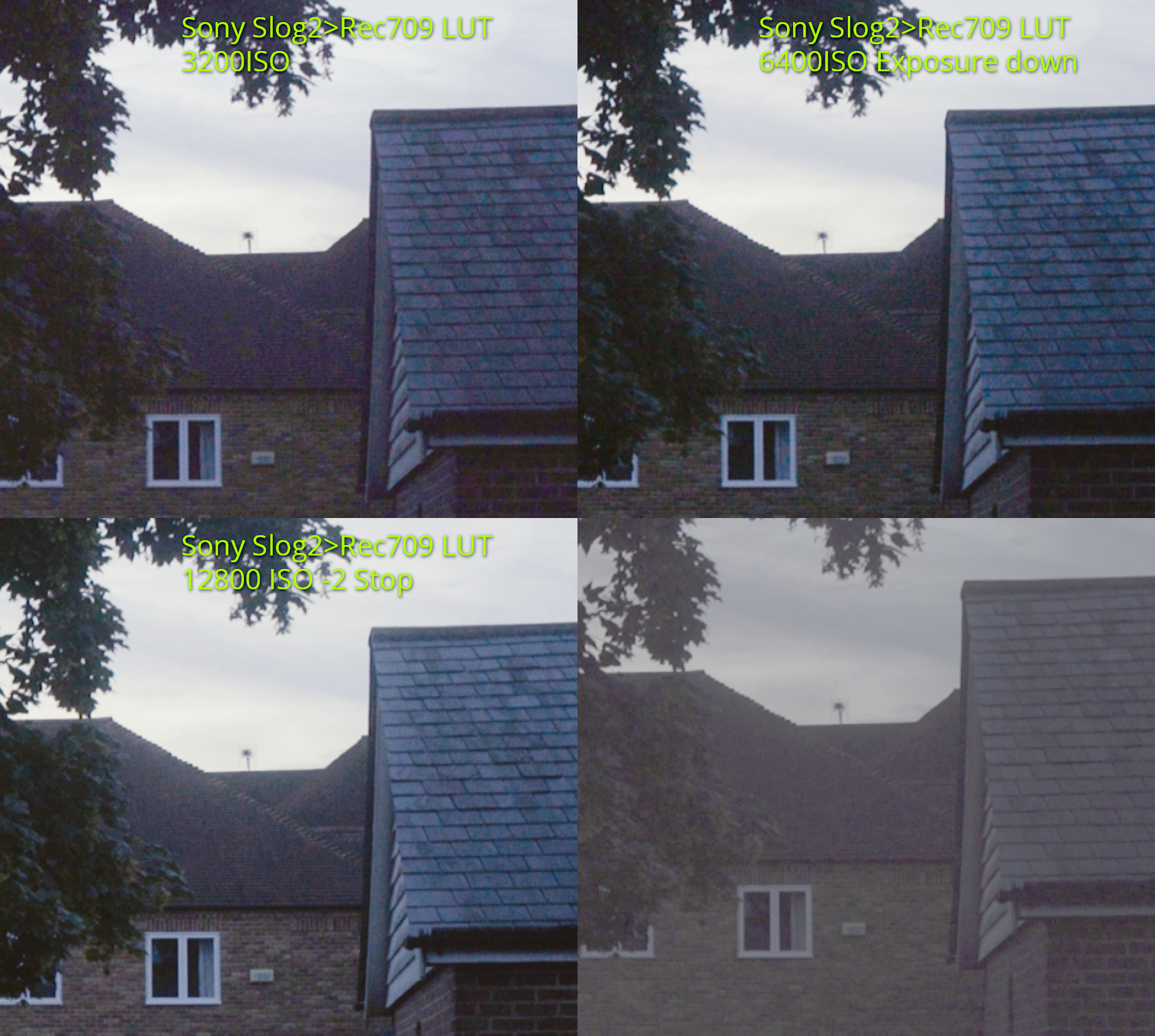
This is the same scene, shot 3200, 6400 and 12800. In SpeedGrade the exposure is balanced to match(ish). The Slog2 curve was enough to retain the highlights even at 12800 ISO.
Because the Slog2 is scene linear it means that a post adjustment like this is photometrically accurate, something you cannot really do with the other profiles.
The LUT on top was the sony provided Slog2/SGamut -> Rec709
You can see that exposing 2 stops up and then bringing that down in post has improved the shadow noise handling a lot. Compare the 3200 vs the 12800. It also means we are avoiding the very bottom end which goes purple. The matrix has a levels adjustment as well so that the shadows are more visible still. So you may think that 12800 is more noisy but it isn't really when you look at it this way and in the shadows.
I've linked this image to my host because DVX is scaling the images and recompressing which makes it all a bit pointless really!
I'm not convinced the Sony provided LUTs are ideal for this camera though, but if you're going to be doing exposure adjustments you really need a way to turn Slog2 into linear space (or log if that's what your grading app is doing) then you can apply a gain (for linear space) or an offset (for log space) to change the exposure.
hth
Paul
A difficult Slog2 scene, dusk, dark and detail in the wrong part of the Slog curve. But if you expose higher up then bring the exposure down in post you can maximise the noise performance. You are basically robbing the highlights and putting the data in the shadows.
This is the same scene, shot 3200, 6400 and 12800. In SpeedGrade the exposure is balanced to match(ish). The Slog2 curve was enough to retain the highlights even at 12800 ISO.
Because the Slog2 is scene linear it means that a post adjustment like this is photometrically accurate, something you cannot really do with the other profiles.
The LUT on top was the sony provided Slog2/SGamut -> Rec709
You can see that exposing 2 stops up and then bringing that down in post has improved the shadow noise handling a lot. Compare the 3200 vs the 12800. It also means we are avoiding the very bottom end which goes purple. The matrix has a levels adjustment as well so that the shadows are more visible still. So you may think that 12800 is more noisy but it isn't really when you look at it this way and in the shadows.
I've linked this image to my host because DVX is scaling the images and recompressing which makes it all a bit pointless really!
I'm not convinced the Sony provided LUTs are ideal for this camera though, but if you're going to be doing exposure adjustments you really need a way to turn Slog2 into linear space (or log if that's what your grading app is doing) then you can apply a gain (for linear space) or an offset (for log space) to change the exposure.
hth
Paul


