A7R mk II Announced - 42.4MP, 5-axis Stabilization, Internal 4k, $3,200.

DR should be just like that of the a7S, which means around 1.5 to 2 stops better than a 5D3 (my test; you have links at the bottom to see the pics yourself; huge difference). Because it's the gamma curve that dictates what you get in video mode, and they're both using slog2 (the sensor is capable of several stops more than what Sony is giving us in video mode).

And regarding the pissing of of previous owners: I own an a7S. It's the most expensive camera I have ever bought, by far. And I'm thrilled at the possibility of them launching an a7S II with IBIS, internal 4K, and maybe in-sensor PDAF or, even better, slog3. Having a better camera in the market doesn't make mine shoot any worse video, and it gives me the possibility to trade up if I think the improvement is worth it *for me*. In fact, I'm eager to give them more money. But they'll have to earn it. They seem to be on a good course...
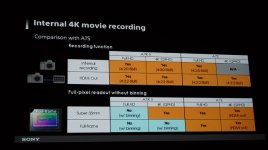
 
"From what I have seen the AR7 II video is only going to be great in 4K s35 mode as all others have pixel binning." - Philip Bloom

Would this still be the case if you're using an external recorder???
 
Let's hope that this "from what I have seen" refers to the slides, not to actual footage. Though it's true that Sony seems to be pushing the a7R II as an APS-C camera for filmmakers, and this may be the reason.
I was expecting very minor aliasing/moire issues in 4K FF...

I think moire will be very minor in the FF 4K mode of the a7R II. It's only skipping half of the rows (the 5D2 was skipping two thirds of its rows), and they are so close together that you'd need a really sharp lens and a very fine pattern to get moire to show up. Going technical: you'll need a lens that resolves at least 1280 line pairs per image height. A good prime can give you that only in the center of the image. A not-so-great prime, or a zoom, not even there. Link with lots of lp/ih numbers from a7R tests.

Plus, the Sony moire is usually monochrome, nowhere as bad as the flying rainbows from Canon.

Aliasing will probably appear more often, but it is much less of a problem than moire. I'd worry more about the bad rescaling algorithms of youtube and vimeo than about the line skipping on the a7R II.
 
That would make me want this cam even more :(
An early reviewer says it looks clean on 12800.

i have high hopes the pixel binnings would look as good as a7s 60p in FF.
 
4K FF from the a7R II should look much better than 60p FF on the a7S: you're skipping half the lines in both cases, but they are much finer lines on the a7R II, you'd need very fine detail and a very sharp prime lens to get strong artifacts. Whereas 60p FF on the a7S is something I always avoid (I go APS-C and use the speedbooster instead of the regular adapter).

Clean 12800 in APS-C 4K would be veeery nice. I was expecting clean 6400 in S35 and clean 3200 in FF. But I guess everybody has a different definition of "clean", so wait and see...
 

I am sure the image quality is very nice, but considering the source, lets keep feet on the earth. :) The 5DMKIII in RAW mode equals or bests many pro cameras as well (whatever that means). An LX100 in 4k will beat many pro cameras. My point is that we are at the convergence point where image quality is getting to be like resolution, more than enough for most work. How cool is that? I do wish the Sony had 1080p120 like the Samsung NX1 though.
 
A7rii is a clear indication that Sony have a sensor technology to release a pro camera that would totally swipe everyone out. They're not releasing it yet because it would upset all the F5/55 users.

It wouldn't upset anyone if they released it right. Put it in the same body as the F5(5), give it a similar name, update the internals a little to provide it with the missing LUT, and monitoring feature functionalities that the F5(5) don't have, and you'd have a new Vistavision member of the same family. That way they wouldn't be obsoleting the older cameras, they'd simply be adding to that same family something a little different. That's how Arri's handled their Alexa development, and it seems the single best way to keep customers happy and coming back for more.
 
I am sure the image quality is very nice, but considering the source, lets keep feet on the earth. :) The 5DMKIII in RAW mode equals or bests many pro cameras as well (whatever that means). An LX100 in 4k will beat many pro cameras. My point is that we are at the convergence point where image quality is getting to be like resolution, more than enough for most work. How cool is that? I do wish the Sony had 1080p120 like the Samsung NX1 though.
true at 5D MK II Raw @ ~ 320 GB/hr.

But I think the Sony dude meant that there are only a handful of pro cameras - and even the new Canon C300 MK II doesn't do it - that give you a native 8.8 MPX sensor with the Bayer filter and claim it to be 4K, while their $3,200 model will at least try to oversample the photo sites and deliver 4K out of 15 MPX, which is currently done only on F65 (in camera out of 20 MPX), Red Dragon (in post out of ~ 22MPX?). The new URSA Mini sensor has a mild oversampling of 4.6K but this is how fast the technology has advanced over the last three-five years, if you consider Alexa as a major departure point.
 
I agree. No doubt Sony has everybody's attention with this camera as they are "going there" in the still and video world. The thought of being able to use Canon EF glass on the thing with an adapter has the photo world lit up. This is the gauntlet being thrown down with regards to specs. The world will not end and other cameras will still work but the bar is being raised at a quick pace.
 
That's very, very good for a FF mode that is not doing a propler full-read-and-downsample. Any aliasing/moire issues the a7R II may have are orders of magnitude smaller than what many people have in mind when talking about aliasing/moire (many of those shots would be showing nasty flying rainbows on a 5D2).
 
That's very, very good for a FF mode that is not doing a propler full-read-and-downsample. Any aliasing/moire issues the a7R II may have are orders of magnitude smaller than what .......
Well, well. :)

After the discussions in the other thread about read mechanism and pixel count , you may not be at all surprised to know what I'm thinking.......

When the camera was first announced, and when it was said that full frame 4K was using binning - s35 4K wasn't - the general assumption was that the full frame mode would be inferior to s35 mode. I was far from sure that was the case for the reasons gone into - but it was a case of "let's wait and see....."

And whilst I'm still waiting for quantitative results, your words above tend to encourage me to think that the full frame mode will indeed prove to be comparable with s35.

The only thing I would quibble about in your sentence above is that if it is doing a 2x2 direct read in full frame mode, that should be considered just as much a "proper full-read-and-downsample" as a conventional deBayer and rescale.
 
Haha, well, I stick to my guns: I still think it's doing line-skipping. I also wrote somewhere that with such small pixels and only read-two-skip-two line-skipping, you'd only see aliasing/moire in charts and with very sharp prime lenses :)

I'll be very happy to write "you were right" if we confirm it's doing 2x2 binning without line skipping.
 
Haha, well, I stick to my guns: I still think it's doing line-skipping. I also wrote somewhere that with such small pixels and only read-two-skip-two line-skipping, you'd only see aliasing/moire in charts and with very sharp prime lenses.
The problem there would be it could never be 4K. The used area is going to be 7680x4320 photosites - or something very similar. Assuming it is that number, then if it was "read-two-skip-two line-skipping", that would only give 1920x1080 2x2 blocks. In other words, it would be a 1080 output.

The reason "read-two-skip-two line-skipping" is seen on other cameras is that it was being used for sensors with typically 12-16Mp photosites in 16:9 mode, which equates to something like 5,000 or so horizontally. This form of skipping then gives resolution of one quarter the photosite count, so about 1250 horizontally (typically 650-700 lpph) before upscaling. And this is as measured for real.

Have you seen - http://www.imaging-resource.com/news/2015/06/16/sony-qa-the-must-have-sensor-tech-of-the-future ? It's a bit difficult to follow - I suspect language may have been a problem - and a bit confusing about mixed references to the A7R ii and the RX10 and 100, but it does seem that Sony have taken a quantum leap forward in sensor design in several aspects just reading a few bits (which may answer your comments about read speed.) For instance (although about the RX10/100 sensor):
Now, with the A/D converters on the back side of the chip, they have four times as many of them, so they can read out a total of 16 pixels at a time, four pixels each from four sets of converters, each "set" being four converters. This is a pretty staggering number of A/D converters: There are 5,472 columns of pixels in the Sony RX100 IV's sensor; with 16 converters per column, that means there are a total of 87,552 A/D converters on the chip!]

And I've finally seen somebody else thinking the same as me! :) Read the comments at the end and (8 down) Peter Loughran is thinking pretty much the same. His last paragraph about "no mention of DCI 4K (17:9 4096x2160)" is quite interesting. It had crossed my mind, but I'd probably just thought it would just be too many photosites for the total.

As others there say, seeing EXACTLY what the crop is will tell a lot, though I still haven't seen any further thought on the idea of s35 HD being a 3x3 bin.....
 
With more processing power behind it, it's an 8K sensor, which is where Sony wants to go with their pro lineup. My feeling is that Sony will introduce 8K-4-4K camera soon, as F65 has been around for four years already and, by 2018-19, it'll be a Medium Format 8K camera with roughly the same technology as A7RII but larger pixels.
 
Love the detail. There's a little bit of moire on the FF video at :20, the metal roof just above the 300mm F2.8 text, but its barely noticable. The shots at :24 of the post with the backlit flowers and the mask at :28 are soft, no pop compared to the rest. Screen caps from the APS-c video on top and FF on bottom.

 
Back
Top