

keylight
Veteran
You're in the clear for the first patent link that Keylight provides. The most important part of the patent is the claims section. In fact, it is really the only part of a patent that matters in the courts. That is the back section of the patent. In this case, the first claim discusses an electronic means of backpan compensation. The other claims discuss the compensator and other features. So it does not cover a mechanical means of doing the same thing.
This is a poorly written patent. Patents should make the broadest claims possible. It should have the first claim as being a backpan mechanism, without specifying how it does it. It has left open that anyone coming up with another means to accomplish backpan can do so without infringing on the patent. The patent was filed in November 1998, so it may only have 3 more years of life (patents filed after 1995 live for 17 years after being granted or 20 years after being filed, whichever is greater).
I wasn't able to read the second link to provide commentary.
My background - I have several patents and have spent years reviewing patent applications with patent attorneys, so I have some minor experience with this sort of thing, but for sure, I am no expert on the subject. You should do your own research and make your own judgements.
Great perspective on this Paul! I'm not sure if they messed up on their patent, because the kind of backpan compensation Jeremy (and the rest of us) have been talking about isn't really what the patent seems to be for. What we're talking about is refer to in the patent as "one to one backpan compensation" and there probably was prior art for this that would have prevented them (or anyone) from patenting it. There's probably a rejected patent application out there somewhere that tried and failed!
Of course, I could be wrong, because the mention that "If it is desired that the camera remain pointed at a fixed compass position in space as the arm is panned in an arc as shown in FIG IB the camera operator must make a compensating reverse pan of the camera perfectly matched to the speed and direction of the arm. This process is known as backpan. [Editor's Note: Later they describe this as "one to one backpan compensation".) Generally only operators skilled and practiced at this maneuver can accomplish it perfectly and they require several rehearsals with the operator of the arm to synchronize their respective movements." The fact that they didn't mention any kind of mechanical device to do this is interesting. But then again, no manual device for doing this has since been patented either!
So in the original post, Jeremy says:
As all cranes keep the head level weather moving up or down, None of them keep the head aiming straight ahead when moving side to side.
That's a description of "one to one backpan compensation".
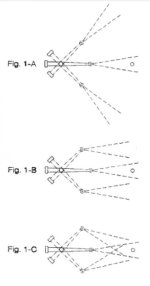
The "backpan compensation" in the patent is actually for "variable backpan compensation" which keeps the camera focused on a fixed object. There's a big difference between those two things. Here's an illustration from the patent that shows what I mean.
Figure A is what all jibs do (no backpan compensation)
Figure B is what Jeremy proposes (one to one backpan compensation) that keeps the camera pointed straight ahead. This could could easily be done (and has been done) with cables because it's one to one, and does not seem covered by the patent.
Figure C is what the patent covers, keeping the camera pointed, not forward, but at a fixed object.
And this is from the Description section:
Accordingly several objects and advantages of my invention are totally automatic correction of backpan perfectly synchronized with the movement of a crane arm or jib even in the event of unplanned or unrehearsed movements of the arm.
Further by incorporating a ratio adjustment which allows the operator to overcompensate the pan of the head in relation to the pan of the crane arm the camera can be made to point at an object in near space as the arm swings as shown in FIG 1C.
This overcompensation or Autopointing is of great benefit to the camera operator since it causes the camera to remain centered on any stationary actor or object without effort on the operator's part.
Further by undercompensating the pan of the head in relation to the pan of the crane arm the camera can be made to backpan at a slower speed than the arm for artistic purposes.
An important feature of the backpan compensator is that it can be turned off or on or the compensation ratio can be varied as desired during the shot.
All this is accomplished without losing the intended functional capability of the remote pan head.
Still further objects and advantages will become apparent from a consideration of the ensuing description and accompanying drawings .
Sorry for the lengthy post! Very interesting topic!


