A-cam dII 'High Definition RAW Format Motion Picture Camera

Aaton

Aaton

What I found really fascinating about Ikonoskop is their Aaton-like approach (see the picture of Jean-Pierre Beauviala at the Ikonsokop boot at NAB), this famous 16mm cameras was made for low budget, independent film making, it is very easy to use hadheld, of high mechanical quality but needs to be used and lookd after properly, not really suitable for rental companies (where the workhorse Arriflex rules) but great for film makers who like to own and operate their own camera. In my humble opinion, if Ikonskop keeps to this approach, they will be very succesful.
 
What about the smear in the highway footage? Do you think this could be fixed in the definitive version of the camera, Otis?

Smear can be improved in two ways. By manipulating the response curve (film exposure emulation) and algorithmically (active reduction). I don't know the specifics of the A-Cam design but they mention that they record linear and they don't include software, so it's up to the DNG conversion app. The DNG apps are not designed to cover specific needs so they will not iclude smear reduction. Manipulating the gamma curve can help but for best results you need the preview if smear is visible or objectionable on the camera monitor while recording. I need this level of control so I'm writing software for rendering that is aware of camera specifics. I could make it compatible with A-Cam output I think.

I don't think smear will be a problem though, even untreated.
 
I don't know where you got that timelapse from, but it's stunning!!, fluid and with great shapes, that's what I call a great timelapse!

Thanks. It is 1 frame per second on a 2/3" Sony sensor. With these new cameras you can record any frame rate and you know what interval is fast enough by monitoring the step from one frame to the next while recording. You can easily stop and start recording on a new frame rate if you think there is not enough overlap for fluid motion or a different motion blur is required, without delays. Given the excellent performance in long exposures (up to many seconds without noise and on a SINGLE solid exposure, not with multple frame combining) they are ideal for timelapse. They don't even need frame rate conversion because only the required frames are recorded and you save space so you can do stuff impossible on traditional video cameras. There is a reason these sensors are used for scientific imaging.
 
I wish these companies would upload 1 or 2 full HD clips. I know bandwidth is an issue, but even a 3-4 second clip could give us a far better idea of quality.

It's like they have something to hide.

When you are in the middle of development, the performance is not ideal. It makes sense to produce reduced resolution clips since the processing is not finalised and representative of the final product. You should expect improvements in all image quality areas. I remember the original RED footage was 1024pixels wide. 4 times smaller than the original frame.
 
The technology is already there. All we need is a genius that make it a out-of-the-box product, with a slick "shoot to deliver" workflow that just works.

Do you hear me Otis? :beer:

Frank

It doesn't take a genious. You just have to have common sense, realise the production situation realities of your market, challenge any existing norms and put them to a reality test today, and steer away from the greed that easily enters the mind of any new enterpreneur. Just like filmmaking really. It helps if you are not bound to agreements, investors, etc. It also helps if you do not have to consider positioning vs other products in your product line.

Ikonoskope wouldn't even think of uncompressed recording bellow 10,000 euro if they had a 30,000 euro compressed video camcorder in the market, right?
 
While a manufacturer has the right to make whatever they want and sell it for whatever they want, the crippling of cameras within my budget, the overpricing of cameras on my wish list, and the seemingly glacial improvement in this industry is frustrating. Red, Ikonoskop, and . . . Grapsas Technologies? . . . may give the market a healthy shake-up.
 
Last edited:
What about the smear in the highway footage? Do you think this could be fixed in the definitive version of the camera, Otis?

Are you referring to the Rolex? If so, here's what Ikonoskop said:

The Rolex shot did not have an OLPF. We have recorded a lot, with OLPF and without, different kinds of scenes etc. We did though like the Rolex scene so much so we decided to publish it anyway.


OPLPF=Optical Low Pass Filter
 
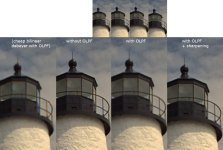
Having a camera without an OLPF is an option is some cameras and IR filters are constructed with and without OLPF. There is no right or wrong. Alias appears only in some cases while the loss of MTF in the filter is universal. When using the OLPF you usually need to add a light carefully tuned digital sharpness filter on the output.
 
An example on the effects on the OLPF on a grossly aliased source created from downsampling (impossibly bad for real shooting) at 1:1 and 300% zoom. The OLPF obviously works but it does not save a low quality implementation (far left).
 

Attachments

  • OLPF.jpg
    OLPF.jpg
    159.7 KB · Views: 0
The DOF on an S16 sized sensor is pretty similar to a 2/3" chip. We shoot all of our video university segments with an HPX500 as we're not looking for shallow depth of field in these. Using an adapter with a full sized 24x36 frame has a look that is night and day different.

What's really exiting about this from our perspective is that the image size is very close to the 2/3" format. This means our B4 multi-format relay lens will almost certainly have a physical port to this body. In other words, full sized 24x36 DOF (or format 2, full cinema gate support) on an imaging engine with the A-cam DII capabilities :-)
 
Hi Dennis,

In order to use the Brevis on a c-mount, at what distance should the lens focus? Is there a macro element inside the brevis that we can remove? There are high resolution c-mount lenses that can focus at any distance and any magnification really, so that should be useful.
 
Yeah i'm kind of digging what little we've seen of it already. and it's simple, compact design it half the appeal. i just worry those 80gb cards are going to be too much. i mean, doing a feature, we've always had a rotation of 3 P2 cards per camera going at a minimum. and unlike P2, you wont be able to rent more as needed, you'll have to buy. at 12 mins per card you'd want to have half a dozen, i imagine, at least -- especially for days you can't offload until the end of the day, or in case a card goes bad you have back-ups, etc.
 
I think many users will go for 8 cards (2hours 1080p 24fps). Films cans do not record much either but nobody goes on location for a full day of shooting with a single 400ft film can. The usb2 offloading will not be easy on location because it is 3-4 times slower than real time.
 
On the other hand, in some projects it takes 1hour to shoot 15minutes, so you can do the job with 2 cards and offloading from the usb deck to a laptop.
 
Back
Top