A-cam dII 'High Definition RAW Format Motion Picture Camera

Raw refers to storing the unprocessed data from the sensor before debayer, not to a specific raw format by Adobe. dSLR manufacturers use their own formats to get more power and full control of the image development. Adobe is just trying to make DNG a defacto standard.

Check the Drama thread. It's out of topic here.
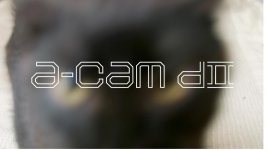
 
I attach a splitscreen artifact from this sample. The artifact is present at all times, it's just that there is nothing dark enough to show it in the rest of the clip. In low key images it can produce a useless shot.

The letters make it a little hard to see, but look at the upper side of the letters, between a and m.

You might remember that this was an artifact of the JVC Hd100 camera.

When you vary exposure, the artifact varies. It's different for every single level of exposure actually. There is no way it can be fixed in post. It's not just a fixed level difference between left and right. You can only fix it at the source, on the in-camera firmware/software. No raw developer will fix it, no custom post processing will fix it.

This happens because fast CCD sensors use multiple outputs (2, 4 etc), each having a different analog circuit. Analog parts of a system are never perfect, so there could be a difference in some levels of exposure, usually at the lower 20% it can be rather significant. You effectively have two or four different sensors, one for each part of the screen (L/R or TopL/TopR/BottomL/BottomR) and they need to match.

That is handled in design and in production:

1) You make sure it is small by choosing good analog components that do not vary much from unit to unit.

2) You make sure the analog design of the camera is very good.

3) You calibrate the good result produced by a good analog design to perfection, and you do it in factory. This requres a methodology, some math, a very precise testing aparatus and some time per unit. Calibration needs to be performed on every single unit. On the Drama, I developed intellectual property and software to handle the unique calibration required for each production unit.
 

Attachments

  • split.JPG
    split.JPG
    32 KB · Views: 0
One more thing, most of the projects I worked on uses Avid or FCP NLE as a platform and these are "golden industry standards". So unless the new camera is compatible with these 2 formats I foresee a short future with any larger production houses.
 
The material does not have to editable directly. One can transcode to something else. I also record raw and transcode when the video is transfered to the computer, DNxHD36, DNxHD185, uncompressed AVI/MOV, DV, still formats, etc. I use a custom codec for original recording that is editable in many NLEs but editing such amounts of data is not very efficient from a storage point of view.

The productions that require uncompressed will use proxies for everything up to special effects and color correction. Even though 2K uncompressed DIs are done, creative edits on most hollywood films are done on DV or Avid 14:1 SD which are used as low quality proxies. Even on projects like Dark Night. The photography of entire hollywood films fits on an external disk this way, and a single gige disk can feed many editing stations on the network.

So, it's not very complex. You produce a proxy for editing, then go back to the raw with EDLs for onlining your editing format of choice, which could be 16bit RGB if quality is an issue, but based on my tests, DNxHD185 will do the job for most projects.

That's how I see raw acquisition. I don't like the Adobe DNG workflow idea.
 
Otis, why you don't like the Adobe DNG workflow idea ?

It looks solid, and with a good mid time support in the industry. Its basicaly uncompressed, and i think is kind of and open standard.

Its not like actual Gibayte/dollar is gettin odd prices, they are going down actually, and with forthcoming SSD, SataIII or USB3.0 rate speed are quiet good indeed.

So taking out the proxy workflow i dont see the real disadvantage. Even with your own compression you have to conver it 2 times at least.

i really dont mind having to buy 2 new Hard disk drives per proyect for data adquisition, the proyect it self pays for it, $500 at most for just space its alot of gigas and good value.
 
Any uncompressed format will require the same storage, no problem there. But DNG enforces Adobe's processing, it gives the designer no control at all on what's happening to the pixels. I can't do what I need to do in DNG.

A DNG camera like the Ikonoskop stores DNG and that has to pass through Adobe's DNG processing. It's the only option. Ikonoskop chose to not write any software or image processing at all. They only do an in-camera preview. It's 90% Adobe's camera and 10% Ikonoskop's camera if you ask me, Adobe is producing the image. Red is 100% Red. Drama is 100% Drama. Panasonic is 100% Panasonic. With its gamma curves, chroma characteristics etc.

Drama can output a DV file directly to a usb key (or any usb/sata/gige storage), and you can do it before returning to your office. There are no intermediate steps, there is no transcoding, there is no time lost. That's very different from transfering DNG in RAW via USB and then using Adobe DNG workflow and then rendering to a DV output.
 
He's pretty laid back.. camera just laid out on the table of a street cafe.
Every clip I've seen of Ted from Red, he's gripping the Epic like a monkey that just stole a grapefruit.
 
One more thing, most of the projects I worked on uses Avid or FCP NLE as a platform and these are "golden industry standards". So unless the new camera is compatible with these 2 formats I foresee a short future with any larger production houses.

FCP is fast losing its "Gold standard" status as it is about two years behind the development curve for modern digital work flows. Adobe CS5 and Sony Vegas are light years ahead. AVID is somewhere in the middle, and more aggressive than Apple in its development.

New camera technologies should not be held back by outdated post tools.
 
He's pretty laid back.. camera just laid out on the table of a street cafe.
Every clip I've seen of Ted from Red, he's gripping the Epic like a monkey that just stole a grapefruit.

I wonder if they (the Ikonoskop guys) are even interested in their own camera at this point...
 
I think they should be praised for doing something very different and really staying with it. It looks from the site that they will be shipping the first orders in October, I would love to see more from the camera.
If the images it produces have half of the finesse that is behind the design then it's going to be a stunning tool.
 
It looks like they will be shipping in the next months since years.

Frank

On the interview it looks like the preordered cameras will be completed by the end of the year, starting in October. New orders in 2011. If batches of 25 are possible in terms of manufacturing cost and logistics, they will make it.
 
It looks like they will be shipping in the next months since years.

Frank

Since two years, to be exact. In october, 2008, they assured that the first preorders will be delivered at the end of december... And six months later they were announcing that they have a working prototype that could shoot 15 fps.

I really liked, and still like, this A-Cam dII but I no longer see it as a purchase option. I can understand and appreciate the effort behind a camera like this but I think these guys haven't been very honest about its development. If I were someone that paid 600 euros two years ago and still waiting for this camera to be a reality today I would be, to say the least, very tired and disappointed. The market has changed in these two years, the AF-100 will be real and in the hands of a lot of people in no more than two or three months, the Sony affordable S35 in a few months more... Yes, this camera does RAW video, but not everybody needs it. It uses a propietary and expensive memory cartridge and this can be hardly some kind of advantage. It has to be seen how its Kodak 2/3 performs but it surely will be behind the Panasonic 4/3 CMOS in terms of noise, etc.
 
Put on top of that the fact that now the whole pricing structure of the camera has changed.
Now you have to pay for the C-mount which originally was included in the price and now you don't get the Ikonoscop lens that originally also was included.
No real harm to people who haven't pre-ordered yet but what about anyone who has pre-ordered and made a deposit?

Euro was worth about 1.50 USD at that time though and it went down to 1.20 USD at some point. That could easily be 1,000 euro on the part costs. Now it's 1.33 USD and rising.

Those who have a preorder can get their money back or buy the extra items. There was no danger in preordering so many people did. Ikonoskop only keep 70 euro from the preorder amount when you cancel the preorder and 0 to 25 euro is required for the actual bank transfer depending on where you live.

Ikonoskop is a project that required many custom parts. The investment must be 800K to 1M euro if you include the time already spend in development and the running costs for selling and supporting the camera for a 2 year period, which is the minimum waranty a product must have in europe. They will need about 200 cameras to break even, and still the investors will have made no money at all. 200 units is a lot for such a product. This could explain the changes in the package contents and the patenting and high cost of the memory card. After the 200 units they will start making the little money the ultra high european taxes allow. I wouldn't blame them for not being enthusiastic.
 
I wouldn't blame them for not being enthusiastic.

And, arrived to this point, I suppose they wouldn't blame their potential customer base for not being very enthusiastic: 6.950€ (A-Cam dII) + 500€ (C mount) + 990€ (160gb memory cartridge) + 990€ (USB card reader) = 9.430€. That, without lenses and with just one memory cartridge... Add VAT if you live in Europe and...

In the best possible and probable scenario for Ikonoskop you still will get the Scarlet 2/3 fixed for half that price and for not much more the 2/3 Cinema.

Even the Scarlet fixed will not be very cheap with lots of memory and accessories and 2/3" CCD with interchangable lenses has many advantages over the Scarlet CMOS. Anything gets VAT when it is sold to consumers in europe, but to a semi pro, pro or anyone with a business registered for VAT, VAT is not an issue. Ikonoskop is not for everyone but with the small factor it could get its own niche.
 
Euro was worth about 1.50 USD at that time though and it went down to 1.20 USD at some point. That could easily be 1,000 euro on the part costs. Now it's 1.33 USD and rising.

Those who have a preorder can get their money back or buy the extra items. There was no danger in preordering so many people did. Ikonoskop only keep 70 euro from the preorder amount when you cancel the preorder and 0 to 25 euro is required for the actual bank transfer depending on where you live.

Ikonoskop is a project that required many custom parts. The investment must be 800K to 1M euro if you include the time already spend in development and the running costs for selling and supporting the camera for a 2 year period, which is the minimum waranty a product must have in europe. They will need about 200 cameras to break even, and still the investors will have made no money at all. 200 units is a lot for such a product. This could explain the changes in the package contents and the patenting and high cost of the memory card. After the 200 units they will start making the little money the ultra high european taxes allow. I wouldn't blame them for not being enthusiastic.

And that is why you don't make promises and price a camera that won't be available for the next two years! It's bad marketing.
There is certainly harm to all people who did pre-order. First they claim back in 2008 if you did pre-order now you will get a camera within 6 months. They deleted that statement after a while on their website (coz they know they don't have a camera ready). So basically they tricked people into pre-ordering, making them believe the camera would be available in a not too distant future.
After two years of waiting and still no camera you cancel and they take 70 Euros from your pre-order... for what exactly?
I do international bank transfers which cost me 15 Euros, that may differ from bank to bank but nowhere is that going to be 70 Euros. It's highly unethical business practice. Why would I be enthusiastic about a company with such business practices?
 
Back
Top