$800-$1000 to spend on lighting gear

ReelFilmGeek

Well-known member
So I have some money and I am thinking of spending it on some lighting gear. I currently only have basic clamp lights, a few china bulbs, and a cheap 126 & 500 led light panel. I currently have been lookingat two things, the first being these Chinese 6 bank light, and I her they are the cheap mans link flo but they are said to be extremely heavy and not sure how durable they are.
http://www.amazon.com/gp/aw/d/B003IXDSZK

My other idea was buying some tungsten hard lights from cool lights. While these aren't soft lights they can be diffused an cool lights has great customer service
http://www.coollights.biz/hardlight....html?osCsid=8cd219ad6688fc09cd2b02d7964e1eda

These lights would be used for short films that I make and maybe freelance work.
 
unless you make money shooting a lot of office interiors (where heat is an issue) - i say go with the cool light fresnels... at least youre working with a known variable
 
unless you make money shooting a lot of office interiors (where heat is an issue) - i say go with the cool light fresnels... at least youre working with a known variable

Yeah, I have to second that. A good fresnel light is very versatile. You can make a fresnel into a soft light, but you will never be able to make those knock off flos into a hard light, which is possible with the fresnels. With the money you are talking about I would suggests getting one of the 1K fresnels and one of the 300 watt fresnels. With the rest of the money get some good stands, a scrim set, some good stingers and some basic grip gear.
 
Why a 1k and 300? Since I have never used any of these types of lights I'm not really sure how much light output they are giving out. 300 honestly seems a little weak but im pretty sure its putting out a lot better light than a 250 work light :\ Was looking at the 650's.
 
Why a 1k and 300? Since I have never used any of these types of lights I'm not really sure how much light output they are giving out. 300 honestly seems a little weak but im pretty sure its putting out a lot better light than a 250 work light :\ Was looking at the 650's.

My suggestion is before you spend a dime on lighting instruments, buy a couple of good books on the subject to help get you up to speed.
 
Why a 1k and 300? Since I have never used any of these types of lights I'm not really sure how much light output they are giving out. 300 honestly seems a little weak but im pretty sure its putting out a lot better light than a 250 work light :\ Was looking at the 650's.

Definitely the fresnels. It's not just a matter of how much output but how you control it. A fresnel can flood or spot and comes with scrims which can limit it's output. They come with barndoors which can limit spill and onto which you can attach diffusion and/or color correction gels as necessary. You can also bounce the fresnel for a soft key or fill.

I will often use a 300 as a kicker. I can scrim down a 650 and might but the 300 works will for that sort of thing.

Barry Green has a great DVD on film lighting where he takes a lot of time describing the various type of film lights and how to use them. Pickup Film Lighting by Kris Malkiewicz. Chapter Two has a good description of film lights, how they work and what they are for.

Also, you can get ND gels in place of scrims but I did that for a while and wound up buying the scrims. It's worth it.
 
Kris Malkiewicz's Film Lighting, Matters of Light and Depth by Ross Lowell, Set Lighting Technician's Handbook, and Barry's DVD
 
Man I wont be able to afford any lights if I buy all of these books, time to go to the library and hope i get lucky.
 
As David suggests, you'll waste a lot more money otherwise. Start with Malkiewicz. not only does he cover types of lights and uses but the subtitle is "Talks with Hollywood's Cinematographers and Gaffers." Inside they show actual setups by the best cinematographers with photos of results. You'll be glad you did. Good luck.
 
Why a 1k and 300? Since I have never used any of these types of lights I'm not really sure how much light output they are giving out. 300 honestly seems a little weak but im pretty sure its putting out a lot better light than a 250 work light :\ Was looking at the 650's.

Well, I suggest the 1K and the 300 watt Fresnel based on the selections that you posted. Of the lights there, I think that the 1k and the 300 watt would give you the most versatility. I would go with the 1K over the 650 because having the extra kick the 1K can give you, if needed, would seem to me to be very handy. I would go with the 300 watt because that would be a very versatile light in tighter spaces where a 1K or a 650 would be over kill.

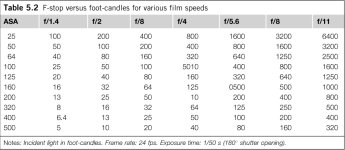
When thinking about light output, for me, the starting point is knowing at what F-Stop I want to be working at with the camera, lenses and ISO setting that I want to use. Once you know what F-Stop and ISO you want to work at you then know how much light you need using this chart:

F-stop versus footcandles.jpg

The magic number, for figuring out the needed footcandles for a needed F-Stop at a specific ISO setting (Shown as ASA in the chart) is 100 footcandles at 100 ISO equals f2.8 (Shown as a typo on the chart as f/8 between f/2 and f/4). From there you can figure the F-stop for any combo of ISO settings.

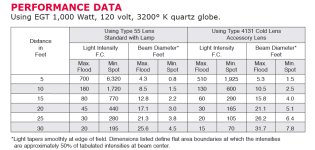
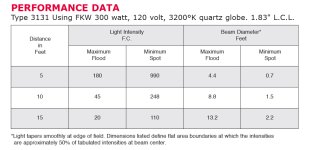
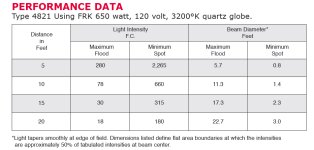
Using this info in the context of the dimensions of the scene/setting/location you are working at you then will know what light output you need from your lights. The light output information of a light is called its "Photometrics" and is expressed as a measurement of footcandles at a specific distance. I have looked and looked for photemetric data for the Cool Light products but have not found them anywhere on their website. Here are some photometric charts from comparable Mole-Richardson Fresnel lights.

For the Mole-Richardson 1,000 Watt 6" Baby Solarspot:

Mole 1K fresnel photometrics JPEG .jpg

For the Mole-Ricardson 300 Watt Betweenie Solarspot:

Mole 300 watt fresnel photometrics JPEG.jpg

And for the Mole-Richardson 650 Watt Tweenie Solarspot:

Mole 650 watt fresnel photometrics JPEG.jpg

These photometric charts are measured with the direct light from the fixtures. I recently took the time to do my own photometric charts for all of the lights that I own. I set up markers in my back yard, spaced 5 feet apart, out to 50 feet. At night, I set my lights at the marked off zero point and then measured the output, in footcandles (and F-stop at 500ASA since I am shooting with a FS-100 right now) at all of the 5 foot intervals (Using a Sekonic Studio Deluxe L-398 Light meter) out to 50 feet. I also measured the light output with the lights set up in several bounce light configurations and charted that out also.

This is where I really learned the value of the higher output lights. For example, a PAR 64 can with a Very Narrow Spot (VNS) bulb has an output of 100 footcandles (FC), or f5.6@ISO 500, at 50 feet as a direct beam out of the fixture. When used as a bounce light, off of a bounce card, I was able to measure about 5 FC, f1.4 @ISO 500, at 25 feet. So, if you want to put nice soft light over large spaces, powerful lights are needed. If the Cool Light 1K Fresnel is comparable to the Mole-Richardson 1K Fresnel, I would be willing to believe that you could get photometric measurements comparable to the PAR 64 can with VNS bulb. Actually, at very narrow spot on the Fresnel, I bet that the output would be a little bit higher. You also have the versatility to flood out the Fresnel, scrim it, dim it or gel it also. You can see the versatility there. In situations where the power of the 1K is not needed, I think you would find the 300 watt to also be very versatile. So, that is why I suggested getting the 1K and the 300 watt Fresnels.

The suggestions about studying up on lighting are also spot on. Malkiewicz's book is excellent. I also suggested getting "The Set Lighting Technician's Handbook" http://www.amazon.com/Lighting-Technicians-Handbook-Fourth-Edition/dp/0240810759 also. That being said, I think that the best learning experience is going to be going out, with the best light kit you can put together, and shoot something. I suggested putting together a short fictional narrative film, over several locations, and going in lighting it the best you can. From this you will learn to understand the strengths and weaknesses of the lights you have, and when you go shopping for additional gear, you will have a tangible personal reference for its usefulness. I kind of see buying lights broken down into a couple/three broadly overlapping categories. First is specific gear for specific purposes, like a 3 light LED kit for interviews. Next would be for power and versatility, like a set of Fresnels. Then would be "Out of the box" lighting; specialty lights, like puck lights, Christmas/fairy lights, higher output bulbs for practicals and so forth. While it is cool to have a light kit like the pros, it is better to have a light kit that works for you and the way that you see things. You develop that by shooting and lighting some stuff and going forward. Good luck.

EDIT: I would also suggest getting a light meter. I have used a very simple, inexpensive Sekonic Studio Deluxe L-398 ( http://www.sekonic.com/Products/L-398A/Overview.aspx ) for over 20 years. I know there are mixed opinions about the usefulness of light meters for digital video, but I just don't know how to think about lighting without thinking in footcandles of light output and you measure that with a light meter. You can get a L-398 used for around $100 on eBay.
 
Last edited:
+1 on what David said... advice like that really got me into understanding continuous light coming from flash. I've read the Lighting Techs handbook once and can vouch for it. It really is an encyclopedia of lighting info, now I just have to read it a couple of more times to make everything stick like glue ;)

One of the basic things that David mentions that I find really useful is the FC chart. 100 - 100 - 2.8 makes it easy to half or double in terms of light needed.

Also, I've used this at lazy times:
http://www.arri.com/lighting/lighting_emea/photometric_calculator.html#top

Ofcourse it only adresses Arri lights, but very useful non the less.

@DAVID
You finish off mentioning light meters. It's one of those things I'm having an ambivalent relationship to. I did my training in the days where digital took over analog, so I was subjected to both worlds. But while I totally see the usefulness of light meters, do you think they are becoming slowly outdated for new generations? I mean, the digital age has made it possible for us to see right away what we are lighting and how we're lighting it?
Isn't the meter more or less now a tool of pre-production rather than during shooting?
 
There's an L-358 for sale in my area for 50 bucks. I was thinking of getting a used Minolta color meter... Would the Minolta allow the same functions as the L-358 in terms of exposure settings? I looked through the manual and I couldn't find anything about f-stops or iso.. so I'm thinking I might get the exposure meter first.
 
There's an L-358 for sale in my area for 50 bucks. I was thinking of getting a used Minolta color meter... Would the Minolta allow the same functions as the L-358 in terms of exposure settings? I looked through the manual and I couldn't find anything about f-stops or iso.. so I'm thinking I might get the exposure meter first.
Color meters have completely different electronics from light meters. They don't function as light meters, they only read color.
 
Despite all the other options, +1 on fresnels if you are budget challenged. Flos are great for interviews and soft lighting needs, but they just don't have much punch, so are limited. The one thing you do get from flos is the option to bulb them for daylight or tungsten spectrum which adds much versatility. If you are doing naturally lit interiors and need daylight fill, flos are the ticket.

I would opt for a 650 fresnel instead of the 300. 650 fixtures can be bulbed with smaller wattages and even using a 650 bulb, you can always scrim or use some diffusion. If you have a 300, you don't have that option. Also, a 650 with a soft box is viable as a key light in a small venue, whereas a 300 with soft box is usually not enough, IMHO.

Given a $1000 budget, you are close to being able to buy 2 Cool Lights fresnel tungstens and possibly a cl455 flo as well which means you might delay a softbox purchase. A 4 bulb flo will take the place of the typical small softbox. Putting a 1000w fixture in a small softbox isn't going to give you much if any advantage over a flo. Later, if needed, you could buy a big softbox for the 1000w or diffuse through a frame. You might look to Westcott for larger economy softboxes, they are middle of the road quality, but whatever you purchase, make sure it is heat rated for the watts you intend to use. There are many boxes out there which are only intended for flash and will ignite when hot!!


Grant
 
Now that is what I call a post David! Thank you very much because that was what I needed to help me decide and learn a little more about lighting!

Also ggrantly, I probably cant afford the 2 fresnel tungstens and a flo because I have to factor in light stands for the lights as well. I am actually looking at cool lights kit with the one 650 and two 300. It doesn't have a powerful 1k but it is three lights that would give me a little more versatility. Plus it would save me a little money buying that kit since its bundled together and It comes with scrims, stands, and even a case (which I will need). No softbox but I can always bounce light for now if I have to. It might be a good starting point, but I'm still looking in to lights.
 
http://www.arri.com/lighting/lighting_emea/photometric_calculator.html#top

Ofcourse it only adresses Arri lights, but very useful non the less.

@DAVID
You finish off mentioning light meters. It's one of those things I'm having an ambivalent relationship to. I did my training in the days where digital took over analog, so I was subjected to both worlds. But while I totally see the usefulness of light meters, do you think they are becoming slowly outdated for new generations? I mean, the digital age has made it possible for us to see right away what we are lighting and how we're lighting it?
Isn't the meter more or less now a tool of pre-production rather than during shooting?

That Arri calculator is very handy, thanks.

Yeah, the usefulness of a light meter for digital cinematography is kind of questionable. I do not advocate using one as the only way to set exposure with a digital camera, that is for sure. I do think that they are probably more useful for lighting planing and set up than for exposure. What I really wanted to convey is an approach to lighting, and understanding lighting output. Taking the time to do the photometrics for all of my lights was such a great learning experience (Which I had been putting off for years actually). Now that I have the info that I have from doing the photometric testing, I actually will probably be using my light meter much less because now I know, very closely, what the lights will do. I can now be much more confident and, hopefully quicker, in setting lighting ratios by eye, and with the scopes and the monitor.

snipe2k5, a color meter does not, to the best of my knowledge, measure light intensity (There might be some that do both, but I don't know). I really don't see the usefulness of a color meter when shooting. With digital video you can see what you are getting while you are shooting it so any color imbalance would be noticeable (Most of the time). A color meter might be useful when checking out discharge sources, but again, you can take a shot with a camera and analyze the image and color in much more detail in a computer than you can with a color meter.
 
Last edited:
Now that is what I call a post David! Thank you very much because that was what I needed to help me decide and learn a little more about lighting!

Also ggrantly, I probably cant afford the 2 fresnel tungstens and a flo because I have to factor in light stands for the lights as well. I am actually looking at cool lights kit with the one 650 and two 300. It doesn't have a powerful 1k but it is three lights that would give me a little more versatility. Plus it would save me a little money buying that kit since its bundled together and It comes with scrims, stands, and even a case (which I will need). No softbox but I can always bounce light for now if I have to. It might be a good starting point, but I'm still looking in to lights.

That sounds like good way to go for starters. Good luck.
 
Last edited:
Back
Top