8 x 8 frame recommendations

The film industry by nature involves a certain amount of risk, which we mitigate as much as we can. Car chases and stunts sometimes go wrong and people get hurt even when everything is done by the book. Interview shoots are much more benign...then again, tell that to the Clintons in '92.

In the wind, large fabrics turn into a sail. Given a strong enough wind, even that little lightweight setup could bend metal. And that I have seen happen. If you still can't imagine why that would be dangerous, try picturing a baseball bat to the face.

I'll give up on this (and delineating between a gaffer and grip) at this juncture. You do you. Just hoping others will take heed.


There are times on here, it’s like talking to a brick wall when you try to help people and teach through your own experience and previous mistakes, so they don’t have to go through the same thing, but it ends up like a conversation with a kid constantly saying, “why?” repeatedly. Some people have to burn their hand on the hot stove themselves, because being told it’s hot just isn’t enough.

I’ve had 4x4 aluminum frames snapped in half by wind gusts and 4x4 and 6x6 aluminum frames broken when they were blown over even being securely bagged. I have a really nice, heavy duty 12x12, but I never use it anymore, because it’s really hard to use it safely with today’s scaled back crews. I’ll fly 4x4’s and 6x6’s by myself if conditions are right and I can usually have at least the producer hold onto it while it’s up.

People that do not deal with silks/textiles regularly do not understand just how little wind/breeze is needed to move them around or bring them down.
 
I get Aluminum square tube from onlinemteals.com to build my frames.
Pick your lengths and have them shipped to your door.

I get my hardware and rags from canvasgrip.com

I have 6x6, 8x8, 12x12 which all ride in my Sprinter van,
along with an area for smaller frames.
 
There are times on here, it’s like talking to a brick wall when you try to help people and teach through your own experience and previous mistakes, so they don’t have to go through the same thing, but it ends up like a conversation with a kid constantly saying, “why?” repeatedly. Some people have to burn their hand on the hot stove themselves, because being told it’s hot just isn’t enough.

I’ve had 4x4 aluminum frames snapped in half by wind gusts and 4x4 and 6x6 aluminum frames broken when they were blown over even being securely bagged. I have a really nice, heavy duty 12x12, but I never use it anymore, because it’s really hard to use it safely with today’s scaled back crews. I’ll fly 4x4’s and 6x6’s by myself if conditions are right and I can usually have at least the producer hold onto it while it’s up.

People that do not deal with silks/textiles regularly do not understand just how little wind/breeze is needed to move them around or bring them down.

The important thing is for this solid wisdom from you and Charles to be in the thread. Beyond that, Eric can do as he wishes both in the thread and in productions. The consequences, of course, will be his. With safety, doing it the right way can be ignored until....well, until it can't. Driving without a seatbelt is safe....until the incident. Then it's not.

I agree, it's weird that some people just don't want to hear it and yet come back for advice. But here we are.

In any case, I'm grateful to have access to seasoned pros on this board. Much to learn and much has been learned.
 
Last edited:
Eric,

The Westcott Scrim Jims, to me, are very flimsy. Fine for indoors but I personally wouldn't use one outdoors, the frames are comically small and underbuilt. There is a paradox in grip gear that
basically equates to weight and heavy build = strength. If you go for anything lighter weight, you are compromising in strength and ruggedness to keep going for years and years.

It's similar to C-stands. There are some Impact and other cheap photo C-stands on the market. They are considerably lighter and easier to move around sets than traditional C-stands, a lot of still photographers favor them
in studio because still shooters aren't typically putting as big or has heavy things on them as video shooters are. Traditional steel base or heavy aluminum C-stands are much better built, but weigh a ton
more. I've had some of the cheap, light Avenger and Impact stands. They are disposable, while my heavy, clunky Norms, Matthews and American C-stands have been working for me for two decades.

You can't have it both ways. With grip gear, you get light and flimsy, versus heavy and rugged. A good compromise might be the heavier aluminum frames that break down into 4' lengths rather than 8'?
Not as strong as the 8' but you can fit the 4' lengths into any car and they are still leagues heavier duty than the Scrim Jim.

My cheaper C-stands are way heavier than my more expensive ones. Not all metals were born equal...
 
One thing I was wondering: you can buy bounce that has holes in them to help with the wind, like the stuff here:

https://laraghouse.com/product/perforated-bounce/

http://trpworldwide.com/wind-fabrics.html

So, couldn't you just use white or black nets to cut the intensity, and they would be much safer in the wind, because they are natually full of holes? You would get less or no diffusion, but that would be the tradeoff. I just don't know if my asumption is right.
 
My cheaper C-stands are way heavier than my more expensive ones. Not all metals were born equal...

Really? Interesting. A set I was on a month ago, the producer had some cheap, Chinese Ali Express no name C-stands I had never seen before, they were chrome plated. Hilarious, they looked like they were part of a lowrider or a Harley.
Certainly eye catching. I asked his grip about them and he said they were junk and got chipped up and looked like garbage really quickly. I didn't pick one up though. The Impacts and Avengers I've used are black and are
typically found in still photo studios in LA. They're pretty junky and wouldn't last two jobs on a five ton.

I sold off most of my grip equipment when I got rid of my truck as all I can fit in my car trunk with the pass through is four. I have four Norms stands left that I've had for ages. They still work but some are pretty beat up,
have held flags up out of the surf on beach shoots, etc. I'll probably sell these and replace them with four Americans, even though I heard Norms is back in business with a new showroom. I have two American Beefy Babys and man their stuff is nice. Super
heavy duty, no nonsense, I like them better than Matthews (which are great!) and my Norms (which are great!) The main tie down knobs are really nice ergonomically.

I can't figure out why anyone would bother with junky C-stands? They're the most important grip building block.
 
What exactly is a professional grip or gaffer going to know about how to keep one from toppling over that a PA would not know?


A grip of gaffer, if they are experienced, will have years of experience in securing overheads. Years that likely include having witnessed things go wrong and witness mistakes made. Knowledge of knot-tying and rigging safety lines. Experience in, and the tools for, staking down an overhead. For instance, driving stakes into asphalt or into seams in concrete. With someone with experience and knowledge in such things on your crew, you wouldn't be having to ask this forum- you'd ask the seasoned pro you work with regularly. Or simply let them handle such things, allowing you to focus on your role as DP and not have to concern yourself with Grip Dept.

I get that you work with small crews, as do I. And there isn't often the budget for a Gaffer or Grip.

I own the Matthews 8x8 frame that has the quick-release connectors precluding the need for "corner" hardware. I use it with Matthews "media" combo stands but after using them I'd rather have true combo stands because regular combo stands have a wider base and, if I am not mistaken, larger diameter grip-heads. Even with two combo stands and heavy bagging, it is dicey if the wind comes up at all. It's a giant sail when you have the silk on it. Last time I used my overhead, I added a c-stand to have 3 points of contact. But even with 3 stands in total it was sketch without some guy-lines run to further secure it when it turned breezy.

An issue I have experienced with using a PA as a grip is that the Producer wants the PA to perform a task for them, and now you've lost your "Grip". Your Grip has been sent to get coffee or some other task for the Producer.

I hope you realize that a Gaffer does more than just execute your lighting for you. Often they work collaboratively with the DP and will come up with lighting, drawing on things they've seen on other sets or drawing on their own talent. I've been on feature-film sets where the DP pretty much let the Gaffer light everything, the DP choosing to more concern themselves with other aspects such as the photography, camera movement, etc. Often a Gaffer can save a DP when a DP is having lighter's-block. A DP can ask the Gaffer "What would you do here?", especially in tricky situations. For younger, less experienced DP's, having a seasoned Gaffer on the crew can be especially beneficial. It seems like I rarely see a combo of young DP & young Gaffer. More often when the DP is young and green the Gaffer is a veteran, there to guide, oversee, and save the DP's behind when in a pickle. If craft the lighting altogether.

If you want to be "Hollywood" to go along with your ARRI cameras, get American grip gear or Norms. But you'll pay a premium for it.

https://americangrip.com

one last thing; It isn't just the stand toppling over that is the concern. A concern is also the frame moving in the grip-heads. Tilting. Even with the sh*t bagged out of the stands there is still safety concern that the grip-heads of your stands won't be able to withstand the torque resulting from windy conditions. There is also concern that sections of the stand bend from force of the wind. That may not result in a safety issue on set but a bent shaft can be difficult to repair. I've had it happen to a stand to where the stand section could no longer retract due to the bend.
 
Last edited:
There are times on here, it’s like talking to a brick wall when you try to help people and teach through your own experience and previous mistakes, so they don’t have to go through the same thing, but it ends up like a conversation with a kid constantly saying, “why?” repeatedly. Some people have to burn their hand on the hot stove themselves, because being told it’s hot just isn’t enough.

I’ve had 4x4 aluminum frames snapped in half by wind gusts and 4x4 and 6x6 aluminum frames broken when they were blown over even being securely bagged. I have a really nice, heavy duty 12x12, but I never use it anymore, because it’s really hard to use it safely with today’s scaled back crews. I’ll fly 4x4’s and 6x6’s by myself if conditions are right and I can usually have at least the producer hold onto it while it’s up.

People that do not deal with silks/textiles regularly do not understand just how little wind/breeze is needed to move them around or bring them down.

I had a shiny-board with every bag I had available on the stand and a PA standing by it, instructed to keep a hand on the stand. Well, the PA got bored holding the stand, started playing on their phone, and a gust of wind came up blowing the shiny-board over onto a vehicle. Not just any vehicle, mind you, but a state-trooper vehicle. Which was brand new, selected for the PSA we were shooting. Oooph. Huge dent in the rear of the vehicle.

I had the trooper arrest the PA on the spot and hold them over the weekend just to teach the PA a lesson. ( kidding )
 
And it's not just damaging OTHER property or possibly hurting people, if you break the frame or tear the silk or net and you haven't accomplished the shot yet or have more shots to do, you're probably hosed if you don't have a spare.
 
Do you truly mean a scrim/net or would it be a silk? I wouldn’t really want to put an 8x8 11 feet in the air outside with just C-stands. Especially if it is a silk.

I was trying to think about the math regarding this.

An 8x8 doesn't seem that much larger than a 6x6, but it's 1.75x the surface area, so the wind load (in lbs per square foot) is going to be 1.75x as well.

I don't know how much wind an average silk lets through (10%? 5%? 0%?) but if you could use a material that lets more wind through, you would negate the increase in wind load. So, something that lets around 50% of the wind pass through (single net? double net?) gets you closer to the same wind load you would see with a silk on a 6x6.

You could check with some of the rag manufacturers to find something that might fit the bill. Even then, though, you still might not want to trust a PA with a death kite.
 
I'm seeing silk used a bunch in this discussions, so I'm wondering if that is being used as a generic term for diffusion or if folks are specifically using silks. Me, I haven't used an actual silk in years--my weapons of choice for butterflies (overheads) are gridcloth and soft frost. Half soft frost is great for taking the edge off sunlight while still transmitting most of it, so it is as close to an "invisible" effect as possible. Thicker diffusions will start to create that more stylized look. If I want to duplicate the apearance of shade, I use light gridcloth with a double net strung on the underside. The net scatters the light from the diffusion so it doesn't smoosh out as much while also cutting the transmission, delivering a sourceless feel and generally matching the look and exposure level of practical shade. Note that the larger the frame, the more the diffusion effect will spread out, and the proximity of the frame is another factor. With a thicker diffusion you are essentially creating a new light source, like a softbox overhead, so raising or lowering it will affect your exposure on the subject (also because from the subject's perspective, more of the sky is being replaced with your frame)
 
Last edited:
Every time I consider something cheap that probably will work I read these threads and those thoughts leave. I have 60 year old mole baby roller stands I got at auction for 35$ with lights that I trust. Getting someone hurt by not making safety first priority is unacceptable unless you’re Gordon Gecko.
 
I'm seeing silk used a bunch in this discussions, so I'm wondering if that is being used as a generic term for diffusion or if folks are specifically using silks. Me, I haven't used an actual silk in years

generic term for diffusion.

Me, I've never had anything but 1 artificial silk on set to choose from. :undecided
 
I'm seeing silk used a bunch in this discussions, so I'm wondering if that is being used as a generic term for diffusion or if folks are specifically using silks.

Generic diffusion. I think my big 12x12 has an artificial silk, but for my 4x4's and 6x6's, most are Chimera 1/4 and full grid cloth. I do have some nets for them, as well, but it's probably been years since I've used them(not counting my flags).
 
I'm seeing silk used a bunch in this discussions, so I'm wondering if that is being used as a generic term for diffusion or if folks are specifically using silks. Me, I haven't used an actual silk in years--my weapons of choice for butterflies (overheads) are gridcloth and soft frost. Half soft frost is great for taking the edge off sunlight while still transmitting most of it, so it is as close to an "invisible" effect as possible. Thicker diffusions will start to create that more stylized look. If I want to duplicate the apearance of shade, I use light gridcloth with a double net strung on the underside. The net scatters the light from the diffusion so it doesn't smoosh out as much while also cutting the transmission, delivering a sourceless feel and generally matching the look and exposure level of practical shade. Note that the larger the frame, the more the diffusion effect will spread out, and the proximity of the frame is another factor. With a thicker diffusion you are essentially creating a new light source, like a softbox overhead, so raising or lowering it will affect your exposure on the subject (also because from the subject's perspective, more of the sky is being replaced with your frame)

I'm not a big fan of silks outdoors either, because of their weird combination of both cutting a lot of light, but also letting harder shadows through (which can make balancing exposure with a bright daytime exterior difficult).

I do find them more useful for interiors though, where you want to create a direct sunlit feel on a subject, but need to reduce the contrast a bit (whilst still keeping some specularity in the light).
 
I'm not a big fan of silks outdoors either, because of their weird combination of both cutting a lot of light, but also letting harder shadows through (which can make balancing exposure with a bright daytime exterior difficult).

So what do you prefer instead?


Much of this is a function of what other lighting tools you have at hand. For instance, if you have a powerful source such as an M80 for front light or if you have no source for front-light at all and only have the overhead.
 
So what do you prefer instead?


Much of this is a function of what other lighting tools you have at hand. For instance, if you have a powerful source such as an M80 for front light or if you have no source for front-light at all and only have the overhead.

My usual go-tos are half-soft frost for a light diffusion (it seems to offer the highest ratio of soft shadows to high light transmission of any fabric I've tried), and Lite Grid Cloth (or 1/2 Grid Cloth as it's sometimes called) for a heavy diffusion (because again, it seems to offer the highest light transmission of any of the heavier diffusions).

If I could depend upon access to larger lighting packages on a more regular basis, I'd probably opt for heavier fabrics more often - but as it is, I tend to lean in on the more "efficient" ones.

Here in Australia, the "white diffusions" 216, 251, 250 seem to be most popular for smaller 4x4 frames. But I generally just use those same two (half soft frost and 1/2 grid cloth) for everything (both big overheads and small frames).

What I really want to test out, but have never encountered anywhere, is Perforated Highlight. Highlight (I gather) is very similar to half soft frost, and they make a version of it with small holes punctured all over it, to let some direct light through.

No doubt that makes the fabric MUCH more fragile, but I do wonder if it's the missing link in achieving the particular blend of "flattering" specular hard light that I've always struggled to achieve.
 
I went with the Avengers 8 x 8.

https://www.adorama.com/aeh2508.html

Folds down compact, stays together in one piece so you don't have to build it which is sweet, so you just unfold it and it sets up quite quickly, but is still durable. I believe you can also leave the fabric attached when it's folded which saves time as well. The Matthew's one you have to build and then put all the separate pieces in a bag. Only downside to it is that the metal slide lock that locks it to keep it from folding on itself did not slide in properly to lock, as it was too tight. So, my gaffer/PA (a film student who has gaffed for me several times before) took a screwdriver and hammer to this new piece of gear (also at the recommendation of a long time pro gaffer I called on the phone who had used the Avengers 8 x 8 before and had this issue) and hammered away until it was wide enough to fit and lock. This was done before the shoot and my gaffer also tested everything out and set it up prior to the shoot day. Apparently this is a known issue with the Avengers frame and may need to be done again in the future if the slide lock gets too tight again, which is a pain. Otherwise, really like the Avengers 8 x 8.

For stands I bought the ones that Rob recommended, the 14.75' Matthews Hollywood Combo Steel Stands.

https://www.samys.com/p/Light-Stand...lywood-Combo-Steel-Stand-14.75-ft./88371.html

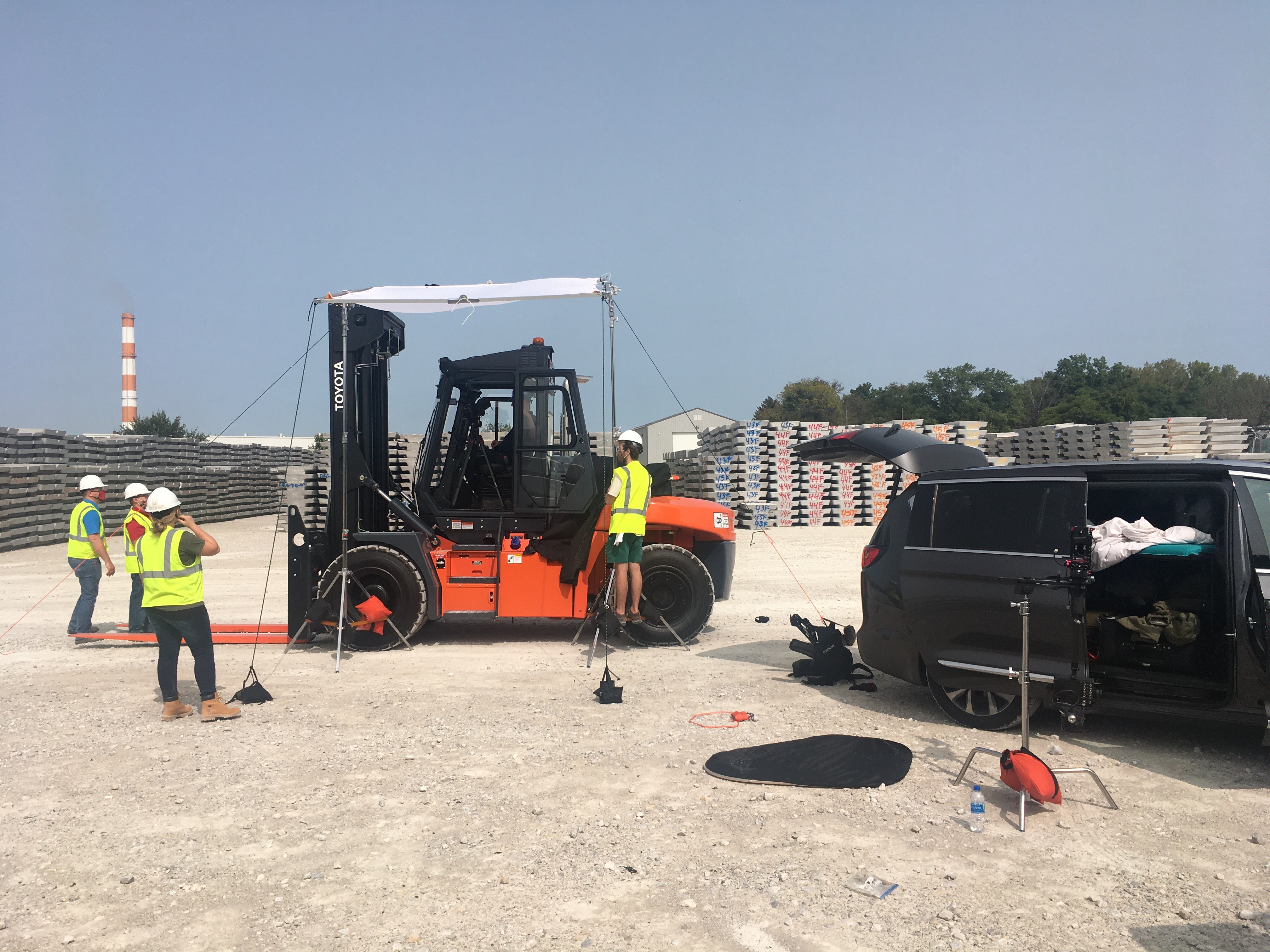
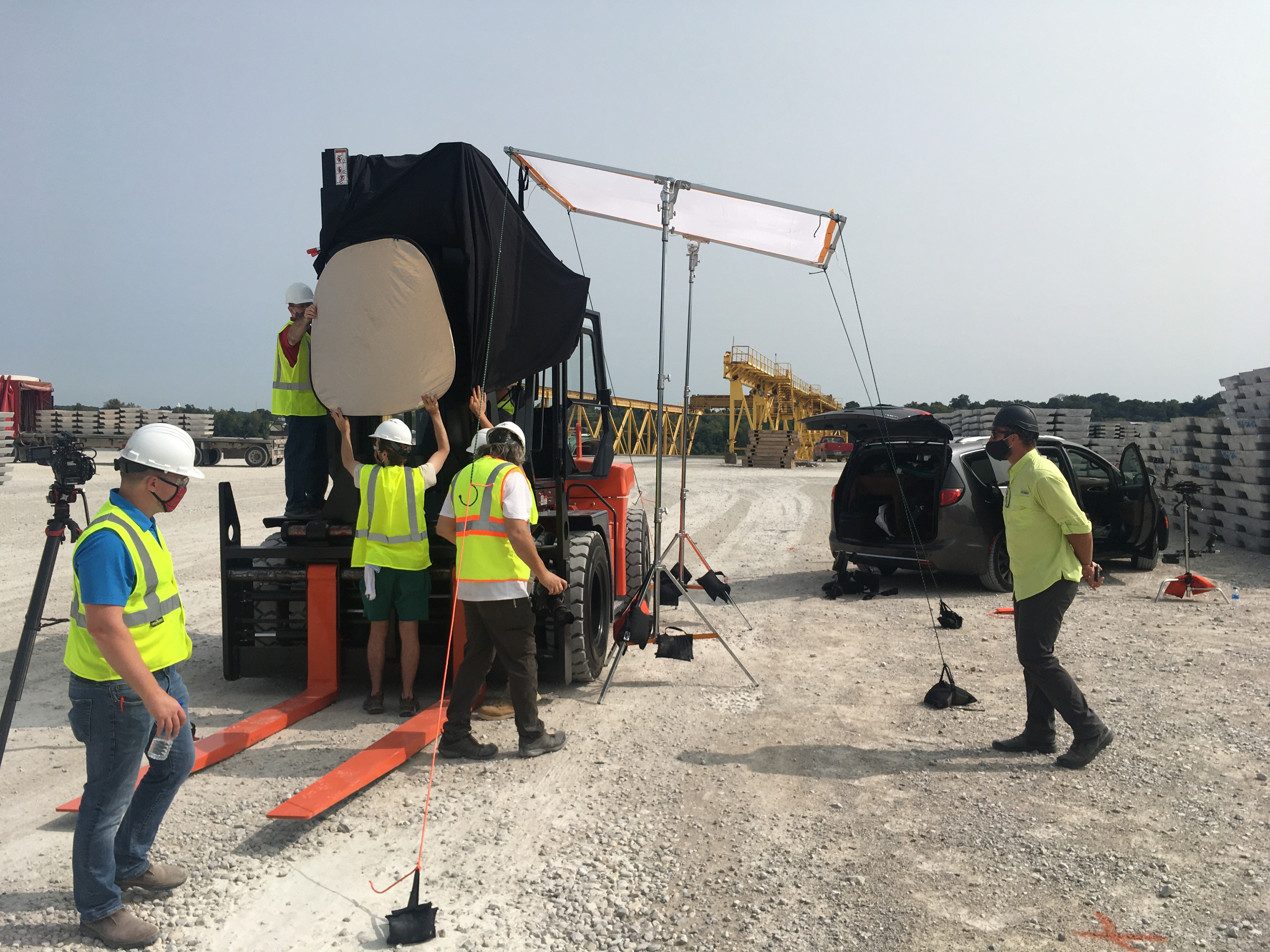
I bought some more sand bags and shot bags. We probably had around 75 lbs on each stand. There was a breeze going but never felt it was stressing our setup.

image-1.jpg


image.jpg


I bought a minivan recently which I built a shelf setup in so as it has more room than my RV and small SUV I now have more space for grip and lighting equipment. The RV had too many issues, hanging in the repair shop half the time I've had it, and the SUV has gotten too small for my needs, so I'll likely sell them both and use the minivan as a good in-between choice. Better gas mileage, can fit in parking garages and my home garage, semi-self driving features which helps as I drive 60,000 miles per year. I always hate with sprinter vans (like my RV) when you're filming in downtown and have to arrange special parking accommodations since you can't fit in a parking garage. With the extra space, might be time to buy an M18 and either one-man-band it or have the PA handle it. :P

I'm kind of hoping for something like an Aputure 1800w. The Mole 1600w weighs around 90 lbs and gaffers I've talked to hate it in large part due to the size and weight. The Aputure 600D doesn't looks all that large and heavy, so if they can in the future get a 1.8k LED at a similar size and weight to the Arri M18, that'd be pretty cool. There are the ETC 4 1000w panel at around 54 lbs, the Ledgo 1200w panel at around 48 lbs, and the Creamsource 1200w SpaceX at around 50 lbs, which are nearing the M18 in power, but they're all larger surfaced panel shaped lights, unlike the Aputure 300D/600D, Hive 575, or Arri Orbiter (too expensive for a 400w light). I'm considering buying an Aputure 300D Mark II to mostly replace my Litepanels Gemini (which I'd still keep for when I want it, but just not pack it on most jobs), just because the Gemini requires a mini combo stand and the size of it means an entire cart trip dedicated just to that light, while the Aputure 300D has similar brightness but packs down to a bag that is about 40% the size of the Gemini bag, as well as fitting on a smaller light stand. I have a bag full of basic light stands, but my mini combo I use for the Gemini needs a bag of its own due to its size and weight. Also takes up more space in the vehicle. Then likely buy the Aputure 600D when it comes out, and hope some more powerful LEDs come out in the future. Maybe buy an M18. Nice thing with the M18 is clients will pay legit rental rates for it since it's a known light.


And Charles, yeah, since I often work on small shoots the gaffer is just a general term for someone who handles anything lighting related, such as grip, electric, lighting, etc. Obviously bigger crews have more specific titles and roles.
 
Last edited:
Back
Top