8-bit Sony HD vs. 10-bit O7Q SDI : Gretag-Macbeth Color Chart Comparison

cuervo

Veteran
Having some time this afternoon, I ran two takes on a Gretag-Macbeth color chart. The results are downloadable from this link.
https://www.dropbox.com/s/25q6v0u1aeo1o2b/Comp.mov

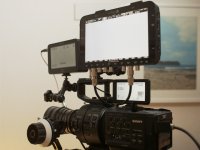
A bit of explanation is in order, here. The sequence labeled "8-bit" is a Macbeth color chart captured from the SDI out, on an FS700 with the output signal set to HD 1080p24 (8-bit 4:2:2). The sequence labeled "10-bit" is a Macbeth color chart captured on a Pix 240 recorder, getting a 10-bit, HD (downsampled from 4K) signal from an O7Q SDI pass thru from an FS700 providing a 4k (12-bit, 4:2:2) .

The image sequences were two seperate captures because of the need to switch camera and SDI cables around. 8-bit vs. 10 bit signal captures are confirmed via looking at the waveforms for each signal. The 8 bit signal is very comb-toothed, while the 10 bit is quite continuous. I normalized each sequence to broadcast IRE (16-235), however, there are gamma exposure variations that I did not correct.

The immediate observation is that the grain structure(AKA noise, particularly in the black areas) of the 10 bit signal is considerably finer (i.e.smaller) than the grain structure for the 8-bit signal.

I hope the pixel peepers amongst you will find this interesting.
-B
 
Last edited:
Having some time this afternoon, I ran two takes on a Gretag-Macbeth color chart. The results are downloadable from this link.
https://www.dropbox.com/s/25q6v0u1aeo1o2b/Comp.mov

A bit of explanation is in order, here. The sequence labeled "8-bit" is a Macbeth color chart captured from the SDI out, on an FS700 with the output signal set to HD 1080p24 (8-bit 4:2:2). The sequence labeled "10-bit" is a Macbeth color chart captured on a Pix 240 recorder, getting a 10-bit, HD (downsampled from 4K) signal from an O7Q SDI pass thru from an FS700 providing a 4k (12-bit, 4:2:2) .

The image sequences were two seperate captures because of the need to switch camera and SDI cables around. 8-bit vs. 10 bit signal captures are confirmed via looking at the waveforms for each signal. The 8 bit signal is very comb-toothed, while the 10 bit is quite continuous. I normalized each sequence to broadcast IRE (16-235), however, there are gamma exposure variations that I did not correct.

The immediate observation is that the grain structure(AKA noise, particularly in the black areas) of the 10 bit signal is considerably finer (i.e.smaller) than the grain structure for the 8-bit signal.

I hope the pixel peepers amongst you will find this interesting.
-B

Thanks Bill, that's really good of you.

Is there any chance of uploading an uncompressed frame from the 8 bit source and one from the 10 bit source.

What i'm trying to see if my hunch that both the 2K and the downsized 1080 show coloured noise compared to the 8 bit (and hopefully 4K). I see the difference quite easily on the 2K and 4K samples from CD and from the bmp you posted of the output previously. This coloured noise is an artefact of the way the images are being down sampled (in camera for the 2K) and the technique the O7Q is using for monitoring.

It's great to see the finer colour resolution though, but that is somewhat mitigated by the additional coloured noise (that would also smooth the waveform off - if you add noise to an 8 bit image in a higher colour space you'll smooth the waveform as well)

Really appreciate the work!

cheers
Paul
 
Bill very kindly did a couple of tests, what's interesting is the type of noise of both, which is something i've seen all over the 2K RAW:

O710vs8.jpg

(NOTE: this has been recompressed as a jpg here, i uploaded a png. Anyone know how to display .pngs here? The jpeg compression is hiding a lot of the differences)

The lower is the output straight from the SDI in 8 bit and the upper is the down sampled from the 4K of the O7Q.

See the difference in colour noise. Remember this is the 8 bit SDI, not the AVCHD which does have heavy de-noising on. It's also worth noting the 8 bit appears to be sharpened a bit too, perhaps Bill you have some in camera sharpening running?

From the 2K i believe this to be an artefact of debayering binned pixels. I would hazard a guess that the 4K->1080p downsample the O7 is doing is designed for speed as it is intended for monitor display.

So the question whether to capture the SDI out from the O7Q to get a greater than 8 bit colour depth (as a stop gap solution) isn't very clear cut, personally i don't think i would do it, this increase in noise and coloured artefacts are more objectionable than clean 8 bit output.

The only 4k reference is from the CD site and i didn't see any coloured noise in those samples. Personally i would choose 4K compressed as my go to option when available. Possibly the high quality 1080p or 2K option if CD can implement this from the 4K source in camera.

Thanks again Bill!

cheers
Paul
 
Last edited:
Hi Paul,

Interesting, because I have the DETAIL LEVEL set to -7/off.
Also, interesting that the images look so much nicer when looking at 10-bit footage on an 8-bit, 24 inch monitor, than the 8-bit images. Guess I need to get my seat-of-the-pants monitor recalibrated.
One more thought....clearly the choice of 8-bit or 10-bit downsampled isn't straightforward. I'm thinking about the 10-bit robustness when color grading, as compared to 8-bit. Definitely a push.
 
Hi Paul,

Interesting, because I have the DETAIL LEVEL set to -7/off.
Also, interesting that the images look so much nicer when looking at 10-bit footage on an 8-bit, 24 inch monitor, than the 8-bit images. Guess I need to get my seat-of-the-pants monitor recalibrated.
One more thought....clearly the choice of 8-bit or 10-bit downsampled isn't straightforward. I'm thinking about the 10-bit robustness when color grading, as compared to 8-bit. Definitely a push.

We can guess that 4K and the internally down sampled 1080 might go via different hardware paths and because of the black pixel highlights then i assume it is the result of the scaling algorithm being used by Sony which is applying a form of sharpening to the 1080p image by default.

8 bit by itself isn't so much of an issue as compression artefacts when grading. I've had good success taking 1080p and scaling to 4K (wavelet scale which rebuilds edges), adding fine noise then downsampling back to 1080p. It's enough to spread the colour values and smooth off banding yet retain detail. Those colour artefacts would IMHO cause more of an issue.

cheers
Paul
 
same stuff i'm testing right now at my place!

looks so stupid, i know. however i have good reason to do this! and hope i can get decent 10bit422HQ from OD7Q (downscaled 1080P from 4Kraw)!!

STUPID01.jpg
 
same stuff i'm testing right now at my place!

looks so stupid, i know. however i have good reason to do this! and hope i can get decent 10bit422HQ from OD7Q (downscaled 1080P from 4Kraw)!!

Good luck, interested to hear/see your findings.

Check whether the camera is outputting 2K or 4K RAW there's a bit of confusion around whether it's a 4K or 2K downsample for display. Look at edges, especially high contrast edges.

Also i'm not sure whether the O7Q is outputting the signal scaled to legal range, if it is then make sure your recorder does not scale to legal range as well.

have fun
Paul
 
Back
Top