GH2 8.4v Battery test results (timelapse)

keylight

Veteran
I used my DIY DWM-DCC8 adapter for this test.

There have been questions about the viability of using an external 8.4v battery with the GH2. I hope the following video answers those questions.

I did a timelapse of the GH2 hooked up to an 8.4v rated battery AND a meter, to show what exactly is happening over time. The camera stayed on for just over 8 hours on a single full charge of the 8.4v battery.


Here are the details: For almost 7 of the 8 hours the camera was recording at 720p. (I had to twice stop and delete the recording to free up space. This was done without turning anything off.) The LCD was on the whole time. The interval of the timelapse was 1 frame per minute.

The battery actually metered 9.93V before I started, but dropped quickly to 9.84v once I got the camera on and recording. Also interesting to note is that the camera shut off at 8.37v and the battery went back up to 8.64v. When I got back to check the test, I turned the on camera and the voltage dropped to 8.41v and displayed "this battery cannot be used" on the screen before shutting off.
 
Ah ok, well it's typical of the battery controller in the GH2 to shutdown when the voltage gets below a certain point. It's imperative that LI-ion batteries never be discharged below a certain point or BOOM. What you see is the camera doing that, not the batteries.

NiMh batteries have a *similar* charge/discharge curve and many LI-ion chargers (called multi-chemistry) can charge them. Some can't.
 
Didn't know that about the chargers. Any way to know for sure? (Although I know you should never use a NiMH charger on LI-ion batteries......)
 
Thanks for the test. This proves that 8.4v is really borderline and the real input needs to be 9.3V.
That is stated on the adapter/charger for the GH1. It says 8.4V for charging the battery, 9.3v for the camera.
 
Didn't know that about the chargers. Any way to know for sure? (Although I know you should never use a NiMH charger on LI-ion batteries......)

Unfortunately there isn't an easy way to know unless you look up the charge controller IC's datasheet and see.

A lot of these chips are getting much more specific in what they charge due to the fact that they are charging much more efficiently, which means the ICs are more precise. That also means that fewer chips are being designed to do multi-chemistry too. I don't see much happening in NiMh anymore since Li-ion and Li-poly have taken over as the battery of choice for most things.

Also, 8.4v is an interesting voltage. pretty much all Li-ion cells are 3.6v or 4.2v(full charge)..
 
I think there's some confusion here, as the bundled battery is only 7.2V.

The body runs fine off that, so the 8.4V AC limit is clearly artifical (the body doesn't charge the battery, so there's no reason why it would need more voltage).

Think about it - why would the body run.... to tell you it can't run? :) I've never seen that happen before on a gadget.

I think what's happening is actually that Panny want to trick you into buying their adapters - if you manage to source a real 8.4V replacement, they simply refuse to run it.
 
Not adapters, but rather batteries. The battery tells the camera to turn on and stay on using their proprietary communication code (generics can not do it unless they crack the code). Adapters are not smart - they do not have communication lines, only power and ground. So they tell the camera to stay on by using higher voltage than any Li-Ion 2 cell battery can deliver (above 8.4V). It is constant cat and mouse game between the OEM manufacturers and generic battery makers.
 
Probably both. BTW I've just checked the voltage of a fully charged (bundled) battery, it's about 8.32V. So 8.4V is the perfect cutoff for AC detection.
 
I think you can go up to around 11V. Going higher shuts the camera off without any messages or blinking light.
 
Hi everyone,

I am planning on doing the same kind of setup with a 8.4v 5000mAh like this one for rc models : http://www.all-battery.com/84v5000mahflatnimhbatterypack11346.aspx and the DCC8.
Is the battery I selected a good one? Can you advise me for another one?

Also as there is no battery monitor on these batteries and the camera does not show wnything as it thinks it's on DC power.
Hobbico Voltwatch2: http://www.amazon.com/Hobbico-Watch-Receiver-Battery-Monitor/dp/B0014T54QQ
Is the Voltwatch a good idea? Do you know how to set it up? [Update: this is for 4.8 not 8.4v. I dyslexia love haha]
What about this one? in blue http://gb.suntekstore.com/Mini-DC-99-9V-Blue-LED-Digital-Panel-Meter-Voltmeter.html?&utm_source=gbus or red http://gb.suntekstore.com/mini-dc-99-9v-red-led-digital-panel-meter-voltmeter.html


I know I will also need a dc connector like one of these to adapt to the DCC8: http://www.altex.com/Right-Angle-DC-Power-Plug-w-6-Cable-21mm-ID-55mm-OD-TC210-P143346.aspx [updated connector]

My last question would be about the connectors. I see that there are a lot of different connectors for the rc models batteries. Tamiya, Traxxas, Futaba J... I am a bit lost in all this. Which one should I use? And how?

I am not a hobbyist and have never fooled around with rc models and these batteries (also I have some knowledge in electricity and welding...)

Can anyone tell me if i'm on the right track?
Thank you!
 
Last edited:
The DC cable connector should be 2.1mm (the ones you linked are 1.7mm). And the Voltwatch is only for 4.6/6V batteries apparently, so that won't work. I'm interested in finding a monitor too, it would be handy for my 12V Lions. But don't forget that these monitors will also draw power, especially if they're using LED displays. For the maximum runtime they should ideally be switchable.
 
Thank you I have updated my post. Anything else?

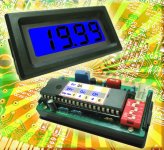
Lots of voltmeters on Ebay, eg. this one that can read 0-20V, and runs off 4-15V:

8035LCDB20V01[1].jpg

The other two you linked are probably fine, but they look to me like their displays are permanently lit. That's a real waste of battery juice. I might do my own monitoring (I already use a microprocessor for timelapsing) and only flash an LED if the battery is getting low.

The 8.4V RC batteries are what other people are using (I don't know anything about them personally as I use 12V Lions with a regulator) - it's working fine for them, but they do apparently put out close to 10V on a full charge, which makes me uneasy. But we don't know if it's a problem or not.
 
Last edited:
Back
Top