7Q hood for bright sun, Monitor Out F35 questions - why do I like F35 MLUT over 7Q

yachacha

Well-known member
I was wondering how 7Q users are viewing LUTs on set.

First of all I have a smallHD 502 viewfinder, not the original EVF, but I use it like EVF connected to the monitor out port, usually with the built in F35 MLUT turned on.

When i look at the 7Q SLOG 1 MLUT, I always feel it has different exposure. I understand this is white paper MLUT and I checked I wasn't adding any gain to my F35 viewfinder feed.

I know this is way to much to ask but a way to view and switch on the 7Q between the monitor out single link as B image and see the dual link SLOG as A and record it. I would pay for it, but I know we are talking about a small drop in the bucket for a lot of code.

I found this hood for iPad mini 3d printed on eBay. Actually lines up nicely with the 7Q inside LCD and has enough blocking to be useable in the sun. I wish I knew a bit more about 3d printing because it would be nice to have something like this which could snap right onto the 7Q sides.

I know the easy solution is to expose using a light meter and always put the 502 as the way to view the F35 monitor out. Sometimes it's just easy and nice to grab F35 and the 7Q without adding the weight of the EVF.
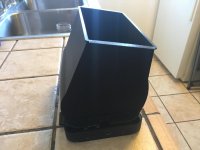
IMG_0806.jpgIMG_0806.jpg
 
I don't think it's a LUT problem. I think it's just inherent to the screen.
I've always found the 7Q screen on standard settings to be too milked out to judge exposure. You can get better blacks in DCI-P3 mode, tweak contrast and brightness etc.. but it just tends to throw other parts of the image out.
And I use it on multiple cameras, so I prefer to leave it on standard REC709 settings.

Don't get me wrong though. The 7q has a nice screen. WAY better than most others. But it's definitely not as good as a viewfinder - even with a hood.

Maybe try feeding the 502 from the 7Q SDI OUT and seeing the difference?
 
Last edited:
I've been feeling similar thing too.

In terms of focusing, try URSA VF.
Connect the VF to the 7Q's SDI out and enable its PsF removal function, you'll see really nice focus without resizing. URSA VF's peaking is also nice.

For color and exposure, both OLEDs are not somehow solid to me.
Maybe I'm too familiar to LCD.

Mitch, will you think of implementing a native color mode for 7Q?

I mean by "native color" that direct RGB values are out to physical panel and user make ODT LUT for the mode.

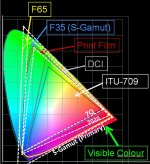
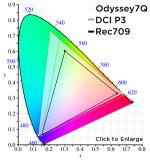
Obviously, 7Q's panel have wider gamut and high dynamic range.
CIE_Odyssey7Q_sm.jpg
But its unique, some calibration and tuning will be necessary to utilize its full potential.
 
I'll present the idea to the engineers, but it is important to note that most people do not know how to deal with such a mode and it would be entirely nonstandard. So the LUT applied would only mean anything to our panel, and if someone then imported it into Resolve and applied it to their footage it would appear all wrong. We strive to make our workflow as straightforward and universally compatible as possible, and part of that has meant that we stick to definable industry standards.

Put it the way: every Rec709 monitor is capable of showing more than REC709, or at least it better be. They just have to limit to a standard so people can match results. Predictability of tools is important stuff.

Our OLED panel is terrific. We once thought about making a one-off specialized sensor camera/OLED device just for NAB to show how much range we could capture. But if you show something like that people assume it's a product and want to buy it (or borrow for free - sigh) and go shoot a movie. Totally not practical as it would have cost us a fortune and gone over the heads of most people, but our testing revealed just how much that OLED can handle.

So I guess that's all a long way of saying just because something can be done doesn't mean it should be.
 
Thank you, Mitch.
I know your business side matters, so I sorted out my idea.

I assume 7Q has a high contrast (3000:1), wide gamut (really good Adobe RGB like), 8 bit drive monitor.
My basic idea is that unlock native color mode and apply Adobe RGB based ODT LUT.
You only need to modify the Adobe LUT only for gamma roll-off.

8 bit driver can handle only 256:1 contrast ratio.
However, if you see a real world motion picture, you see the contrast and tone over several frames.
I assume here you see them over 0.5 second of frames so 12 frames or more is averaged in you brain.
12 frames means around 3.6 bit more fineness for driver.
As a result, you get virtualy 11.6 bit driver
It's just enough to drive 3072:1 contrast ratio panel.

I think other recorder monitors are all LCD and their contrast ratios are 1000:1 or much less.
Frame averaging effect cannot increase contrast ratio.

With native color mode, only 7Q can claim real HDR.

Point for your business is this.

Below is a overlay of sony's gamut.
7Q will show the hidden color and shadow of F35 and films very nicely.
I want to see them!

CIE_Odyssey7Q_comparison.jpg
 
Interesting in theory. In practice I'd have to ask the engineers. I definitely take issue with what some others claim as HDR monitoring. We'd still need to make this make sense financially as well as not confuse our clients.
 
Aha mitch,

I have to admit so many times seeing things in my 7Q highlights that look beautiful and look like crap on 2011 laptop screen and even 17-inch panasonic 1760. SmallHD 502 is great to use as EVF with F35. The more i look, the more I don't really like the F35 MLUT or the 7Q SLOG 1 MLUT.

There are times I give up on SLOG all together and get to working on custom settings that I think look great out of camera. I feel one problem with the F35 is it's "outdated" custom color settings. If you use F900 color it is way too much and looses a lot at the top and bottom. If you use hyper gamma it still suffers from that problem of being so good at seeing into the shadows, you get a lot of noise in those areas also. I find one of the biggest issues with F35 footage that make it pop out from newer cameras is the noise you get in the dark areas. Playing with the gamma levels and low key saturation i find letting the blacks fall off a little more in camera leads to a lot less noise.

I also like using the click wheel and menus in the F35, I think I am the only one. But if you ever give the manual a complete look through, you will understand it's not super complicated and super powerful what you can do in camera to the color settings.

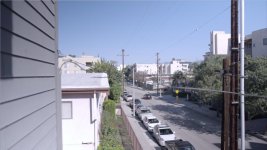
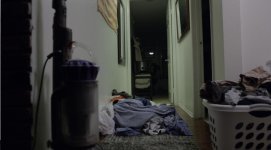
This is straight out of F35 7Q file - It is custom setting that i keep modifying and changing to try to get as close to finished color straight out of camera as possible. I'm not saying it is as versatile as SLOG, but it is fun to see what is possible in camera.

telephone pole.jpgdirty laundry.jpg
 
Why not show S-log, create a set of LUTs you like for various lighting conditions (day int., day ext., night int., night ext.) and then load them onto Odyssey as custom files? You can use the same LUTs in post to match the look.

Frankly I'm amazed that most people don't do this. We make it easy, and then what you see on set is what you get, but with room to fix it if you mess up or something doesn't match. Locking in the look in camera means massaging two shots from different days is that much harder.
 
Hijacking a bit here.

Mitch, you guys really should just make a very lightweight OLED monitor only (no SSDs, single SDI/HDMI) but with full LUT support to your native OLED screen. I'd be on that immediately. As much as i love the O7Q image i don't need to record with it these days and it's a bit redundant. But having said that as you say, the panel is stunning by comparison to everything else i have here.

We can use a probe to see the full gamut and then produce ODT LUTs for just the screen for whatever use we need, be it F35, Red or whatever.

There's little display colour management in camera monitors these days.

You'd sell a bunch of those panels.

But needs to be super lightweight, and as small as possible.

cheers
Paul
 
Paul I'm with you.. now let me suggest the monitor/recorder becomes modular and you can cut the deck in half and discard the recorder section when not needed. Then you're left with a beautiful 7", thin, p-tap powered 7Q+ we love. Trouble is I think we're asking a computer company to become more of a monitor company when their strategy seems to be focused mostly on footage acquisition.
 
The problem here boys is "How much would you pay?" It's a pretty competitive field out there.Everyone has their ideal dream product, but how many of those overlap and how much would they be willing to pay to fulfill that dream?

These are the questions with which we and any company must grapple.
 
Back
Top