30's musical's and audio?

In a completely different arena the topic of 30's musicals came up, and in particular the 'sense' that women's voices were 'higher' as well as men's. It could be that at the time soprano for women and tenor for men were 'preferred', but I'm wondering if there was some technical reason why such as microphone technology, recording, etc.

By the 40's, and 50's the voices seem to be 'lower', for example Bing Crosby being listed as a baritone, and Judy Grarland's, contralto (low end for women...), became more popular. (There's also vibrato which has all but disappeared from 'pop' music and mitigated from 'classic opera' as well...).

Anyone have any thoughts on this.
 
Well optical tracks have a very limited range with out Noise reduction. Basically nothing over 10K and nothing below a couple of hundred Hz. You can look up "Academy Curve" which is the EQ spec for optical track mixing (not exactly accurate but basically true).
"The response is flat between 100Hz and 1.6kHz. Response is reduced 7dB at 40Hz, 10dB at 5kHz and 18dB at 8 kHz. The severe reduction of the high end of the spectrum was specifically designed to conceal the high frequency crackling noise inherent in early film sound production."

But not sure that helps because things didn't change (for film playback) till Dolby A in 1966 and the curve didn't come in till 1938.

Playback systems for theatres also didn't have much of a high end (partly for the same reason), so maybe it's not so much that styles changed but that we have better playback so we hear the higher frequencies that the original screenings didn't have?

Records were also pretty frequency limited, so maybe it's basically singers trying to work with the medium as it existed?

Vibrato may also have been a way to mask the inherent speed variation of records. If your going to get it anyway why not make it a plus?

It's also possible that technology changes are giving us an incorrect impression of what it sounded like then. As the incorrect playback speed of silent films gave them a jerky and "over cranked" look to later viewers.

Silent films were shot and played at 19-20 frames per second and sound films are played at 24 FPS. Most of us alive today have only seen silent films played back at 24 FPS. A few transfers (Criterion Collection for instance) correctly transferred the silents at the correct speed and frame rate converted them so that they play back as they should. That and of course "silent" films were no where near silent. Basically along with a score (played by a group of players up to a small orchestra) they had essentially all the sound FX done live. The only sound you didn't get was the dialog. Which is part of the reason that when "sound" films came in they called them "talkies". Calling the older films "silent" would have confused people no end.

Other interesting trivia...

A Clockwork Orange was the first film released to use Dolby A (and thus have better sound than films from the 30's) And the first film seen by almost everyone in stereo was the second Star Wars.

Decent sound came late to the game.
 
THIS MIGHT BE OF INTEREST

Kind of what I said above but with the change that when mixing you mixed with the inverted version of the Academy curve, so you added a lot of pre-emphasis to your tracks so they would play back "normally" in the feq. limited theatres.

The author points out how many films are not deemphasized when they are transferred resulting in a very trebly sound with todays playback systems.

Also this site is interesting and more detailed.
 
Last edited:
I don't think there's any technical "recording" reason for this, if indeed the downward trend in pitch actually exists. Bass voices have been recorded successfully since the dawn of recording itself (Feodor Chaliapin springs to mind - his recordings go back to the early 1900s), and then we get Paul Robeson in the 1930s. Judy Garland's voice is still at a higher pitch than a male tenor so by definition there would have been no problem recording a voice like hers in the 1930s or earlier. (The Wizard of Oz is 1939 anyway).

If there was a trend downwards then it will be due to fashion and preference. Women's speaking voices have dropped in pitch and it has been argued that this is because a lower pitch is perceived (by both sexes) as more powerful and sexy. I suspect this is partly subconscious, partly deliberate - as an example of the latter, Margaret Thatcher had voice training in order to specifically drop the pitch.

Female "pop" singer voices are still often very high, as are males.

Wish I had enough time and money to make a PhD thesis out of this... perhaps titled "Down Pitch to Power Voice"...

I read the articles that Noiz referred, to and I think perhaps there is a combination of things, such as uncompensated optical track transfers, some amount of 'aesthetic' change, and perhaps just a 'sampling' bias that a specific voice 'stands out', while others are not noticed as much.

Sure, for 'general' audio recording, many voice ranges were recorded through out the period, but I was specifically interested in 'movie recording/reproduction' which did have some limitations that phonographs did not... well had less of...

I'll have to take a sample of 30's film DVD/BD and see if by 'equalizing' to the mentioned Academy profile, they 'sound different'...
 
It's also a cultural thing. From A German perspective English, American and to some degree Australian women are extremely high pitched (especially speaking voice), compared to German women.
 
It's also a cultural thing. From A German perspective English, American and to some degree Australian women are extremely high pitched (especially speaking voice), compared to German women.

Oddly... ironically... it was this clip that sort of initiated my question... It starts off with the men, and occasionally the woman has a few lines...


But here's a somewhat contemporary US production...

 
Last edited:
Well optical tracks have a very limited range with out Noise reduction. ... things didn't change (for film playback) till Dolby A in 1966 and the curve didn't come in till 1938.
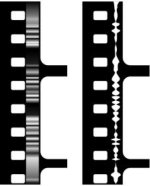
There was a lot of experimenting with different kinds of audio track recording on film and it went through SEVERAL generations and methods before analog noise reduction arrived on the scene.

There were many techniques like balanced vs. unbalanced, variable width, variable area, variable density, and even different colors when color distribution became available.

420px-Optical-film-soundtrack.svg.jpg

And, of course, film stocks improved as well over those decades. Remember that the same film "grain" affected visual noise as well as audible noise.

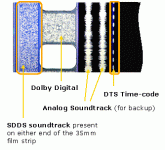
And then at the end of life for film distribution, they were printing 2-D digital "barcodes" between the sprocket holes.

soundtrack-on-film-small.gif
 
Of course the last slide is circa late 80's or later. That optical track would be matrixed and encoded with Dolby SR, giving it almost the fidelity of tape. The optical digital tracks are not referred to as "optical tracks". When folks talk about "optical tracks" they are referring to analog audio optical tracks.

But indeed there was a lot of work to try and improve the sound and some strides were made but very little improvement actually came about till Dolby Noise reduction upped the game.

Maybe more to the OP's point, magnetic tape didn't exist in the US till after WWII and you can't edit a phonograph so all recording prior to WWII for film were done with optical recorders. They recorded a version of the tracks in the photos above. So not only do you have optical track playback but it's a third generation optical track at best.
 
You are kidding, yes? Vibrato came into use long before recording tech. existed. Ask a singer, or better, a singing teacher.

Sorry I didn't mean to imply it was created for that reason just that at the time it might have been used as a technique for those recording at the time to help mask the defects of the medium. I can easily see a performer after hearing the wavery playback decide to go with the limitations. The whole "megaphone" fad in the 20's was partially to allow live singers to mimic the sound of popular recordings of the day.

So no I wasn't kidding, but I might be wrong. It's hard to know for sure (since there are no reliable recordings) but the excessive use of vibrato in popular music in the US seems to coincide with the advent of early recordings and goes away after recording technologies improve. So it could be just the way trends go and they happen to happen close to each other, or they could be related.
 
Back
Top