2K bulb in 1K?

Okay a 30a dryer plug is not 3 phase. 3 phase is something you don't generally see in a residential setting and is mostly found in industrial situations. It's not 2 phase either. Most US residential electrical is simply single phase. A 220 dryer outlet will have 2 hot legs, but that has nothing to do with phases.

The only people I know who have anything 3 phase in their homes are people running 3 phase equipment in their home shops (mills, lathes, etc) and are usually just using a phase converter to power them.

Before going any father please contact an electrician that can help with what you are trying to do.

Beat me to it. As to three wires coming into a breaker box..... that's a dead give-away it's NOT three phase. Three phase power will have 3 hots, neutral, and possibly a ground (though normally the ground is created locally at your box or near it with a ground rod).

The most common residential set up will have the 3 wires you reference above. the A/B legs, and a neutral. That would be 120/208 or less commonly, 120/240. There will be some slight variance on the voltages such as 118/207 etc, that's normal. Sometime the messenger wire doubles as the neutral.

Please do not confuse "legs" for phase..... if you were to connect the three wires into a three phase hookup.........you will cause a massive short circuit. A hot to hot short and a hot to neutral short.

PLEASE STOP WHAT YOU ARE DOING and get an electrician to be hands-on with your project and questions! You are risking property damage, injury and/or death. Electricity can and does kill people every year from people not knowing what they are doing with it!!!!!
 
Last edited:
PLEASE STOP WHAT YOU ARE DOING and get an electrician to be hands-on with your project and questions! You are risking property damage, injury and/or death. Electricity can and does kill people every year from people not knowing what they are doing with it!!!!!

+infinity
 
Thanks all for your input.. I would most certainly not plug in anything unless I was sure what I was doing.. I need to speak with some electricians, I have a ton of questions to ask. However from what I've read, It seems that two sides (Hot,Neutral) are used for smaller appliance 120v operation, while a larger appliance may draw from both poles at 240v. This is what I'm interested in.. Not three phase power - Got myself confused.

Although my home has 240v receptacles, some homes as you mentioned will run on 220v, 230v, or some other odd voltage like 120v/208v. This is where I fear I might have problems stepping down the power since it doesn't give me a nice 240/120 split.
 
Have your electrician check your voltages. I doubt it's 240. It is more than likely 208 if you are in the US.
 
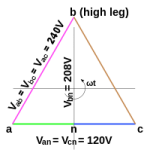
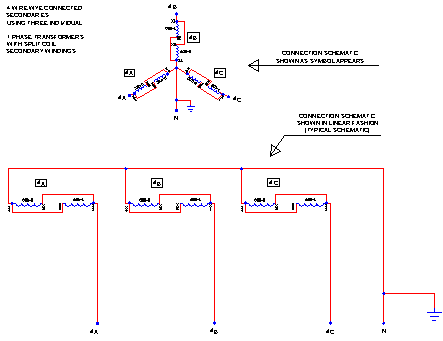
Yes.....and no. It depends on how the feed into your place is "transformed". If the transformer was "Delta" wound, then yes you would see 120/240. But this is usually only seen in heavy industrial areas. The most common in the US uses a "Wye" transformer. Which means the voltage is stepped down to 120/208. It has to do with the way the transformer is wound and tapped and the involvement of the neutral.

This is done way upstream from your house at the local power distro yard and on the pole where it is stepped down from the transmission voltage to household voltage.

DC, on the other hand, cannot be transformed by itself. And it is just single "phase" (positive and negative), which is why it pretty much has to be generated local to the facility using it. You cannot "double" the voltage by adding another positive from the same source because it is still the same positive. The voltage is what is generated.

There are DC step ups, but they involve converting the DC to AC, transforming the AC, then reconverting to DC.......
 
Last edited:
But I thought that the 208v voltages could only achieved in a three phase system? I read that a 'delta' transformer stepped down power into a 240v/120v source: 240v utilizing both legs for large heating elements, and a phase-to-neutral connection would be used for the dryer tumbler at 120v.

edit: Ah, then that would put me in agreeance.. Except, I don't understand why regular residential homes can't have 240v coming out.


27zgfgy.png
 
LOL, okay, you've done your homework.......... It is hard sometimes to explain electrical theory if someone is new to it.

Yes, you have shown a "Delta" transformer, but those are not commonly used for residential applications.

What you have should be:

wye_detail1.gif


Now, there are other configurations for transformers Delta/Delta, Open Delta, Delta Wye, Wye Delta, and Wye Wye. But the most common is Wye, and if you see a 208 voltage.........you can be confident it is coming from a wye transformer.

Okay, lets talk about legs and phases. In residential electrical, we don't call them phases, but in actuality, they are phases, but you only get to see two of them. In the distribution net, the power is sent out as three phase, but it is divided across the grid. Each neighborhood will only see AB, BC, or CA phases, unless they pull the third phase into the neighborhood. A good way to see if you have 3 phase to your area is to look at the power poles. If you see 4 wires across the top, that means all three phases are there with a neutral, but again........that is not common in a residential area.

Balancing the power draw across all phases is the job of your local utility. By making sure the different leg divisions (AB, BC, CA) are balanced for load, the system will remain stable. But if they get imbalanced one set drawing too much, you start to see power outages in you area.
 
So because of the configurations to carefully balance the load.. Some homes end up with 120v for each leg, but 208v when both are measured across?

I live in an 'electrically diverse' area you might say but fortunately many homes here have the same 30a 240v outlet. I read that it would be possible to read the voltages across one of the poles using a cheap voltmeter, but reading them both requires a more expensive tool...
 
Yes, the leg to leg voltage should read around 208. Leg to neutral should be around 120.

A "240" outlet is probably 208. Its like calling all florescent set lights Kino's. It's just what they are commonly called. Or tripods = sticks

As for reading your voltage........those cheap mutlimeters are not good. Home depot sells a decent DMM (digital multimeter), even radio shack has a couple. But if you are not familiar with electrical safety, don't attempt it. It is easy to mess up and get a nasty shock.
 
Back
Top