24p/60i light/grain

jeans

Well-known member
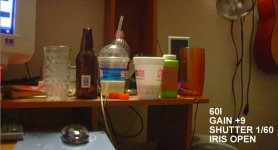
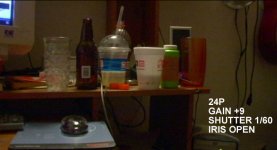
Has anyone else noticed that you get more light and less grain with 60i as apposed to 24p with all the other settings the same? It seems counter intuitive to me. With 24p shouldn't you be able to get more light spread over fewer frames. Here are a couple pics to illustrate. Am I missing something? I am also curious why I cant go slower than 1/60 shutter in 60i.
 

Attachments

  • cups24p.jpg
    cups24p.jpg
    44.8 KB · Views: 0
  • cups60i.jpg
    cups60i.jpg
    46.7 KB · Views: 0
I guess it makes sense that you cant go slower than 1/60 in 60i and 1/24 in 24p. I just don't understand why 60i should be getting more light at 1/60 shutter than 24p.
 
24p requires more light than 60i because it's only taking a 24 image samples per second. 60i is sampling 60 times per second, so it "gathers" more light.
 
When shooting in NTSC interlaced mode, 1/60th of a second is effectively no shutter at all and therefore the minimum possible. In this mode the camera is gathering light all the time (half the time for odd lines, the other half for even lines). When shooting in 24p mode with a 1/60th of a second shutter, the camera is gathering light for 1/60th of a second (.0167 seconds) for each of the 24 frames. This is the equivalent of using a film camera with a shutter angle of 144 degrees.

The amount of light that the sensor "sees" in 24p mode with a 1/60th of a second shutter is 40% of what the camera would "see" if it were operated in 60i mode. This accounts for the difference in the illumination level of your two example grabs.
 
Thanks khmuse. That was very well and simply explained, so much so that I don't know why it didn't make sense to me in the first place.
 
Consequently, you'll find that 1/24 shutter, 24p is as bright as 60i at 1/60. However, the blurred motion will look less film-like.
 
Yes, I did notice that, about the brightness and motion blur. I also read that films don't usually use anything slower than 1/60 shutter.
 
Film shutters don't work that way. Typically, a 180-degree shutter is used, and what that is is a half-circle which spins and lets light in as it does. So, when it passes over the iris, being half a circle, it allows light in for half the time. That's more or less 1/48th of a second, so it's equivalent to (but not exactly like) a 1/48 shutter speed.
 
Back
Top