2021 - What would be your documentary setup and why?

Most wedding photographers carry 2 or even 3 bodies at once with different zooms or primes. The cameras hang from a body harness when not in use. I suppose it's a photojournalist thing, too.

Obviously, our need for heavy rigging and accessories prevents video shooters from doing the same. But I've toyed with the idea of carrying two gimbals (or one gimbal and an unrigged camera with wide-angle) and setting one camera down to roll with the other. One thing that stops me from doing that is the need to change exposure and color settings when I switch cameras. It would probably slow me down a lot. Whereas the stills shooters are shooting RAW and probably Aperture priority exposure or something

A bit easier for stills people in my opinion. Certainly manageable for a video shooter, in particular with an M43 system. However, less desirable for motion capture.
 
Is that a common problem? Are you using the VND within the specified range?

I threw in the towel a couple years ago and got VNDs because I decided that any quality issues with VND were a lesser deal than using ISOs and apertures I didn't want to use when shooting with a fixed ND that I didn't have time to change. (Obviously, this is on cameras without internal ND.)

If memory serves me, most if not all of the good VNDs might warm the image a bit, but I don't remember there being a color shift across the range. I don't think that happens with the filters I use, though I could be wrong.
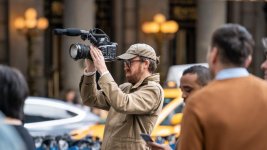
VND is great. Built in ND and e-ND tend to be better. However, in those faster paced single camera doc situations, a variable ND is much better than no ND. And until 2020, there weren't many things that replaced what a Mirrorless and VND combo provided. However, these days, there are a fe options, and I think the C70 is well up on the list. Same goes for the Fx6.

The good and bad about VND besides issues at the extreme end,

good- can roll the exposure mid shot
bad - can accidentally bump the VND in any number of situations an never know until the shot is ruined or at least compromised in some way.

Internal ND with at least one great "1stop" filter inside. Big jumps on internal ND are practical, but if ever wanting more control, and using external ND with the internal ND having an option for one stop adjustments in tandem with the external ND is a nice option.
 
fx6 e-ND can do stepless adjustments, no? but only 7 stops max ND vs 10 stops on the C70

it's a little annoying that neither of those cameras has an evf
 
HBO's "How To..." is so good. I have only seen one episode, but a really great use of modern tech in sort telling. High resolution, small form factor. ample DR. Cheap and plentiful recording space and storage. Fast NLE editing. Allowing a very ateur style documentary approach. I love it.
 
Interesting. I wonder what sound set-up was used. I was amazed how clear the dialogue was in many of the shots, given the circumstances.

He/they used an antique toy-like beige wired reporter mic (visible in the frame) for some shots, but I wasn’t even convinced it was switched on!
 
A long time ago an audio pro here shared an extremely directional shotgun, maybe a Neumann.

I watched tests of it being used in the middle of NYC and was floored with how much it blocked traffic noise which sometimes prevents you from thinking straight while you're walking a few blocks.

I'm not sure what they used, but great shotguns are pretty great.
 

great range. on an A7s3 it wouldn't even matter the F4 rating. haha. I love shooting at F4. Though documentary often has the need for faster lenses. A7s3/Fx6 may solve that.

But such a practical range for s35. Nice to be able to get over 100mm for this extreme detail close ups, and then back out wide enough to capture the whole "room" so to speak.


Seems good for sports action in that sense too. Go from wide imposing closeups, and stadium panoramas, and then zoom in close for coverage of the games being played. Just that until the recent Sony cameras, F4 would have scared me away. haha.
 
A long time ago an audio pro here shared an extremely directional shotgun, maybe a Neumann.

I watched tests of it being used in the middle of NYC and was floored with how much it blocked traffic noise which sometimes prevents you from thinking straight while you're walking a few blocks.

I'm not sure what they used, but great shotguns are pretty great.

Also, if wide lensed and up close, even most on camera mics can pickup a good interview in the city.

Do you remember which Noy-man that was?

A lot of sound people gravitation to Sanken for that similar reason.

The one aspect of Covid, is not having to deal with a crowd. So, sound may be unique during this time. Unless they play loud music all the time. haha.
 
Is that a common problem? Are you using the VND within the specified At least, it is on all of the VNDs I have owned.

Polarisation and IR contamination, plus refraction are common issues. I still use my VND, I’m just very careful not to use too much ND.
 
IDR, but you can search random comparisons on YouTube and probably would come across one from that company. (Maybe might have been a Schoeps, I think one of the two.)

Even though the mics are closer, this test is cool:

 
Polarisation and IR contamination, plus refraction are common issues. I still use my VND, I’m just very careful not to use too much ND.

Lightcraft 4x4 VND have been great. They were a little green, to be honest, but I swapped out one of the elements for a Schneider CPL, and colours were better.

But yeah, IR contamination. We talked with Tiffen about a product, will be interesting to see if they do it.
 
IDR, but you can search random comparisons on YouTube and probably would come across one from that company. (Maybe might have been a Schoeps, I think one of the two.)

Even though the mics are closer, this test is cool:

The digital CMIT by SChoeps is insane. That thing is on a different level.


I still tend to just rock a MKH50, and then go. Always sound right. But if I were consistently in an outdoors environment filming people from a distance, I'd likely switch it up to the shotgun. But the physics of good sound is similar to the physics of good lighting: be in good conditions, and if you can't be, then embrace what is there and don't hide it. Haha. I think of weather reporters in a storm. Nothing is going right, but that is what works.
 
Polarisation and IR contamination, plus refraction are common issues. I still use my VND, I’m just very careful not to use too much ND.

Ah that's true. And I mean - polarization is how the thing works, isn't it? Though I wonder if IR contamination and refraction could be thoroughly eliminated with IR filtering and fancy glass coatings

Or maybe you can't eliminate refraction with coatings since there will always be an air gap. Or maybe they could fill it up?
 
Last edited:
. But the physics of good sound is similar to the physics of good lighting: be in good conditions, and if you can't be, then embrace what is there and don't hide it.

Of course, recording sound with an on-camera mic is arguably seldom if ever the right condition ;)
 
Back
Top